Key takeaways
- AI dubbing pharma projects live or die on one question: what happens to the review. The technology changes the cost, speed, and number of language versions a company can maintain. It does not remove medical and regulatory review, and in a regulated environment it should not.
- The savings come from removing studio logistics, not from removing people. Classical dubbing runs at roughly USD 100 to 500 per video minute per language; AI dubbing sits near USD 1 to 20, a reduction of around 90 to 95 percent. The reviewers who sign off each language stay exactly where they were.
- Regulators are not blocking AI, they are describing how to use it. The EMA reflection paper (September 2024), the first CHMP qualification opinion for an AI methodology (March 2025), and the joint EMA-FDA guiding principles (January 2026, explicitly non-binding) all point one way: risk-based oversight and human accountability.
- A pharma-grade pipeline needs three things consumer tools do not provide. Human-in-the-loop sign-off per language version, versioning and audit trails that survive an inspection, and a vendor that passes a GxP assessment (data processing agreement, audit rights, documented quality system).
- Data residency and corporate jurisdiction belong in the decision from day one. An EU server operated by a US parent does not, by itself, settle the jurisdiction question. For patient-facing content that unsettled question becomes a line item in every risk assessment.
- Done this way, AI dubbing is an infrastructure decision, not a magic trick. Generation becomes cheap, review becomes structured, updates become manageable, and the whole apparatus has to hold up in a vendor audit and a privacy review. That is the model behind alugha.
I have sat across from regulatory affairs teams often enough to know the pattern. They have heard the technology pitch before: faster output, lower cost, fewer manual steps. What they actually want to know is what happens to the review. That is the right question about AI dubbing pharma programs, and it deserves a straight answer. The review does not disappear. It moves, and it stays exactly where it belongs: with medical and regulatory professionals, for every language.
AI dubbing in pharma does not remove medical review from multilingual patient communication. It cannot, and in a regulated environment it should not. What it changes is everything around the review: the cost of producing language versions, the time it takes to update them, and the number of versions a company can realistically maintain. The review itself stays exactly where it belongs, in the hands of medical and regulatory professionals, for every single language.
What AI dubbing in pharma actually changes
AI dubbing in pharma does not remove medical review. It changes what surrounds it: the cost of producing each language version, the time to update it, and the number of languages a company can realistically maintain. Medical and regulatory professionals approve every language version before release. Generation gets cheaper. Review stays exactly where it belongs.
This distinction sounds obvious. In practice, it is the line that separates AI dubbing projects that get approved in pharma from those that die in the first compliance meeting.
The promise is real, and so is the misunderstanding
Start with what the skeptics get right, because they get a lot right. A synthetic voice that mispronounces a dosing instruction in Polish is not a productivity gain. A translation error in a patient video is not a rounding error; it touches pharmacovigilance, liability, and trust. Regulatory teams that refuse to wave AI-generated content through are not being difficult. They are doing their job, and the industry is better for it.
At the same time, the underlying economics have genuinely shifted. Classical studio dubbing runs at roughly 100 to 500 US dollars per video minute per language, with turnaround times of two to six weeks for each language (Checksub, CAMB.AI). AI dubbing sits at roughly 1 to 20 US dollars per minute, with languages processed in parallel, which industry sources put at a cost reduction of around 90 to 95 percent (Pitchavatar). If the basic mechanics are unfamiliar, our explainer on what AI dubbing actually is walks through the speech-to-text, translation, and voice-synthesis chain. For a company whose package leaflets must exist in up to 24 official EU languages under Article 63 of Directive 2001/83/EC, that shift is not a marginal improvement. It is the difference between multilingual patient video being a pilot project and being portfolio policy.
Most companies are still at the pilot stage. In alugha’s audit of 25 DACH and EU pharmaceutical companies in July 2026, only 7 had a structured patient video program in place, and 23 remained monolingual. Human-in-the-loop AI dubbing is the realistic way to close that gap without waiting for a larger studio budget.
The misunderstanding begins when someone reads those numbers and concludes that the savings come from removing people. They do not. The savings come from removing studio logistics: booking voice actors per language, re-recording per correction cycle, managing 24 separate video files. The human judgment in the workflow was never the expensive part. It was always the most valuable part.
Regulators are not blocking AI, they are describing how to use it
A common assumption in the industry is that European regulators view AI with suspicion and that any AI component invites delay. The record says otherwise.
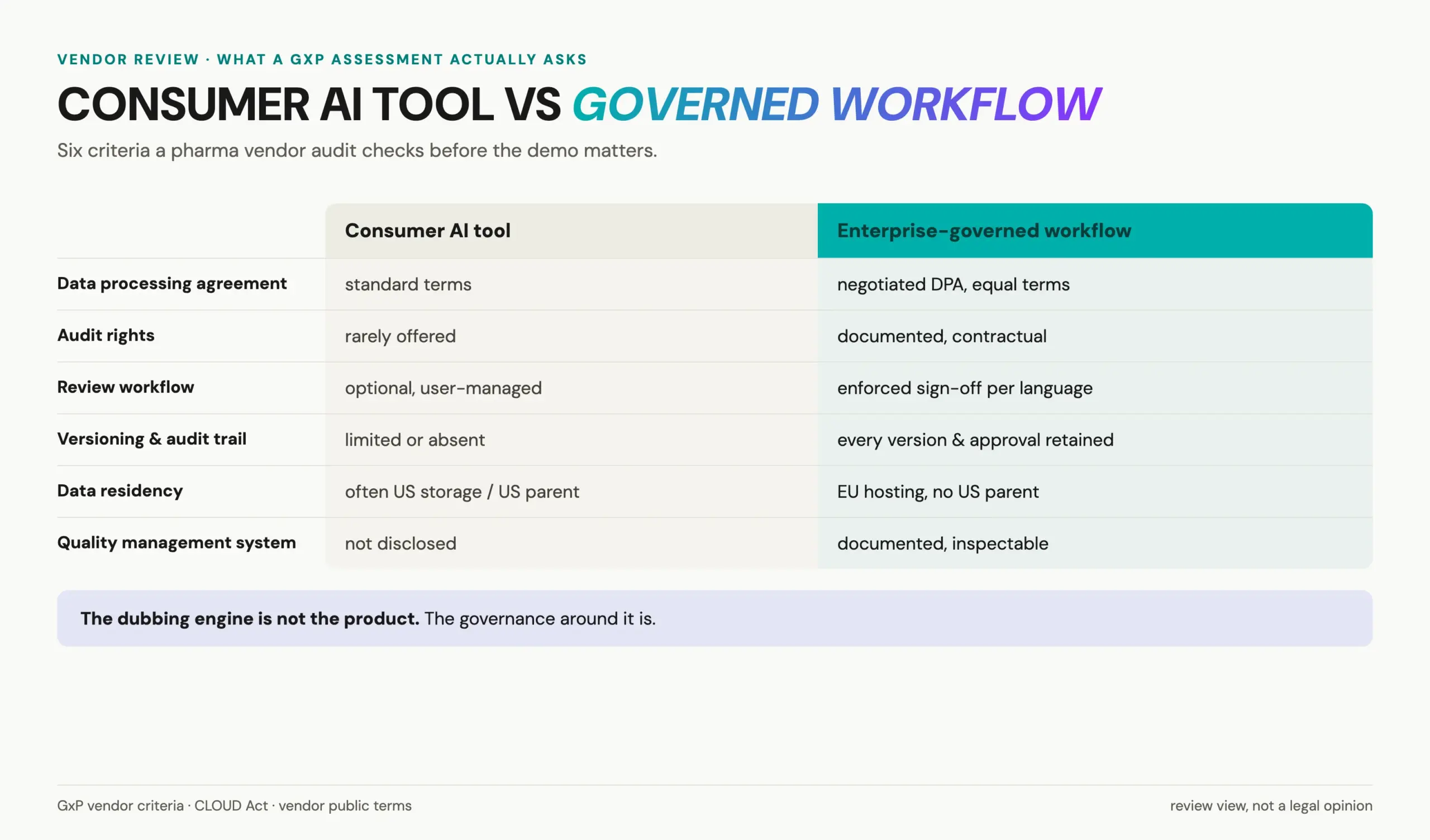
The EMA finalized its reflection paper on the use of AI across the medicinal product lifecycle in September 2024, taking a risk-based approach as part of the joint HMA-EMA AI workplan running through 2028. In March 2025, the CHMP issued its first qualification opinion for an AI-based methodology, the AIM-NASH tool. The FDA, for its part, launched its own agency-wide generative AI tool, Elsa, in June 2025, and had already seen more than 500 submissions with AI components between 2016 and 2023, per the context of its January 2025 draft guidance.
Then, on 14 January 2026, the EMA and FDA jointly published ten guiding principles of good AI practice in drug development. These principles are explicitly non-binding; they are not formal guidance and should not be cited as such. But their direction is unambiguous: risk-based oversight, human accountability, documented quality management. Regulators on both sides of the Atlantic are not asking whether AI belongs in regulated processes. They are describing the conditions under which it does.
For patient-facing video, the translation of those conditions is straightforward. AI may generate the language versions. Humans must own them.
AI dubbing pharma only works with governance built in
Here is the operational core, and it is less glamorous than the technology. An AI dubbing pipeline that is fit for pharmaceutical use needs three governance elements that consumer tools do not provide.
Human-in-the-loop review for every language version
Each dubbed language version is a distinct piece of regulated patient communication. It needs sign-off from medical affairs or regulatory affairs before release, in that language, by someone qualified to judge it. This is not a caveat to the business case. It is a component of it. A workflow that routes every generated language version through a named reviewer, captures their approval, and blocks publication without it is what makes the technology usable in this industry at all.
Labeling and leaflet processes in pharma are led by regulatory affairs, with mandatory involvement of QA, legal, medical affairs, and marketing (GlobalVision, Loftware). An AI dubbing workflow that ignores this structure will not be adopted, however good the voices sound. A workflow built around it turns the strongest internal skeptics into process owners. The same discipline applies to synthetic voices themselves; our guide to voice cloning technology, ethics, and enterprise governance sets out the consent and provenance controls a regulated buyer should expect before a cloned voice reads a single dosing instruction.
Versioning and audit trails that survive an inspection
Patient information does not stand still. Every pharmacovigilance update, every safety-relevant label change, must propagate to all language versions of the accompanying material. With 24 separate video files scattered across agencies and drives, that is an update project. With a central multi-audio container, where one video holds all language tracks behind one link, it is a controlled change: one source updated, every language version re-reviewed, every approval logged, every prior version retained. The mechanics of that single-link, automatic language switcher are what turn a version-control nightmare into a routine change request.
That last part matters more than it first appears. A company must be able to show which version of which language a patient saw at which point in time. Versioning and audit trails are not enterprise decoration. They are the difference between a video program that survives a GxP vendor assessment and one that fails it.
Vendor qualification, or why the tool question is really a workflow question
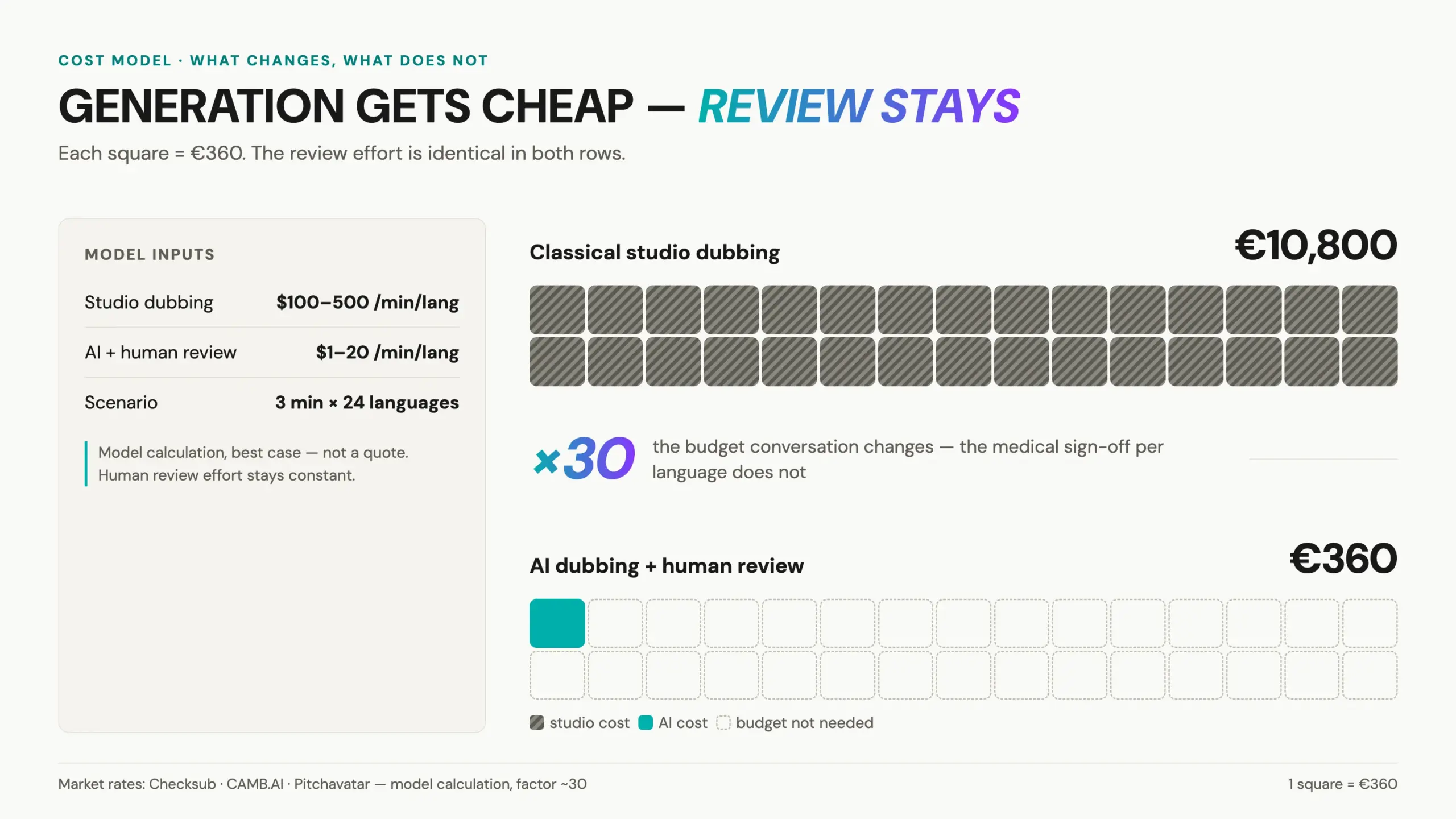
Consumer AI platforms are impressive, and it would be dishonest to pretend otherwise. But GxP vendor assessments ask questions that consumer platforms are not built to answer: Is there a data processing agreement on equal terms? Are there audit rights? Is there a documented quality system behind the service? Consumer video platforms are, for these reasons, generally not qualifiable in GxP vendor assessments. The gap between a good demo and a qualified vendor is precisely the governance layer.
The contrast becomes concrete when you line up a consumer AI dubbing tool against an enterprise-governed workflow on the criteria a GxP assessment actually scores.
| Assessment criterion | Consumer AI dubbing tool | Enterprise-governed workflow |
|---|---|---|
| Data processing agreement | Standard terms, take it or leave it | Negotiated DPA on equal terms |
| Audit rights | Rarely offered | Documented, contractually granted |
| Review workflow | Optional, user-managed | Enforced sign-off per language before publish |
| Versioning and audit trail | Limited or absent | Every version and approval retained and logged |
| Data residency and jurisdiction | Often US storage or US parent | EU hosting without a US parent |
| Quality management system | Not disclosed | Documented, inspectable |
None of this means consumer tools are bad. It means the question “which tool has the best voices” is the wrong first question. The first question is whether the workflow around the tool can be qualified. If it cannot, voice quality is irrelevant, because the program never ships.
A side note while we are on this lane: alugha publishes daily updates on LinkedIn on exactly these questions, EU compliance dates, voice cloning governance, and multilingual delivery patterns for regulated teams. If that is the cadence your team needs, follow alugha on LinkedIn for the running thread.
The data residency question does not go away
There is a second dimension that pharmaceutical IT and privacy teams will raise before anyone discusses voice quality, and they are right to raise it: where does the data live, and under whose jurisdiction?
The current market answers are worth reading closely. HeyGen states on its own security page, verbatim, that “All HeyGen customer data is stored in the United States.” ElevenLabs documents EU data residency as an exclusive feature available to Enterprise customers; the company itself remains under US jurisdiction. Neither of these is a hidden fact. Both are published by the vendors themselves, and both are exactly the kind of detail a European privacy officer will find in the first hour of a vendor review.
The jurisdiction question runs deeper than server location. In June 2025, the director of public and legal affairs of Microsoft France testified under oath before a French Senate inquiry that he could not guarantee that data of French citizens would never be handed to US authorities without French consent (Forbes, July 2025). The point is not that US providers act in bad faith; they operate under the legal framework that applies to them, including the CLOUD Act. The point is that an EU server operated by a US parent company does not, by itself, settle the jurisdiction question. The deeper mechanics of that gap, and why Schrems II makes it a recurring risk rather than a one-time check, are set out in our analysis of data sovereignty and Schrems II for enterprise video hosting. For patient-facing content in a pharmaceutical context, that unsettled question becomes a line item in every risk assessment, renewed at every contract cycle.
None of this makes US-based tooling unusable in every scenario. It does mean that data residency and corporate jurisdiction belong in the vendor decision from day one, not as a retrofit after legal has seen the contract.
What the economics look like when governance is included
A fair objection at this point: if every language version still needs human review, how much of the saving survives?
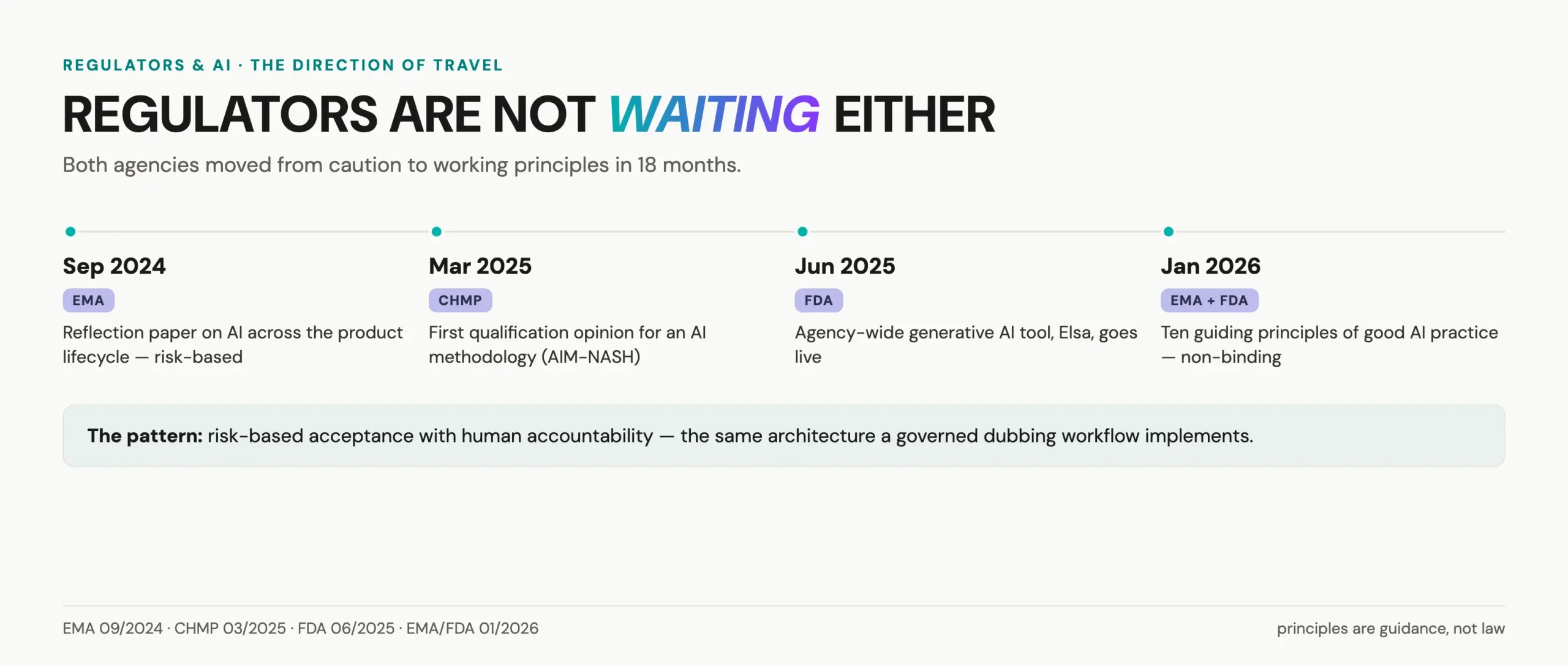
Most of it. Consider a model calculation, and treat it as exactly that, a best-case model, not a quote.
| Three-minute patient video, 24 EU languages | Classical studio dubbing | AI dubbing |
|---|---|---|
| Generation cost (model, best case) | ~EUR 10,800 | ~EUR 360 |
| Rate assumption | ~EUR 150 / min / language | ~EUR 5 / min / language |
| Time to produce | Weeks to months | Days |
| Files to manage | 24 separate files | 1 multi-audio container |
| Human review effort | Per language, qualified reviewer | Per language, qualified reviewer |
That is a factor of roughly 30 on the production side. The review effort is broadly the same in both scenarios, because qualified humans were reviewing the studio versions too. Treat the factor-30 figure as a model calculation, not a promise; real programs vary by content type, language pair, and correction cycles.
The economics do not merely survive the governance layer. They are what make the governance layer affordable at portfolio scale. When generation is cheap and review is structured, a company can afford to review 24 languages properly. When generation costs five figures per video, most languages are simply never produced, and the review question never arises because there is nothing to review. That is the quiet failure mode of the old model: not bad translations, but missing ones.
It is also why adoption pressure is building. Per McKinsey’s 2024 survey of more than 100 pharma and medtech executives, every respondent had experimented with generative AI and 32 percent were already scaling it, yet only 5 percent had turned it into a consistent advantage. The gap between experimenting and scaling is rarely the model. It is the workflow around it.
Where this leaves pharmaceutical teams
The honest summary is unspectacular. AI dubbing in pharma is not a shortcut, and vendors who sell it as one are selling to the wrong industry. It is an infrastructure decision: generation becomes cheap, review becomes structured, and the whole apparatus has to hold up in a vendor audit and a privacy review.
The obvious counter-argument is that governance this thorough slows a program down, and that a pilot could ship faster without it. That is fair. A workflow with named reviewers, versioning, and vendor qualification takes longer to stand up than uploading a video to a consumer tool.
It is also, based on our audit of 25 DACH and EU pharmaceutical companies in July 2026, the difference between the 7 companies that already run a structured patient video program and the 23 still stuck at one language. The four-pillar readiness test introduced earlier in this series exists for exactly this reason: teams that score well on it spend less time fighting their own governance, because the workflow was built for it from day one. Companies that approach AI dubbing this way tend to find their regulatory teams turning from gatekeepers into co-designers of the workflow.
This is the design philosophy behind alugha’s multi-audio platform: AI dubbing paired with human-in-the-loop review per language version, versioning and audit trails as standard, and hosting by a German company in the EU without a US parent. Not because governance sells better than magic, but because in this industry, governance is the product.
Frequently asked questions
Is AI dubbing allowed in pharma patient communication?
There is no rule prohibiting it. QR codes on pharmaceutical packaging may already link to approval-compliant materials, explicitly including videos (BfArM FAQ on Article 62 of Directive 2001/83/EC), and the EMA and FDA have jointly described non-binding principles for good AI practice (January 2026). The practical requirement is that AI-generated language versions pass the same medical and regulatory review as any other patient-facing material. Our guide to sharing a video by QR code covers the delivery side of that link.
Does human review of every language version cancel out the cost savings?
No. The savings come from replacing studio production logistics, not from removing reviewers. In a model calculation for a three-minute video in 24 languages, generation cost falls from roughly EUR 10,800 to roughly EUR 360 in the best case, while review effort remains comparable to the classical workflow. Treat that figure as a best-case model, not a quotation.
What should a GxP vendor assessment ask an AI dubbing provider?
At minimum: where customer data is stored and under which jurisdiction, whether a data processing agreement with audit rights is available, how language versions are versioned and approvals logged, and whether the review workflow enforces sign-off per language before publication. Vendors’ own security documentation is the right starting point; HeyGen, for example, states that all customer data is stored in the United States, and ElevenLabs offers EU residency only at enterprise level.
Do the EMA and FDA principles from January 2026 create binding obligations?
No. The ten guiding principles of good AI practice in drug development, published jointly on 14 January 2026, are explicitly non-binding. They signal regulatory direction, risk-based oversight and human accountability, but they are not formal guidance and should not be treated as law.
How do AI dubbing pharma platforms differ from consumer tools like ElevenLabs or HeyGen?
The difference is the governance layer, not the voices. Consumer platforms such as ElevenLabs or HeyGen are built for reach and speed. A pharma-grade platform adds enforced review per language, retained versions and audit trails, a negotiable data processing agreement with audit rights, and EU hosting without a US parent. Those are the criteria a GxP assessment scores, and they are usually where consumer tools fall short.
Can one video serve all 24 EU languages from a single link?
Yes, with a multi-audio container. Instead of 24 separate files, one video holds every language track behind a single link and selects the viewer’s language automatically. That structure is what makes versioning and audit trails workable: a pharmacovigilance update changes one source, triggers re-review of each affected language, and retains every prior version for inspection.
Does the data residency question apply if the vendor uses an EU server?
Partly, and that is the trap. An EU server operated by a company with a US parent can still fall under US jurisdiction through frameworks such as the CLOUD Act, as the Microsoft France Senate testimony in 2025 made plain. Server location is necessary but not sufficient. Corporate jurisdiction, who ultimately controls the entity, is the second half of the question a privacy officer will ask.
Is AI dubbing accurate enough for dosing instructions and safety information?
The raw output is not the safeguard; the review is. AI transcription and translation quality varies by language pair, and no responsible provider claims otherwise. That is exactly why sign-off per language by a qualified medical or regulatory reviewer is non-negotiable for safety-relevant content. Accuracy is a property of the workflow, not of the model alone.
How much can AI dubbing realistically reduce localization cost in pharma?
Industry sources put the generation-cost reduction at roughly 90 to 95 percent versus classical studio dubbing, driven by removing per-language studio logistics rather than removing reviewers. In a best-case model for a three-minute video across 24 languages, that is a factor of around 30 on production cost. Review effort stays broadly constant, so the net saving is large but not total.
What happens to a dubbed patient video when the label changes?
In a governed workflow, a safety-relevant label change updates the single source, flags every affected language version for re-review, captures each new approval, and retains the superseded version. The company can then show which version of which language a patient could have seen at any point in time, which is precisely what an inspection asks for.
—
This article is part of alugha’s Pharma QR Code Patient Information series on compliant multilingual video.
Related in this series: ePI timeline for EU pharma · Multilingual patient information videos · Accessible patient videos under the EAA and WCAG · GDPR-compliant video hosting vs. US platforms · Pharma video pilot rollout playbook