One QR code. One video every patient understands
Electronic product information (ePI) is coming — expected to become mandatory for new medicinal products around 2028. alugha provides the video layer on top: multilingual, accessible, hosted in Germany. Permissible under today’s rules.
The package leaflet satisfies the law. It often fails to reach the patient
Every package leaflet in the EU is legally reviewed, complete, and written in the official language. And yet it fails at its actual job: helping people understand their therapy and use it correctly. The numbers — here from Germany, one of Europe’s largest pharmaceutical markets — have been known for years.
6.2 mil
adults in Germany are functionally illiterate — 12.1% of the working-age population.
58.8%
of adults in Germany have limited health literacy.
~€125 b
in avoidable costs every year across Europe is the OECD estimate for non-adherence — along with roughly 200,000 premature deaths.
21.2 mil
people in Germany have an immigration background — for millions, German is not their first language.
alugha's answer: One QR code on the pack, one video, every patient's language.
Made and hosted in Germany
WCAG-compliant player
No US parent company
One video - hundreds languages
alugha's answer:
One QR code on the pack, one video, every patient's language.
Made and hosted in Germany
WCAG-compliant player
No US parent company
One video - hundreds languages
How it works
alugha adds a QR code to your pack that leads to a single video — in a multi-audio container. The video detects the patient’s device language and starts in that language automatically. Subtitles and audio description live in the same container. You maintain one link, not twenty-four.
Step 1. You provide the approved source video
An instruction or patient-education video in one source language, consistent with the approved product information and signed off by your own departments. On request, we support concept and production.
Step 2. We localize, your experts approve
AI-supported dubbing and subtitling into every target language — with a mandatory human-in-the-loop step: no language version goes live before it has passed review by Medical Affairs and Regulatory. A pharmacovigilance update is made once, centrally; every language version follows.
Step 3. One QR code on the pack, hosted in Germany
The patient scans and sees the video immediately — no app, no account, no consent banner, because there is no third-party tracking. The QR code is a permissible additional code alongside the FMD Data Matrix; the content is submitted through the familiar variation procedure.
alugha player
in action
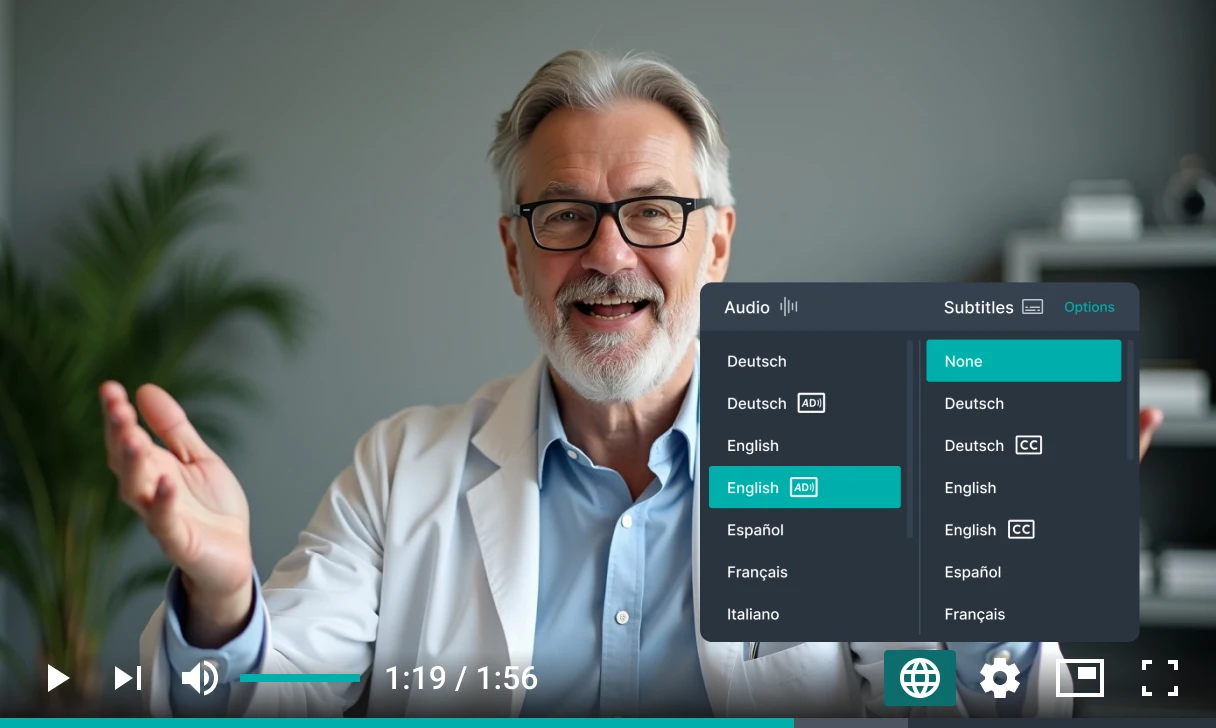
On the right you see a demo medicine pack with a real alugha QR code. Take your phone and scan it — you land directly in a patient video that starts in your device language, with no app and no consent banner in between. Switch languages in the player. Turn on the audio description.
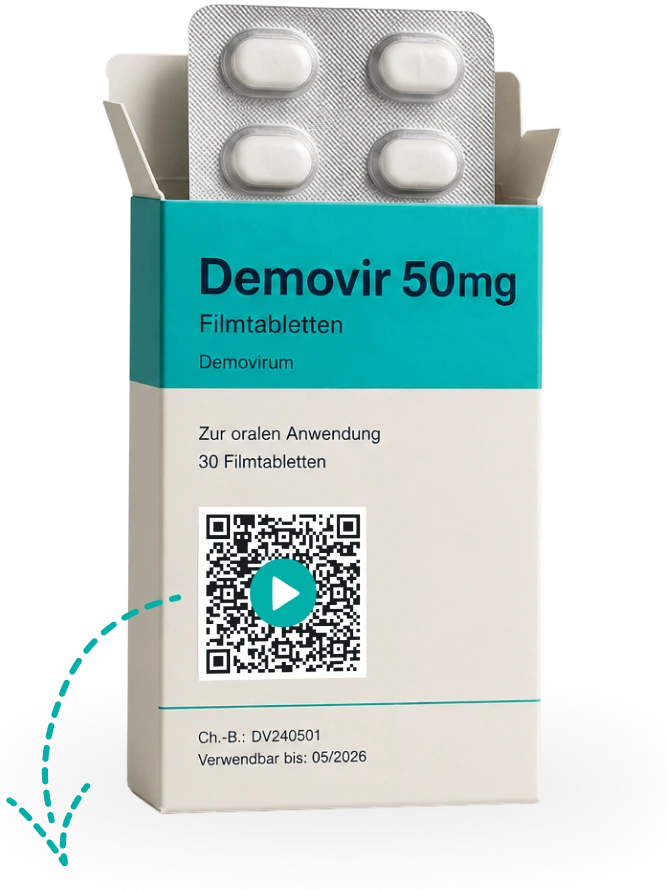
That is the entire journey your patient will take later: one scan, one video.
FULL SERVICE
Skip the learning curve and project management headaches. Our full-service team becomes your dedicated localization partner, managing the entire workflow for you—from accurate transcription and translation to professional dubbing and final quality checks. You get a single point of contact and a final, ready-to-publish video asset, set to engage your global audience.
Transcription
Translation
Dubbing
Accessible subtitles
Burned-in subtitles
BUILD YOUR HEAD START BEFORE ePI ARRIVES
You can introduce QR-linked patient videos today using the existing variation process. As Europe moves toward mandatory electronic product information (ePI), early adopters will have mature workflows, real usage data, and a significant competitive head start.
Available today
QR-linked patient videos are already permissible using today’s regulatory framework.
Coming next
Transcription, translation, and voice-over are ready in seconds, not days.
Your advantage
Start now to build approval workflows, multilingual content, and real-world data before competitors.
Permissible today. Mandatory tomorrow. Your advantage starts now.
Where your QR code leads matters
A medicine package QR code connects patients to sensitive health-related information. The platform behind that QR code determines how data is handled, where it is hosted, and what risks your organization carries.
alugha player
Just scan and watch. No consent banner pop-up.
Hosted in Germany
No third-party trackers in the player
No app, account, or unnecessary friction for patients
Multilingual video, subtitles, and accessibility in one player
Simplified review for Data Protection and Regulatory teams
US player
Consent banners before viewing
Third-party tracking technologies may create privacy concerns
Data-transfer assessment required for non-EU providers
Hosting location alone does not define data access obligations
Additional legal and compliance review required
Accessible by design. Ready for every patient
Since 28 June 2025, digital services covered by the European Accessibility Act must meet accessibility requirements. For patient videos, this means subtitles, audio description, and an accessible player.
Accessibility requirement
alugha player
Accessibility requirements VS
alugha player
Subtitles
WCAG 2.1, SC 1.2.2 (Level A)
Subtitles in up to 200+ languages in one player
Audio description
WCAG 2.1, SC 1.2.5 (Level AA)
Dedicated audio track in the same video
Formats for partially sighted people
Art. 56a, Directive 2001/83/EC
Audio track + AD meet the requirement digitally
Official languages
Art. 63, Directive 2001/83/EC
All language versions behind one link
Accessible player
EN 301 549 / WCAG 2.1 AA
Keyboard, contrast, configurable autoplay
With alugha, all language versions, subtitles, and accessibility features are stored in one video container and delivered through one link — helping pharma teams create inclusive patient information from the start.

Where to start
We recommend starting with a tightly scoped pilot: one product, one brand, one market. A QR video in five to ten languages, at a fixed price, with metrics defined up front — scans, video views, completion rates and, if desired, comprehension and adherence indicators plus the load taken off your patient hotline.
Scoping
Weeks 1–2
Product selection, language set, stakeholder alignment with Regulatory, Medical, Packaging and Data Protection.
Production
Weeks 3-6
Source video, AI localization, approval loops with your departments (human in the loop).
Go-live
QR integration into the artwork through your existing change process; hosting and player in Germany.
Review
After 3 months
Scan and usage report against the agreed metrics; a decision paper for the rollout.
where to start
Well-suited first candidates
We recommend starting with a tightly scoped pilot: one product, one brand, one market. A QR video in five to ten languages, at a fixed price, with metrics defined up front — scans, video views, completion rates and, if desired, comprehension and adherence indicators plus the load taken off your patient hotline.
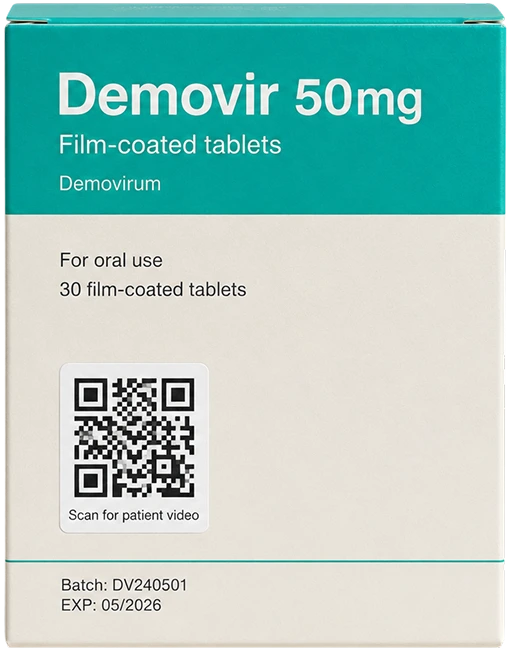
Benchmarks from connected-packaging implementations show what is achievable: scan rates around 14 percent and two to three minutes of engagement.
14% scan rate
2–3 minutes engagement
Self-injection biologics
The move away from paper is already underway in medical device law via eIFU.
OTC products
Uncomplicated from an advertising-law perspective
Hospital products
And products with new marketing authorisations in 2026–2028 that will fall under the ePI obligation anyway.
FAQ
Got questions? Check out these common ones, or send us a message — we’re happy to help!
Is a QR code on the pack even permissible?
Yes. Under Article 62 of Directive 2001/83/EC, additional, patient-relevant, non-promotional information is allowed on the pack and the leaflet. The FAQ published by BfArM (the German Federal Institute for Drugs and Medical Devices) explicitly lists product information texts, training material and videos as linkable content; the EMA has allowed mobile scanning for centrally authorised products since 2015. The QR code itself does not require approval; the linked content is submitted through the variation procedure.
Does the QR code conflict with the securPharm Data Matrix?
No. The Data Matrix required by the Falsified Medicines Directive serves verification and remains untouched. The patient-facing QR code is a permissible additional code on the pack. Longer term, a GS1 Digital Link code can bring both worlds together — with Sunrise 2027, 2D codes are becoming the global packaging standard anyway.
How do we make sure the videos do not count as advertising?
The linked content must be consistent with the approved product information and non-promotional — the same requirement that applies to every package leaflet (in Germany, this line is drawn by the HWG, the Act on Advertising in the Healthcare Sector). Instruction and patient-education videos that reflect the approved product information are information, not advertising to the public. Editorial control remains entirely with your Medical and Regulatory teams; alugha provides technology, localization and hosting — no content is created or published without your approval.
Who reviews the AI-translated language versions?
Your own departments — without exception. Human in the loop is not an add-on for us but part of the workflow: no language version goes live before it has passed the approval process you define (Medical Affairs, Regulatory and, where relevant, local affiliates). AI accelerates production and updates; responsibility and the final decision stay with people.
What happens when a pharmacovigilance update comes in?
You update once, centrally; we roll the change into every language version; your teams approve — and the QR code on the pack stays unchanged, because it points to the container, not to an individual file. This operational case is exactly where the difference shows: maintaining 24 separate video files at every update is the reason multilingual patient videos have failed in practice so far.
Does the video replace the package leaflet?
No — and we do not claim it does. The legally required leaflet — paper today, increasingly ePI tomorrow — remains the obligation. The video is the comprehension layer on top. Whether Member States provide for paper, electronic or both is their own decision under the EU pharmaceutical package; the right to a paper copy remains in place.
Why isn't a YouTube channel with our videos enough?
For three reasons. First, data protection: under Section 25 of the German TDDDG, an embedded US player requires consent before it loads — your patient sees a consent banner instead of the video, and by the logic of the CJEU’s Lindenapotheke ruling, a scan on a medicine pack should be treated as health data (our conclusion from the ruling, not part of it). Second, vendor qualification: consumer platforms are practically impossible to qualify in GxP vendor assessments — no data processing agreement on equal terms, no audit rights. Third, language logic: you would need a separate video and a separate link per language — with the multi-audio container, it is one link for all languages, with automatic language selection.
How long does a pilot take, and what does it cost?
From scoping to go-live, plan for six to ten weeks, depending on your approval loops; the review follows after three months of live operation. Pilots are fixed-price projects with five-figure budgets (EUR) — we scope the specific range in the first conversation, because it depends on the language set, video length and integration effort.
Ready to explore your first patient video pilot?
Discuss your product, languages, and regulatory requirements with our team. We’ll help you evaluate the right approach — from your first QR code on the pack to a scalable multilingual patient information solution.
Let's plan your project together
Prefer a personal conversation? Book a free consultation with our expert to get tailored advice and a precise quote for your project.