Key takeaways
- Multilingual patient information means every patient gets the same approved guidance in a language they actually understand, delivered as a short video behind a QR code rather than dense legal prose in one official language.
- The legal duty already exists. Article 63 of Directive 2001/83/EC requires package leaflets in the official language or languages of each market, which can mean up to 24 versions of the same product, and the EU pharmaceutical reform makes electronic product information the default format for new medicines around 2028.
- AI dubbing removed the cost barrier. Classic studio dubbing runs at roughly 100 to 500 US dollars per minute per language, while AI dubbing lands at roughly 1 to 20, which is what turns 24 language versions from a special project into standard operating procedure.
- Speed does not replace review. Every AI-generated language version stays a draft until Medical Affairs or a qualified medical reviewer signs it off against the approved product information, with a documented approval trail.
- One link carries every language. A multi-audio container holds all audio tracks, subtitles, and audio description in a single video object, so one printed QR code serves every market and stays correct after a pharmacovigilance update.
- This is where alugha operates: automatic language selection for 200-plus languages, subtitles and audio description in one container, AI dubbing with human review, hosted by a German company on European infrastructure, an alternative to routing patient video through US-based hosting,.
A multilingual patient information video is a short, approved, non-promotional clip that explains how to take or use a medicine, produced once and localised into every language a patient actually speaks. It supplements the statutory package leaflet rather than replacing it, and it reaches the people that dense legal text in a single official language leaves behind.
I have sat through enough patient information reviews to know where they fail: not in translation, but in scale. A leaflet in German helps a patient who reads German. It does nothing for the millions who do not, and printing more paper languages was never going to solve that. Multilingual patient information has to mean video, in the language the patient actually speaks, one QR code away.
A QR code on a medicine package can already link to an approved patient video. German and European regulators have permitted this for years, and the EU pharmaceutical reform will make electronic product information (ePI) the default format for new medicines around 2028. The harder question for pharmaceutical companies is no longer whether to add a video layer to patient information. It is how to deliver multilingual patient information at portfolio scale, in every language a patient actually speaks, without multiplying cost and regulatory workload by 24.
This guide walks through the legal baseline, the demographics that make single-language leaflets a comprehension problem, the economics of AI video dubbing, the review workflow that keeps every language version compliant, and the technical architecture that keeps 24 language versions behind a single link.
Why multilingual patient information matters more than ever
Package leaflets are written for a reader who barely exists. They assume fluent command of the local language, comfort with medical and legal terminology, and the patience to work through small print. The population data tells a different story.
A multilingual patient information video is a short, regulator-permitted video that explains how to take or use a medicine in the patient’s own language, accessed via a QR code on the pack. It supplements the statutory package leaflet; it does not replace it, and every language version passes medical review before release.
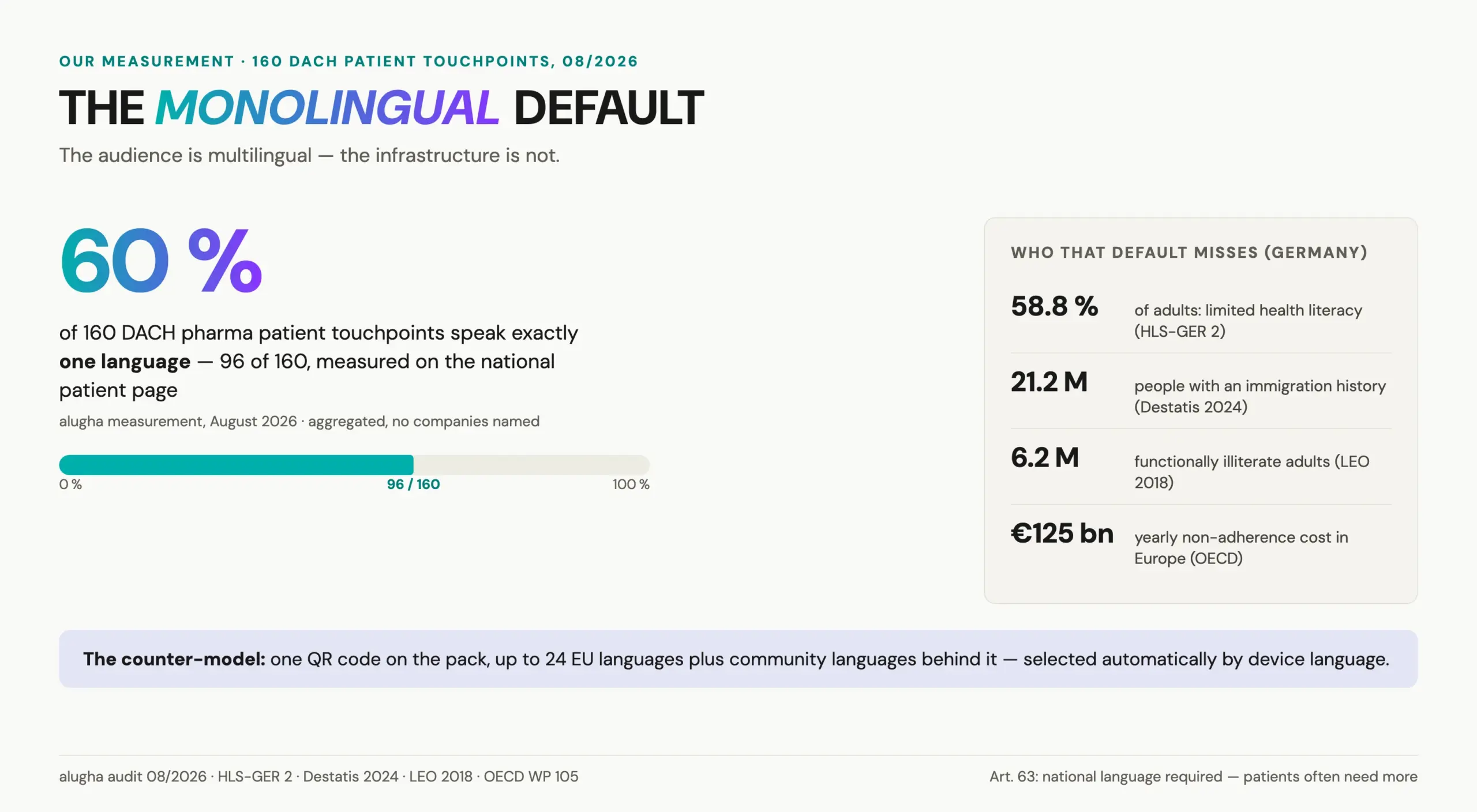
In Germany, 58.8 percent of the population has limited health literacy, per the HLS-GER 2 study (University of Bielefeld, 2021). That is a majority of patients struggling to find, understand, and apply health information, and the figure sat at 54.3 percent in the first survey wave (2014), so the problem is not shrinking.
Language adds a second barrier on top of comprehension. Germany counts 21.2 million people with an immigration history, 25.6 percent of the population, per the Mikrozensus (Destatis, 2024). For millions of them, German is not their first language. A further 6.2 million adults in Germany are functionally illiterate, per the LEO study (University of Hamburg, 2018). A leaflet printed only in German, in legal-medical prose, is structurally inaccessible to a substantial share of the people it is legally meant to protect.
Our own audit of 160 patient-facing touchpoints across the DACH region in August 2026 found 96 of them, 60 percent, offering exactly one language, the local original, with no video layer at all. The demographic mismatch above is not a hypothetical; it is what the packaging on the shelf still looks like today.
What limited health literacy means at the point of care
The consequences are measurable. Non-adherence to medication is associated with an estimated 125 billion euros in avoidable costs and roughly 200,000 premature deaths per year in Europe, per an OECD estimate (Health Working Paper 105, 2018). About half of patients on long-term therapies for chronic conditions do not take their medicines as prescribed, per the WHO adherence report (2003).
Patients cannot follow instructions they never understood. This is why patient education on medication adherence keeps returning to the same finding: comprehension is the lever, not compliance messaging. A video in a patient’s own language, with a human voice explaining how to take or inject a medicine, is one of the most direct routes to patient medication adherence available. Until recently it was simply too expensive to pull across a whole portfolio.
The regulatory baseline: Article 63 and the 24-language reality
Multilingual obligations are not new territory for pharma. Article 63 of Directive 2001/83/EC requires labelling and package leaflets in the official language or languages of each member state where a product is marketed. Across the EU, that means up to 24 official language versions of the same product information. Article 56a of the same directive has required Braille on packaging and leaflet formats suitable for blind and partially sighted patients on request since 2004. The multilingual, accessible baseline already exists in law. What is changing is the medium.
QR codes that link to approved, non-promotional content are permitted today. The BfArM explicitly names training material and videos among the content a pack QR code may link to, and the code itself is not subject to a separate marketing authorisation (BfArM FAQ). For centrally authorised products, the EMA’s mobile scanning guideline has allowed QR codes on labelling since 2015. Sharing an approved clip this way is a variation handled by Regulatory Affairs, not a new approval, and the mechanics of pointing a code at a hosted video are the same ones any team already uses to share a video by QR code.
The direction of travel is equally clear. The EU pharmaceutical package, politically agreed in December 2025 (Council of the EU), anchors ePI in legislation. Electronic availability of the package leaflet becomes mandatory for newly authorised medicines from the start of application, expected around 2028, with existing products following within roughly three years after that (for the exact mandate dates by product type, see our EU ePI timeline breakdown). The EMA’s ePI pilot with Denmark, the Netherlands, Spain, and Sweden published 23 ePIs in the FHIR-based EU ePI Common Standard, and the final report recommends a phased rollout (EMA, December 2024). Among the benefits the EMA names explicitly: accessibility, searchability, and multilingualism. Fourteen of 31 European countries already run active ePI pilots, with seven more planned, per an industry survey (AESGP/EFPIA/Medicines for Europe, February 2026).
When does electronic product information (ePI) become mandatory?
Around 2028 for newly authorised medicines, with existing products following within roughly three years after that, based on the political agreement reached in December 2025. Member states decide whether the leaflet ships on paper, electronically, or both, and patients retain a right to a paper copy where a product goes electronic-only. One boundary is worth stating plainly: a video never replaces the statutory package leaflet. It supplements it. The ePI is the obligation; the video is the understanding.
The economics: why AI dubbing changes the calculation
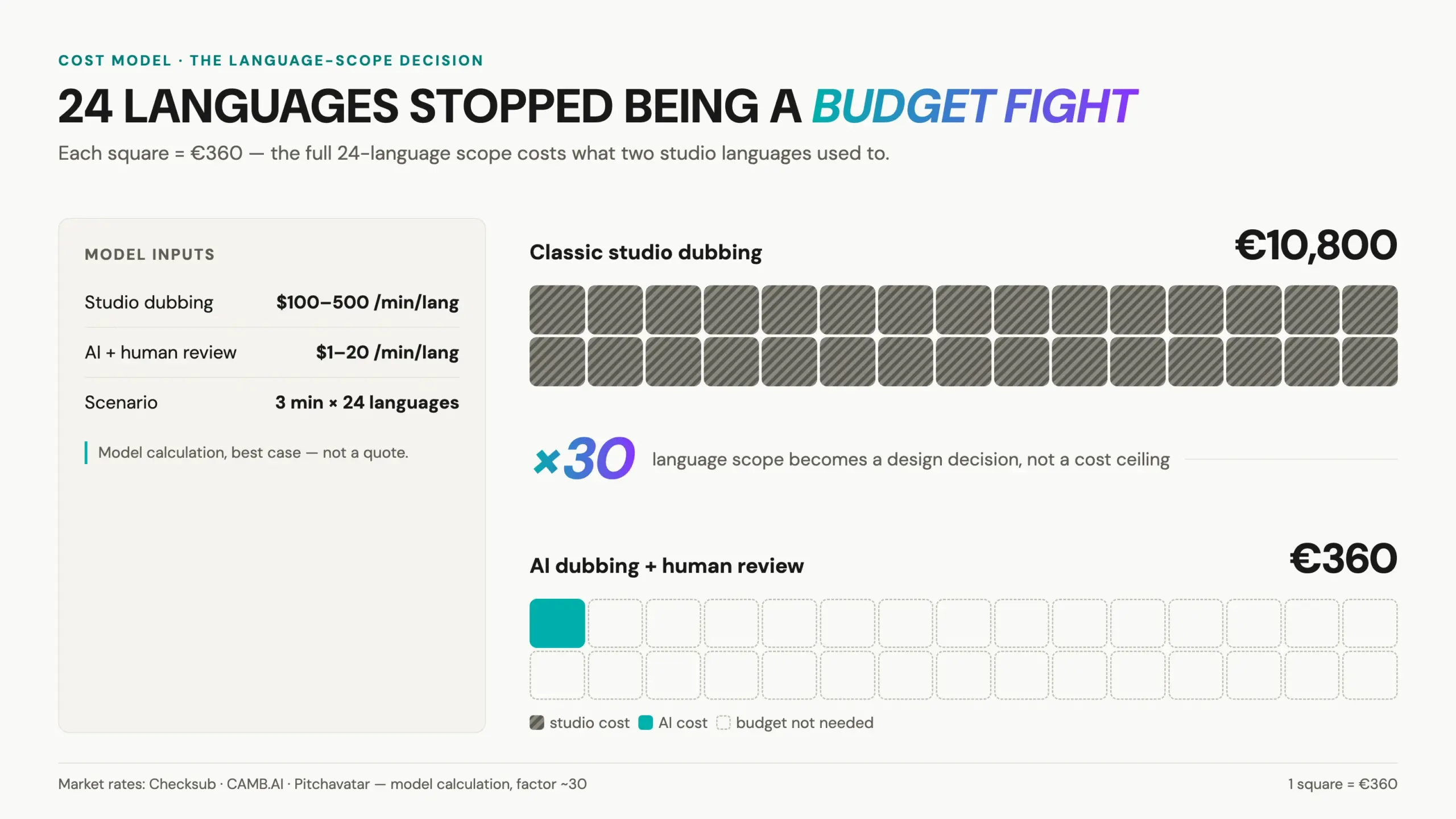
The reason most patient videos exist in one or two languages is cost, not intent. Classic studio dubbing runs at roughly 100 to 500 US dollars per video minute per language, with turnaround times of two to six weeks per language (market ranges per Checksub and CAMB.AI). At those rates, 24 language versions of even a short instructional video were a budget line few brand teams could defend.
AI video dubbing compresses that range to roughly 1 to 20 US dollars per minute, with all languages processed in parallel in hours to days, a cost reduction in the order of 90 to 95 percent (Pitchavatar). The technology has matured fast, and the practical mechanics of how AI dubbing works are now well documented for anyone weighing it against the studio route. If you are new to the method, our explainer on what AI dubbing is and how it works covers the fundamentals.
A model calculation for 24 languages
Treat the following as a model calculation with best-case assumptions, not a quote. A three-minute patient video localised into all 24 EU official languages:
| Approach | Assumed rate | 24 languages, 3 min | Turnaround | Files to manage |
|---|---|---|---|---|
| Classic studio dubbing | ~150 EUR/min/language | ~10,800 EUR | Weeks to months | 24 separate files |
| AI video dubbing | ~5 EUR/min/language | ~360 EUR | Hours to days | 1 container |
That is a difference of roughly factor 30 under these assumptions. The precise multiple will vary with video length, language mix, voice requirements, and review depth. The structural point survives every sensitivity check: language versions stop being the bottleneck. Scale the model to a portfolio of 50 products and the classic approach exceeds half a million euros per video wave, which explains why it rarely happened. The AI-supported approach moves multilingual patient information from special project to standard operating procedure.
Cost is not the whole story. In a full audit of 25 pharmaceutical companies in July 2026, scored against the four-pillar readiness test we introduced earlier in this series, 23 of 25 were single-language across every video asset we found, and the average portfolio scored 66 out of 100, with none scoring strong on all four pillars. Cheap dubbing does not fix a portfolio that was never built for structural readiness. It removes the excuse for not fixing it.
Human-in-the-loop: medical review for every language version
Speed without control is worthless in a regulated environment, so the workflow matters as much as the technology. AI-generated language versions of patient information are drafts until qualified humans have reviewed them. That is not a limitation to apologise for. It is the design.
A compliant workflow looks like this:
- Approved master content. The source video script derives from the approved product information. Medical Affairs and Regulatory Affairs sign off the master before any localisation begins.
- AI translation and dubbing. The approved master is translated and voiced into the target languages in parallel.
- Review per language version. Each language version passes through review by Medical Affairs or qualified medical translators before release. Terminology, dosing instructions, and warnings are checked against the approved product information for that market. Nothing publishes on machine output alone.
- Documented sign-off. Every version carries a documented approval trail, which is what a GxP-minded quality system expects to see.
Regulators have not rejected this direction; they are structuring it. The EMA and FDA jointly published ten guiding principles of good AI practice in drug development (January 2026), explicitly non-binding but a clear signal that AI-supported processes with appropriate human oversight belong in the industry’s toolkit. Human-in-the-loop review is precisely the kind of oversight that turns AI efficiency into something a pharmaceutical quality system can approve.
One link, every language: the multi-audio container principle
Producing 24 language versions is only half the problem. Distributing them is the other half, and it is where most projects quietly fail. Twenty-four separate video files mean 24 URLs, 24 QR codes or an awkward language-selection page, 24 assets to version-control, and 24 chances for a patient to land on the wrong one.
The multi-audio container solves this structurally. All audio tracks, subtitle tracks, and audio description live inside one video object behind one link. The player reads the device language and starts playback in the patient’s language automatically, and switching languages is one tap, not a new URL. This is the same automatic language selection principle that lets one link serve a global audience, applied to a regulated context. For the packaging side, the consequence is significant: one QR code, printed once, serves every market and every language version, and a GS1 Digital Link QR can additionally resolve to batch- or market-specific landing pages (GS1). The wider pattern of multilingual video delivery for global audiences is exactly what a pharmaceutical portfolio needs at scale.
Are patient information videos accessible under WCAG and the EAA?
Accessibility comes along in the same container instead of being a separate project. For video, WCAG requires subtitles at Level A (SC 1.2.2) and audio description at Level AA (SC 1.2.5) per the W3C, and EN 301 549 makes WCAG 2.1 AA the operative European standard for digital services under the European Accessibility Act. Subtitles per language plus an audio description track in the same container put a patient video on that standard from day one, with the practical checklist in our EAA and WCAG guide for pharma video. Our guide to audio description explains why the track matters for blind and partially sighted patients. A video with a human voice in the patient’s language also happens to serve exactly the groups Article 56a has protected on paper since 2004.
Paper leaflet versus multilingual patient information video
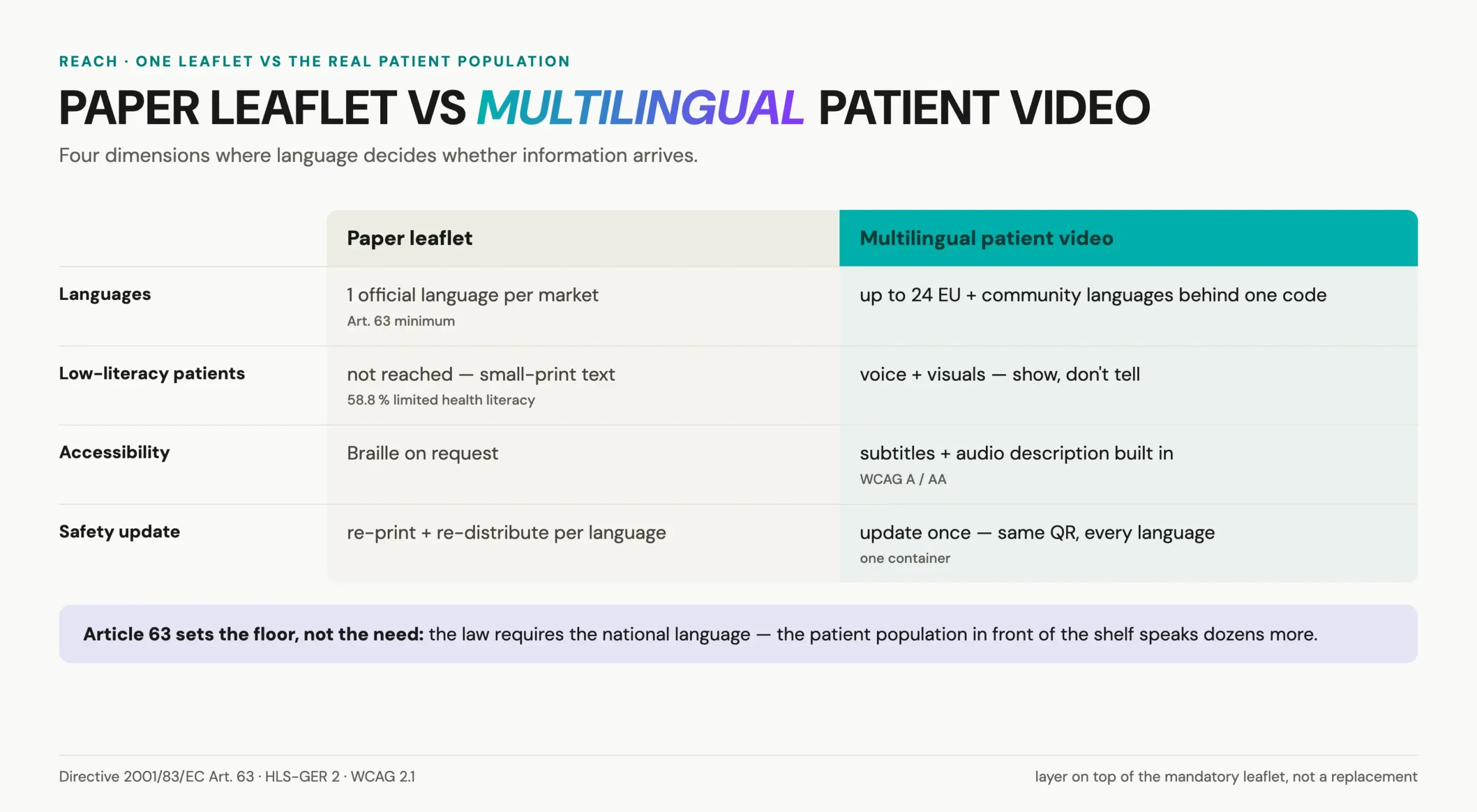
The two formats are not in competition. The leaflet is the legal document and the video is the comprehension layer. Seeing them side by side clarifies why the video earns its place on the pack.
| Dimension | Paper leaflet only | QR video in a container |
|---|---|---|
| Languages | 1 (the market’s official language) | Up to 24, plus community languages |
| Reaches low-literacy patients | No | Yes, via voice and visuals |
| Accessibility | Braille on request (Article 56a) | Subtitles + audio description built in |
| Update after a safety change | Reprint and redistribute | Update once, same QR stays valid |
| Cost to add a language | Full retranslation and reprint | Marginal, AI dubbing in parallel |
Keeping every language current: pharmacovigilance updates
Patient information is not static. Safety variations, updated warnings, and label changes arrive on their own schedule, and when they do, every language version must follow. This is where the file-based approach collapses at scale: a pharmacovigilance-driven change to a video that exists as 24 scattered files means 24 re-edits, 24 re-uploads, and 24 opportunities for an outdated version to stay live somewhere.
A central multi-audio container inverts the maintenance model. The master is updated once, the affected language tracks are re-generated and re-reviewed through the same human-in-the-loop workflow, and the single link on the package now serves the current version everywhere. No printed QR code needs to change. For Regulatory Affairs and pharmacovigilance teams, updating one object with a documented review trail per language is an auditable process; chasing two dozen files across channels is not. Run the update math across a portfolio and this operating cost, more than the initial production cost, is what decides whether multilingual patient video is sustainable.
Where this is heading
The thesis is straightforward: multilingual patient information stops being a special project once AI dubbing, human review, and a multi-audio container are combined into one operating model, and pharma teams that wait for the ePI mandate to force the issue will spend 2028 catching up instead of leading.
The counter-position, and it deserves a fair hearing, comes from regulatory affairs teams who argue that adding a video layer before the ePI framework itself is finalised is premature. The legal target keeps moving, from a December 2025 political agreement to an application date that is still an estimate, and building process around a moving target is a legitimate risk to flag.
That caution is fair, and worth conceding. Nothing here should be built as a one-off scramble against an uncertain date. But the underlying pieces, patient-language video content, human-in-the-loop review, and single-link distribution, do not depend on the exact year ePI becomes mandatory. They depend on demographics that are already fixed and a QR-code permission that already exists today. Waiting for regulatory certainty on the last mile is not the same as waiting to start.
alugha builds exactly this stack: a multi-audio player with automatic language selection for 200-plus languages, subtitles and audio description in one container, AI dubbing with human review workflows, hosted by a German company on European infrastructure. Pharmaceutical teams exploring a QR-to-video pilot for one product and one market can start small and scale language by language. Enterprise setups are custom arrangements, so it is worth contacting sales with a concrete product in mind.
Frequently asked questions
Is multilingual patient information legally required in the EU?
Yes, at the leaflet level. Article 63 of Directive 2001/83/EC requires package leaflets in the official language or languages of every member state where a medicine is marketed, which means up to 24 language versions across the EU. Videos are not legally required. They supplement the statutory leaflet and extend it to patients the printed text does not reach.
What is a multilingual patient information video?
It is a short, approved, non-promotional clip that explains how to take or use a medicine, produced from the approved product information and localised into several languages. It sits behind a pack QR code, plays automatically in the patient’s language, and complements the package leaflet rather than replacing it.
Can AI-dubbed patient videos be published without human review?
No. Each language version should pass through review by Medical Affairs or qualified medical reviewers against the approved product information before release, with documented sign-off. The EMA and FDA’s joint guiding principles on AI in drug development (January 2026) point in the same direction: AI with structured human oversight.
How much does AI video dubbing cost compared to studio dubbing?
Market ranges put classic studio dubbing at roughly 100 to 500 US dollars per minute per language and AI video dubbing at roughly 1 to 20, a reduction in the order of 90 to 95 percent. For a three-minute video in 24 languages, a model calculation lands near 10,800 euros classic versus about 360 euros with AI, factor 30 under best-case assumptions.
Do patient information videos replace the package leaflet?
No. The leaflet, and in future the ePI, remains the legal document. A video is an additional, non-promotional format that improves comprehension, which regulators such as the BfArM explicitly permit behind a pack QR code today.
How many languages should a patient video cover?
Start with the official languages of your marketed territories, since these mirror the Article 63 baseline, then add the most common patient languages in each market. In Germany, with 21.2 million people with an immigration history (Destatis, 2024), the highest-impact additions are typically the major community languages rather than more EU official languages.
When does electronic product information (ePI) become mandatory?
Around 2028 for newly authorised medicines, with existing products following within roughly three years, based on the December 2025 political agreement on the EU pharmaceutical package. Member states decide between paper, electronic, or both, and patients keep a right to a paper copy where a product goes electronic-only.
How do multilingual videos support medication adherence?
Comprehension is the lever. About half of patients on long-term therapies do not take medicines as prescribed (WHO, 2003), and non-adherence is tied to an estimated 125 billion euros in avoidable European costs (OECD, 2018). A human voice in the patient’s own language explaining dosing and administration is a direct patient education on medication adherence intervention that plain text cannot match.
What happens to the language versions when safety information changes?
All of them must be updated. A central multi-audio container makes this manageable: the master is revised once, affected language tracks are regenerated and re-reviewed, and the existing link and printed QR code deliver the current version everywhere without repackaging.
Do multilingual patient videos need to meet WCAG accessibility standards?
Yes, once a video sits inside a digital service in scope of the European Accessibility Act, EN 301 549 applies, which sets WCAG 2.1 Level AA as the operative standard. In practice that means subtitles in every language track (Level A, SC 1.2.2) plus an audio description track (Level AA, SC 1.2.5) inside the same video, not bolted on as a separate page.
Are patient information videos accessible under the European Accessibility Act?
For digital services, EN 301 549 makes WCAG 2.1 AA the operative standard, which means subtitles (Level A) and audio description (Level AA). A container that carries subtitles per language plus an audio description track meets that bar. The statutory paper leaflet itself falls outside the BFSG, but a digital patient video does not, so building accessibility in from day one is the safer path.
—
This article is part of alugha’s Pharma QR Code Patient Information series on compliant multilingual video.