Key takeaways
- Accessible patient videos are prerecorded videos that meet WCAG 2.1 Level AA: captions for deaf and hard-of-hearing patients, an audio description track for blind and partially sighted patients, and an operable player, delivered in the patient’s own language.
- The European Accessibility Act did not create a “produce video now” rule, but it made WCAG 2.1 AA the default for every consumer-facing digital patient service rolled out in 2026 and 2027.
- Audio description is the requirement most teams miss. Captions are the Level A baseline (SC 1.2.2); audio description is the Level AA duty (SC 1.2.5) that EN 301 549 references, and it is a predictable first audit finding when it is absent.
- Pharma has carried an accessibility duty since 2004. Article 56a of Directive 2001/83/EC already obliges marketing authorization holders to provide the leaflet in formats for blind and partially sighted patients. A described, multilingual video is such a format, and unlike a Braille run it scales.
- The comprehension gap is the real business case. In Germany 58.8% of adults have limited health literacy and up to 24 official EU languages apply per product. AI-assisted production has made a video in every language affordable at portfolio scale.
- Architecture decides whether accessibility scales. A container that carries one link and one QR code per product, with languages and description tracks stacked underneath, avoids the file-and-QR explosion that separate-file platforms create. That is the model alugha is built on.
What are accessible patient videos? Accessible patient videos are prerecorded patient information videos built to WCAG 2.1 Level AA: they carry captions (Success Criterion 1.2.2), an audio description track that narrates on-screen information (SC 1.2.5), and run in a keyboard-operable, sufficient-contrast player, delivered in the languages of the markets where a medicine is sold.
I spent July auditing the digital patient touchpoints of 25 pharma companies with Lighthouse. The pattern held page after page: leaflets in one language, accessibility scores drifting, and only seven of twenty-five running a structured patient video. Fewer still offered anything close to accessible patient videos with captions and audio description. That gap is not a content problem. It is a compliance problem, and it has a name.
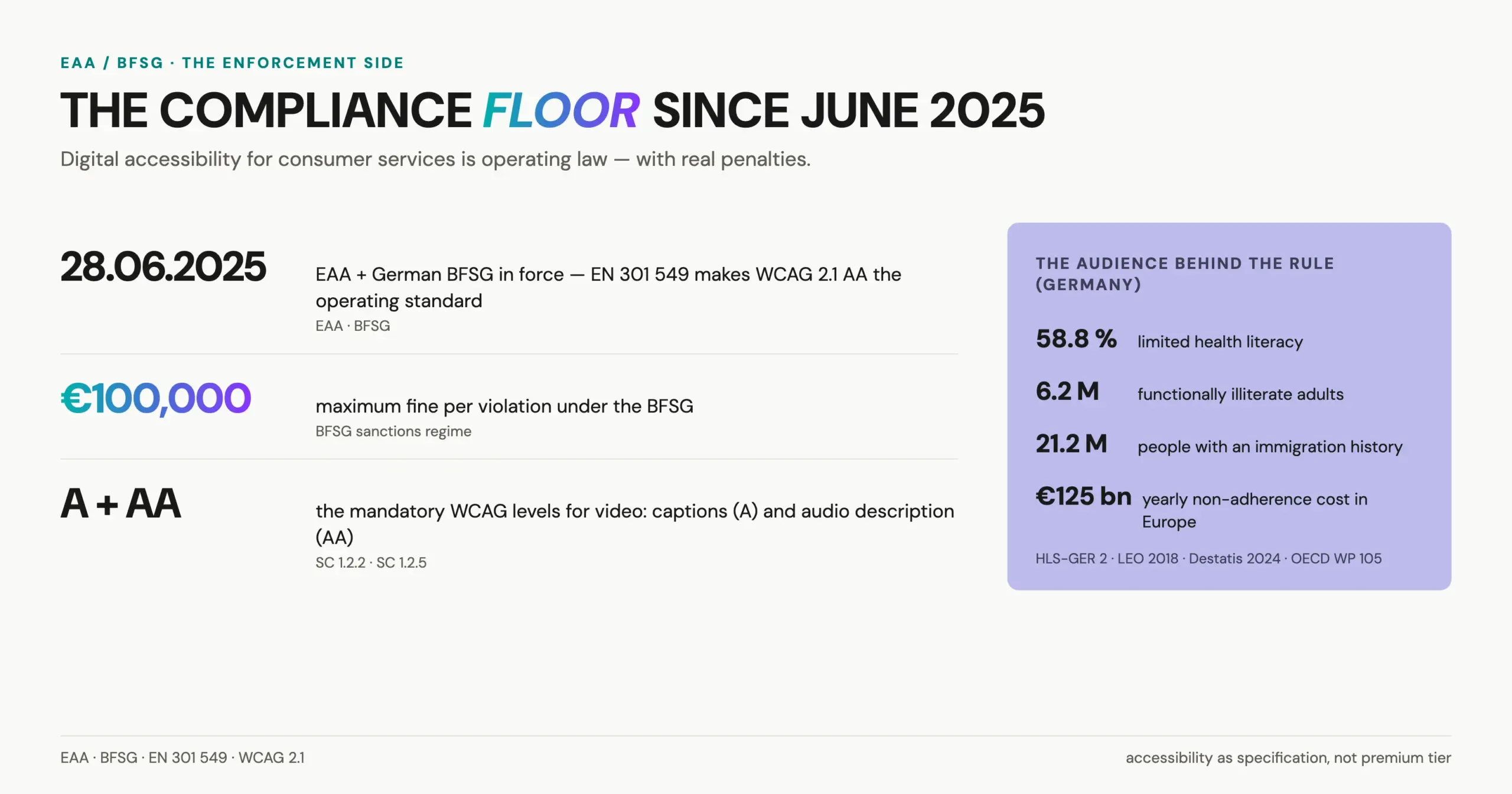
Since 28 June 2025, the European Accessibility Act (EAA) has been enforceable law across the EU. In Germany, its national implementation, the Barrierefreiheitsstärkungsgesetz (BFSG), backs it with fines of up to 100,000 euros for certain violation categories, plus possible sales bans (BMAS, 2025). Websites, apps and online shops get no transition period; the grace periods that exist apply only to legacy contracts, legacy products and self-service terminals.
Pharma companies planning digital patient information for 2026 and 2027 face a simple question: build it accessible from day one, or budget to build it twice. This guide covers what the EAA requires, where its scope honestly ends, what WCAG 2.1 AA means for video, and why accessible patient videos are the most scalable way to meet obligations medicines law has, in part, imposed since 2004.
What the EAA covers, and what it honestly does not
The EAA (Directive 2019/882) and the German BFSG primarily target consumer-facing digital products and services: e-commerce, banking, e-books, transport apps and a defined list of others. Three consequences follow for pharma.
The paper package leaflet does not fall under the BFSG. Printed patient information is regulated by medicines law, not by the accessibility act. Any vendor telling you the BFSG forces you to replace paper leaflets today is wrong.
A purely corporate pharma website is not automatically in scope either. A B2B site presenting the company and its pipeline is not, by itself, a listed consumer service.
Digital patient services for consumers do fall in scope. Patient portals, apps, and QR-based service offerings aimed at consumers are exactly the kind of digital service the framework was written for. The moment a QR code on a package leads a patient to an interactive digital information service, that service lives in EAA territory.
The practical takeaway is not “pharma must do video now because of the EAA.” The accurate version is stronger: the EAA has made EN 301 549, and through it WCAG 2.1 Level AA, the default norm for everything digital in the EU.
Which standard applies: EN 301 549 and WCAG 2.1 AA
The BFSG itself names no WCAG level. Conformity is presumed via the harmonized European standard EN 301 549 (version 3.2.1), which references WCAG 2.1 Level AA for web content (ETSI/BMAS, 2025). A revised EN 301 549 pointing to WCAG 2.2 AA has been announced for 2026. Until it is published and harmonized, WCAG 2.1 AA remains the operative benchmark, with a transition to 2.2 already visible on the horizon.
For planning purposes: build to WCAG 2.1 AA today, and check the delta to 2.2 AA before any major release. The video-specific requirements discussed below are identical in both versions. Teams that want the full picture of what shifts between the two versions will find it in our companion guide on WCAG 2.2 accessibility for enterprise video, which walks through the new success criteria that touch player controls rather than video content.
Accessibility duties pharma has carried since 2004
The EAA is the new headline, but it is not the first accessibility obligation in the medicines lifecycle. Two provisions of Directive 2001/83/EC have been in force for decades.
- Article 63 requires labelling and the package leaflet in the official language or languages of each member state where the product is marketed. Across the EU, that means up to 24 language versions per product (EUR-Lex).
- Article 56a, in force since 2004, requires the medicine’s name in Braille on the packaging and obliges marketing authorization holders to make the package leaflet available, on request, in formats suitable for blind and partially sighted patients (EUR-Lex).
Article 56a is the provision most digital teams have never heard of, and it changes the framing. Accessibility for patient information is not a future requirement arriving with the EAA. It is a current obligation, one most companies fulfil today through expensive single-purpose solutions: Braille runs, telephone hotlines, individually produced audio versions.
A multilingual video with a professional audio track and audio description is precisely such a format, and unlike a Braille print run, it scales across languages and products. The EU pharma package, politically agreed in December 2025, points the same way: the EMA names accessibility, searchability and multilingualism as core benefits of electronic product information (EMA, 2024), a field sometimes discussed alongside electronic product code information services in packaging circles. The ePI obligation arrives for newly authorized products around 2028 and existing products around 2031, see the full ePI timeline for the staged dates (Consilium, 2025), so treating accessible video as ePI groundwork builds for the regulation’s direction of travel, not against it.
What WCAG 2.1 AA requires for accessible patient videos
Accessible patient videos are prerecorded patient-information videos that meet WCAG 2.1 Level AA: captions for viewers who are deaf or hard of hearing, audio description for viewers who are blind or have low vision, and a fully keyboard-operable player. EN 301 549 makes this the compliance baseline for any EU-regulated digital patient service.
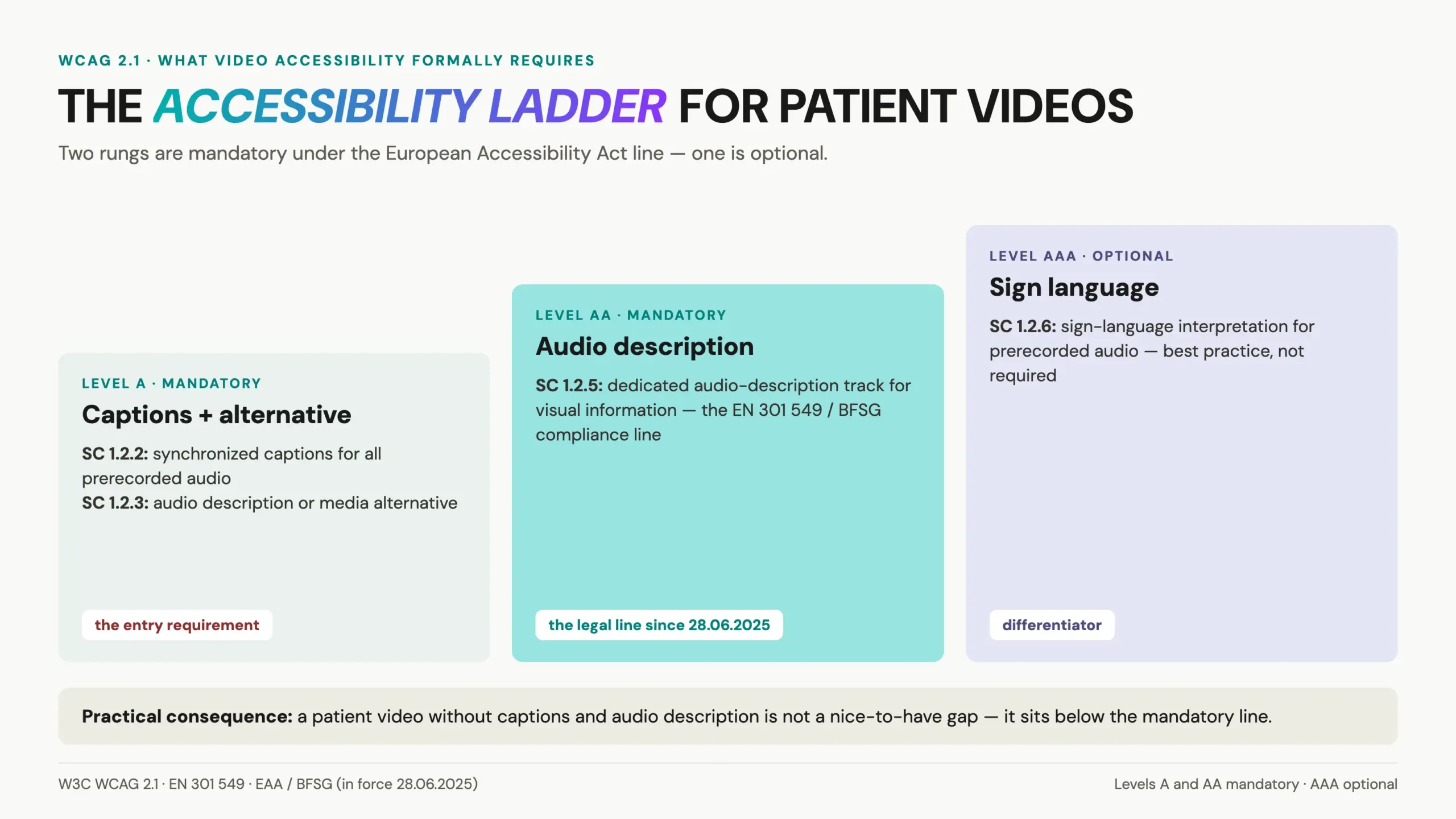
WCAG organizes requirements into three levels: A (baseline), AA (the level EN 301 549 demands), and AAA (enhanced). For prerecorded video, the map is short and unambiguous (W3C). The table below is the version worth pinning above a project plan.
| WCAG success criterion | What it requires for video | Level | Status for EU conformity |
|---|---|---|---|
| SC 1.2.2 Captions (Prerecorded) | Synchronized captions for all prerecorded audio | A | Mandatory |
| SC 1.2.3 Audio Description or Media Alternative | Description of visual information, or a full text alternative | A | Mandatory |
| SC 1.2.5 Audio Description (Prerecorded) | A dedicated audio description track | AA | Mandatory (EN 301 549 line) |
| SC 1.2.6 Sign Language (Prerecorded) | Sign language interpretation of the audio | AAA | Optional differentiator |
Captions: the Level A baseline for accessible patient videos
Success Criterion 1.2.2 requires captions for all prerecorded video with audio. This is Level A, the absolute minimum. Captions serve deaf and hard-of-hearing patients first, but the operational benefit reaches further: they make a patient video usable in a pharmacy queue, on public transport, or anywhere sound is off. For pharma, captions go through the same medical and regulatory review as any patient-facing text, so caption files belong in the workflow as versioned artifacts, not afterthoughts. Building captions that are themselves accessible, correctly timed and readable is a discipline in its own right, covered in our guide to accessible subtitles for corporate video.
Audio description: the AA requirement most teams miss
Success Criteria 1.2.3 (Level A) and 1.2.5 (Level AA) require audio description for prerecorded video: a narration track that describes visual information not conveyed by the main audio. A patient instruction video that shows an injection technique on screen while the voiceover says “hold it like this” is inaccessible to a blind patient without audio description.
This is the requirement that separates genuinely accessible patient videos from videos that merely have subtitles. It is mandatory at the AA level that EN 301 549 references, and it maps directly onto the Article 56a duty to provide formats for blind and partially sighted patients. In audits of digital patient services, missing audio description is a predictable first finding. Teams new to the format will find the mechanics, from script timing to voicing, in our complete guide to audio description.
A subsequent measurement across 160 individual patient-video touchpoints in August 2026 put the average accessibility score at 88.8 out of 100, but 40 of those 160 touchpoints, one in four, scored below 85, with audio description the most common reason.
Technically, audio description is an additional audio track, which has an architectural consequence. A platform that treats each language and each track as a separate video file multiplies files, links and QR codes with every added format. A container approach, where one video carries multiple audio tracks including description tracks, keeps one link and one QR code per product while formats accumulate underneath.
Sign language and other AAA differentiators
Success Criterion 1.2.6, sign language interpretation for prerecorded audio content, sits at Level AAA. It is not required for EN 301 549 conformity, and no one should claim otherwise. It is, however, a visible differentiator: German public-sector bodies already provide DGS content under BITV 2.0, and patient organizations notice who goes beyond the minimum.
Beyond the content criteria, the player itself must be accessible: full keyboard operability, sufficient contrast, visible focus, no autoplay traps. A perfectly captioned and described video inside an inaccessible player still fails.
Paper leaflet versus QR video: what actually changes for the patient
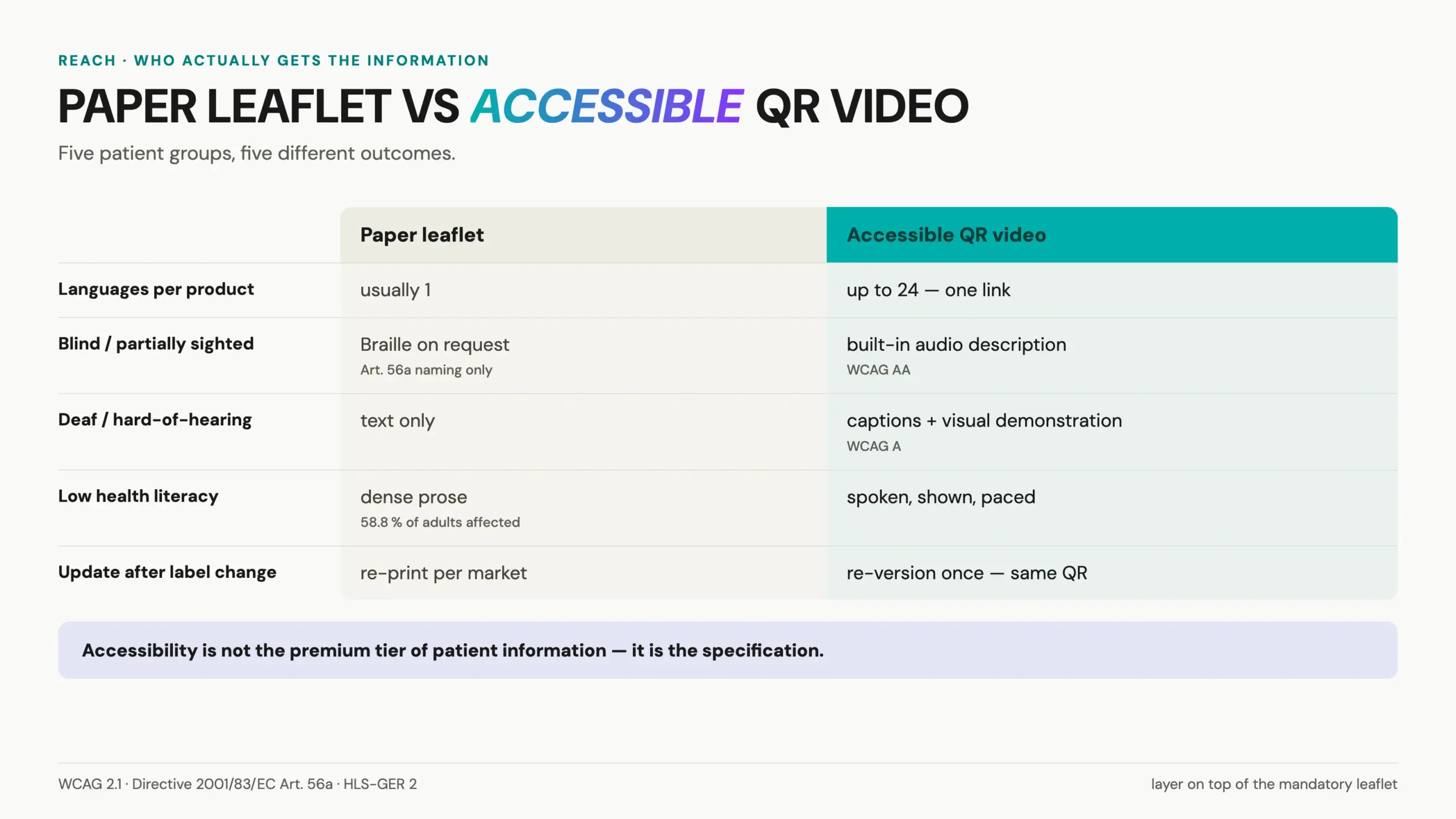
The legal duties above resolve into one practical comparison. A patient standing in a pharmacy with a package in hand has two information formats available. They are not equivalent.
| Paper leaflet | Accessible QR video | |
|---|---|---|
| Languages per product | Usually 1 (market language) | Up to 24, one link |
| Format for blind patients | On request, separate production | Built-in audio description track |
| Deaf / hard-of-hearing | Text only | Captions plus visual demonstration |
| Low health literacy | Dense legal-medical prose | Spoken, shown, paced |
| Update after a label change | Reprint and redistribute | Re-version the source, republish once |
| Cost to add a language | New print run | Incremental, AI-assisted |
The paper leaflet is not going away. Medicines law keeps it, and the EU pharma package preserves a right to a paper copy even where a member state permits electronic-only provision. The point is narrower: for the patients a leaflet serves worst, an accessible video is the format that reaches them.
Why video is the scalable answer, not the nice-to-have
Set the legal layer aside for a moment and look at who actually reads a package leaflet.
In Germany, 58.8 percent of adults have limited health literacy (HLS-GER 2, University of Bielefeld/BMG). The LEO study (University of Hamburg/BMBF, 2018) counts 6.2 million functionally illiterate adults, 12.1 percent of the working-age population. And 21.2 million people, 25.6 percent of the population in the 2024 microcensus, have an immigration history (Destatis, 2025), so German is not the first language for millions of patients.
These groups meet a leaflet written in legal-medical fine print, in one language. The system-level cost is documented: the OECD estimates non-adherence at roughly 125 billion euros and around 200,000 premature deaths per year in Europe (OECD Health Working Paper 105, 2018), with the WHO putting non-adherence in chronic long-term therapy at about 50 percent (WHO, 2003). This is where accessible video and patient education on medication adherence stop being separate conversations. The same asset that satisfies WCAG is the clearest vehicle for patient medication adherence, which is why medication adherence patient education increasingly treats video as a primary format rather than a supplement.
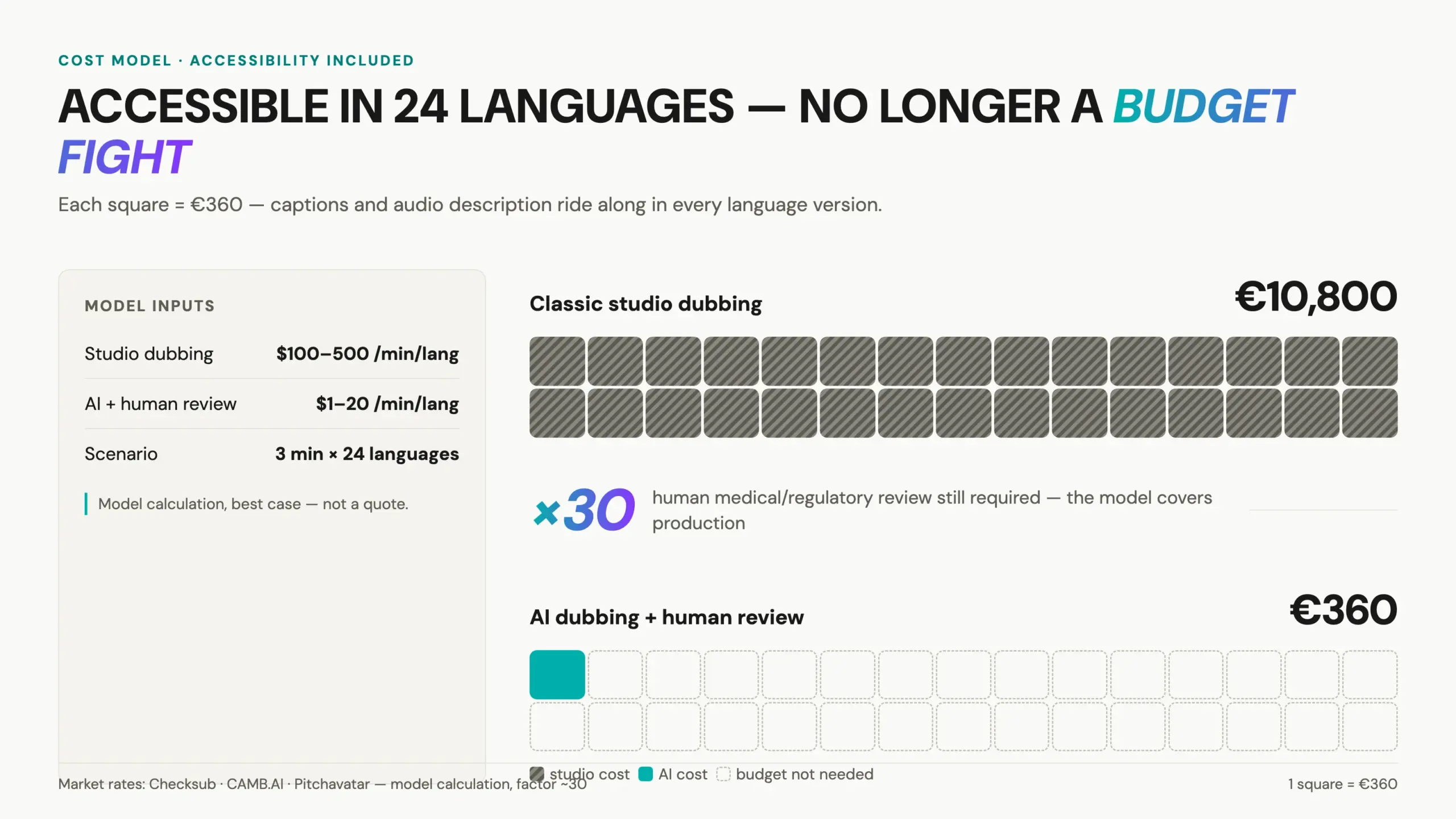
A video in the patient’s own language, with captions and audio description, is the most direct format for medication adherence and health literacy for exactly these audiences. What has changed is that it is now affordable at portfolio scale. Classic studio dubbing runs at roughly 100 to 500 US dollars per video minute per language, weeks of turnaround. AI dubbing sits at roughly 1 to 20 US dollars per minute, languages produced in parallel (Checksub; CAMB.AI).
| Method | Cost per video minute per language | Turnaround | When it fits |
|---|---|---|---|
| Classic studio dubbing | ~100–500 USD | Weeks | High-stakes hero content, small language set |
| AI video dubbing plus human review | ~1–20 USD | Days, parallel languages | Portfolio-scale patient information |
As a model calculation, assuming best-case rates: a three-minute video in all 24 EU official languages costs on the order of 10,800 euros with classic dubbing versus roughly 360 euros AI-assisted, a factor of about 30. That figure is a best-case model, not a quote. Human review by Medical and Regulatory stays a mandatory step, a feature of a compliant process, not a limitation. The economics of that shift, and where an AI dubbing video translator fits a regulated workflow, are covered in our explainer on what AI dubbing is and how it works.
A side note while we are on this lane: alugha publishes daily updates on LinkedIn on EU compliance dates, accessibility standards, and multilingual delivery patterns. If that is the cadence your team needs, follow alugha on LinkedIn for the running thread.
A practical roadmap: build accessible from day one
For teams planning a QR-to-video patient information rollout, the sequence looks like this.
- Scope check. Determine which of your digital patient touchpoints fall under the EAA as consumer services. Involve legal early; the classification drives the obligation.
- Set WCAG 2.1 AA as the project baseline. Write it into the vendor requirements and the internal brief. Retrofitting audio description onto a finished video library is the expensive path.
- Plan captions and audio description as reviewed artifacts. Both carry medical meaning and belong in the same review workflow as the leaflet text, per language.
- Choose an architecture that scales formats. One link and one QR code per product, with languages, caption tracks and description tracks added underneath, keeps packaging artwork stable while accessibility grows; the same container logic applies to electronic instructions for use for medical devices wherever a drug-device combination is in scope. Auto language selection at the container level, of the kind described in our note on the automatic language switcher, means one QR resolves to the right language without a menu.
- Verify the player, not just the content. Keyboard operation, contrast, focus states, no forced autoplay. Test with assistive technology before launch.
- Document conformity. An accessibility statement and test evidence turn a good build into a defensible one when a market surveillance authority or a procurement audit asks.
Companies that follow this sequence convert a compliance deadline into an adherence asset: the same video that satisfies WCAG reaches the 58.8 percent who struggle with the printed leaflet.
That gap between obligation and readiness is not theoretical. The July 2026 audit, scoring each digital patient touchpoint with Lighthouse against the four-pillar readiness test introduced in this series, put the industry average at 66 out of 100, and not one of the twenty-five companies scored strong across all four pillars at once.
The honest claim is not that accessible video fixes non-adherence. It is narrower: video is the most scalable format pharma has for meeting accessibility obligations it already carries under Article 56a, and for meeting the WCAG 2.1 AA bar the EAA now sets for anything digital. A fair counter-argument exists: for a company running a single domestic market in one language, an audio-described video is not obviously cheaper than a compliant transcript and a phone hotline, and some legal teams will argue the corporate-website carve-out covers more of their footprint than this article assumes. That argument holds up for narrow, single-market footprints. It stops holding up the moment a portfolio spans more than a handful of languages or markets, because that is exactly where the per-language cost of hotlines and Braille runs stops scaling.
Where alugha fits
alugha, a German video platform provider, builds multilingual accessibility into the video container itself: one video, one link, with subtitles in over 200 languages, multiple audio tracks including audio description under the same QR code, automatic language selection, and a WCAG-conformant player, hosted in the EU. For pharma teams preparing accessible patient videos ahead of the ePI transition, that architecture removes the file-multiplication problem this article describes. Enterprise setups vary with portfolio size and language count, and pricing follows from that, not from a fixed tier.
Frequently asked questions
What are accessible patient videos?
Accessible patient videos are prerecorded patient information videos built to WCAG 2.1 Level AA: captions (SC 1.2.2) for deaf and hard-of-hearing patients, an audio description track (SC 1.2.5) for blind and partially sighted patients, and a keyboard-operable, sufficient-contrast player, delivered in the languages of the markets where the medicine is sold.
Do accessible patient videos replace the paper package leaflet?
No. The paper leaflet remains a legal requirement under medicines law, and the EU pharma package keeps paper available even where member states allow electronic-only provision. Video complements the leaflet as an accessible, understandable format; it does not substitute for it.
Does the EAA force pharma companies to produce video today?
No. The EAA covers consumer-facing digital services, not the paper leaflet and not automatically a corporate website. The realistic reading: any digital patient service you launch now must meet WCAG 2.1 AA, and video meets accessibility and comprehension needs in one asset.
What WCAG level do patient videos need?
EN 301 549 references WCAG 2.1 Level AA. For prerecorded video that means captions (SC 1.2.2, Level A) and audio description (SC 1.2.5, Level AA), delivered in an accessible player. Sign language (SC 1.2.6) is Level AAA and optional.
What is the difference between captions and audio description?
Captions are synchronized text of the spoken audio and relevant sounds, for patients who cannot hear the audio. Audio description is an added narration track that describes visual information, such as an on-screen gesture or an injection step, for patients who cannot see the screen. WCAG requires both for AA conformity.
Is AI dubbing acceptable for regulated patient content?
AI dubbing changes the cost curve, not the review obligation. Every language version of patient-facing content still requires human review by Medical and Regulatory before release. The savings come from production, not from skipping oversight. An ai video dubbing workflow with a documented human-review step is a compliant process, not a shortcut around one.
What fines apply under the German BFSG?
The BFSG provides for fines of up to 100,000 euros for certain violation categories, and market surveillance authorities can restrict or prohibit non-conforming services. Websites, apps and online shops have no transition period. Grace periods apply only to legacy products and contracts.
Do QR-based patient videos count as a service under the EAA?
Yes, in most consumer-facing cases. When a QR code on a package leads a patient to an interactive digital information service, that service is the kind of digital offering the EAA framework targets. The paper leaflet the QR sits on remains outside the BFSG, but the digital service it points to does not. The QR code itself is not subject to marketing authorization; what matters is that the destination content is authorization-compliant, and the EMA has permitted QR codes on centrally authorized products since 2015 (BfArM FAQ; EMA).
How many languages does an accessible patient video need?
At minimum, the official language or languages of each market where the medicine is sold, which Article 63 of Directive 2001/83/EC can push to 24 EU languages per product. A container architecture lets those language and description tracks sit under one QR code rather than fragmenting into separate files and links.
How much does an accessible multilingual patient video cost?
Production cost depends on length and language count. As a best-case model, a three-minute video in 24 EU languages runs on the order of 10,800 euros with classic dubbing versus roughly 360 euros AI-assisted, before the mandatory Medical and Regulatory review. Platform and enterprise arrangements are custom; figures come from the vendor, not a public rate card.
—
Does accessible video actually improve medication adherence?
Partly, and it should be stated honestly. Video does not replace clinical adherence support. But 58.8 percent of German adults have limited health literacy, and the WHO puts non-adherence in chronic therapy at roughly 50 percent; a format patients can understand, in their own language, addresses one contributor to that gap, not the whole problem.
This article is part of alugha’s Pharma QR Code Patient Information series on compliant multilingual video.