
Last month a regulatory affairs director asked me whether her team needed an ePI strategy for a product launching in 2027. I asked what she meant by an ePI strategy. Silence. That gap, between a headline announcing digital leaflets and an actual plan, is where most pharma companies sit right now. Some vendors call electronic product information (ePI) “mandatory from 2026.” It is not. The EU pharma package reached political agreement in December 2025, formal adoption is expected in summer 2026, and the electronic leaflet obligation bites for new marketing authorisations around 2028, with existing products following around 2031. Between those dates sit voluntary pilots, draft roadmaps and member state decisions worth tracking.
Key takeaways
- Electronic product information is not “mandatory from 2026”. 2026 is the expected year of formal adoption of the EU pharmaceutical package, not the year the obligation applies. The application date lands around 2028 for new marketing authorisations and around 2031 for existing products.
- ePI is a data discipline, not a document conversion. The EU ePI Common Standard is built on HL7 FHIR, which turns the package leaflet and summary of product characteristics into structured, machine-readable content that updates centrally and displays on any device or channel.
- Paper is not disappearing. Each member state decides whether leaflets are paper, electronic, or both. Where a market goes electronic-only, patients keep the right to a free paper copy on request.
- Europe is already moving ahead of the law. A joint industry survey of 31 countries found 14 with active ePI pilots and 7 more planned; the Belgium-Luxembourg hospital pilot has covered more than 4 million packs since 2018.
- A QR code on the pack can already link to compliant video today. Under Article 62 of Directive 2001/83/EC and the EMA’s 2015 mobile scanning guideline, a 2D code may resolve to authorisation-compliant, non-promotional content, explicitly including videos.
- Compliance and comprehension are two different layers. An ePI makes information available; a short, multilingual, accessible video on top of it makes the information understood. Both can sit behind the same code. alugha hosts that comprehension layer on EU-sovereign infrastructure.
What is electronic product information (ePI)?
Electronic product information is the authorised product information for a medicine, the package leaflet and summary of product characteristics, published in a structured, machine-readable electronic format rather than as a static PDF or paper insert. It updates centrally, displays on any device, and can be read aloud by assistive technology. The concept was formalised in the ePI Key Principles agreed by the EMA, the Heads of Medicines Agencies and the European Commission in 2020.
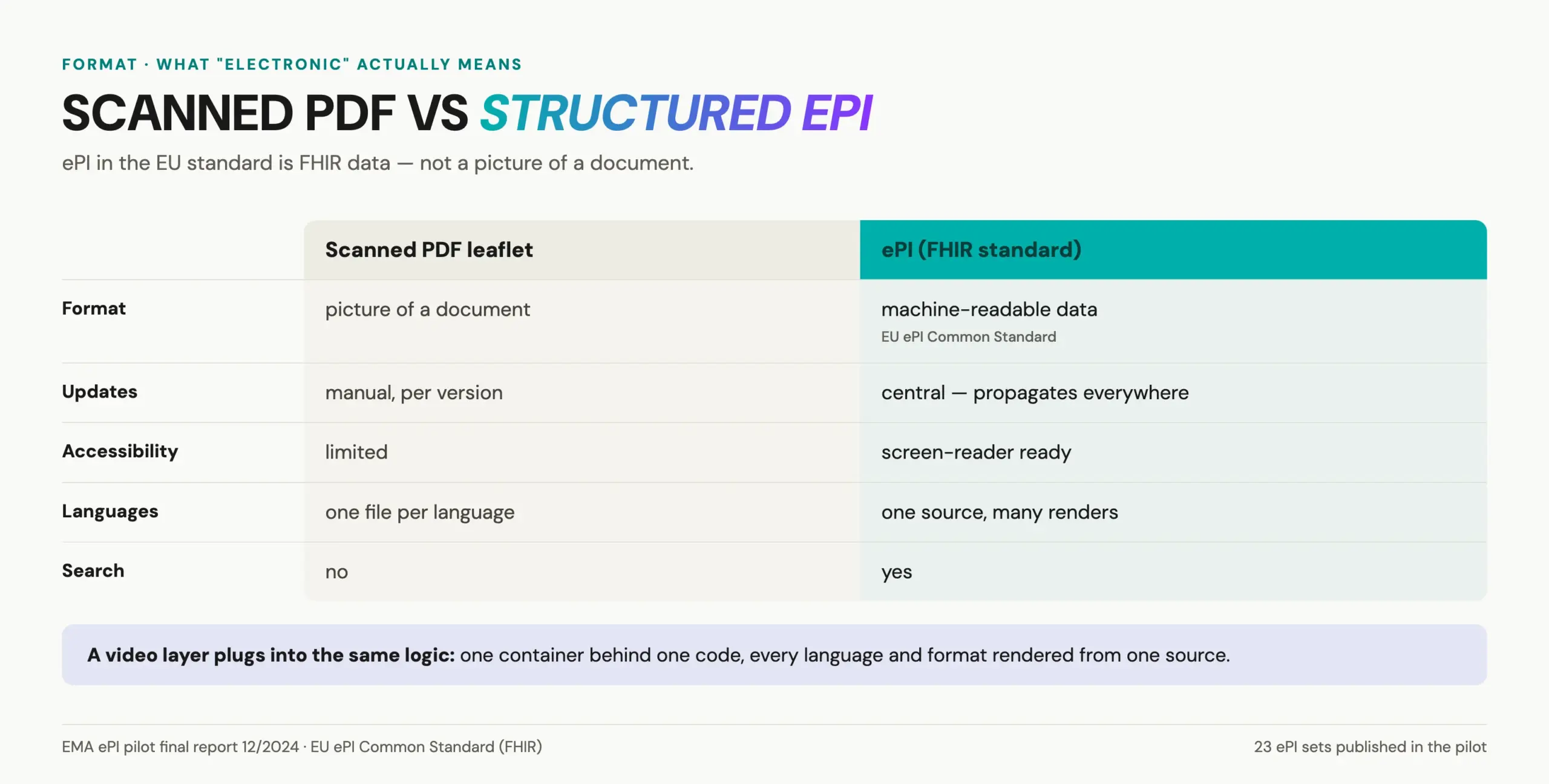
The difference to a scanned leaflet matters. A PDF is a picture of a document. An ePI is semantically structured data, where each section, warning and dosage instruction is a discrete element that can be updated the moment a safety variation is approved. The EMA names accessibility, searchability and multilingualism among the benefits. Note the word capability, not guarantee: our own measurement across 160 DACH pharma patient touchpoints (August 2026) found 60 percent still monolingual today, on infrastructure that was technically capable of serving more languages long before ePI existed. A structured format does not translate content by itself; someone still has to build the multilingual layer on top of it. For companies, the promise is one structured source of truth per product instead of dozens of national PDF versions drifting out of sync. That promise depends entirely on the technical standard underneath it holding up market by market.
| Scanned PDF leaflet | Electronic product information (ePI) | |
|---|---|---|
| Format | Picture of a document | Structured, machine-readable data (FHIR) |
| Updates | Manual, version by version | Central, propagates to every channel |
| Accessibility | Limited | Screen-reader friendly, device-independent |
| Languages | One file per language | One source, many language renderings |
| Search | Not possible | Built in |
| Integration | Standalone | Connects to portals, pharmacy and hospital systems |
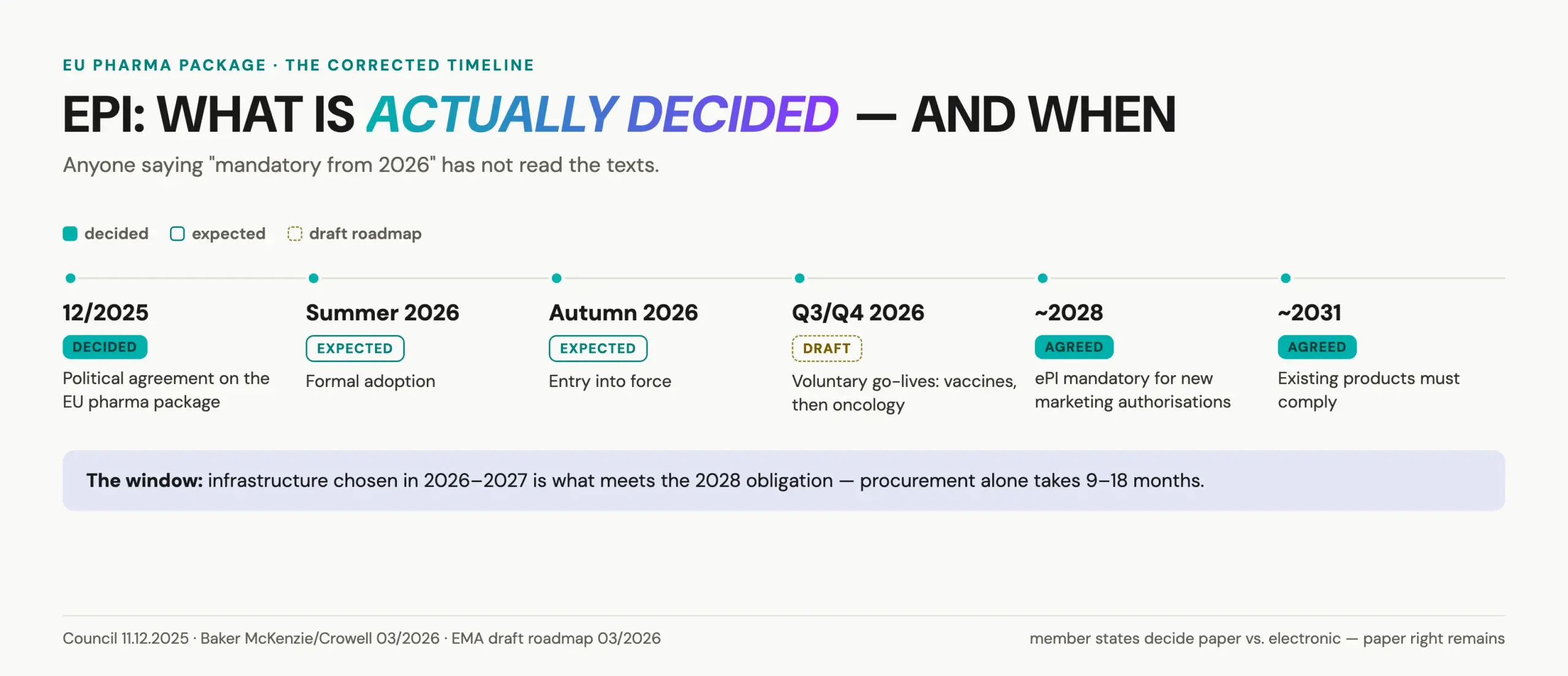
The corrected electronic product information timeline
Inaccurate dates circulate widely. The single most common error is treating 2026 as the obligation date. It is not. The table below is the sequence as it stands in mid-2026, separating what is decided from what is drafted or expected.
ePI becomes mandatory in two stages: around 2028 for newly authorised medicines, and around 2031 for products already on the market, once the EU pharma package’s 24-month application period runs from its expected autumn 2026 entry into force. Formal adoption is expected in summer 2026, not the obligation itself.
| Date | Milestone | Status |
|---|---|---|
| 11 December 2025 | Political agreement on the EU pharma package | Decided |
| March 2026 | Final compromise texts published after COREPER | Decided |
| Summer 2026 | Formal adoption by Parliament and Council | Expected |
| Autumn 2026 | Entry into force | Expected |
| Q3 / Q4 2026 | Voluntary go-lives, vaccines then oncology, English only | Draft roadmap |
| Around 2028 | ePI obligation for new marketing authorisations | 24 months after entry into force |
| Around 2031 | Existing products must comply | +3 years after application |
What happened in December 2025?
On 11 December 2025, the Council and the European Parliament reached political agreement on the EU pharmaceutical package, the largest overhaul of EU medicines legislation in more than 20 years (per the Council’s press release, December 2025). The package anchors ePI in EU law: package leaflets must be made available electronically, in line with the EU ePI Common Standard once it is operational. This is the agreement, not yet the applicable law.
When does the ePI legislation actually apply?
The final compromise texts were published in March 2026 following COREPER endorsement. Formal adoption by Parliament and Council is expected in summer 2026, with entry into force around autumn 2026 (per analyses by Baker McKenzie and Crowell, March 2026). Entry into force is not the same as applicability. The new rules become fully applicable 24 months later, around the end of 2028. From that date, electronic availability of the package leaflet becomes mandatory for newly authorised medicines. Any product entering the EU market from then on needs an ePI strategy in its launch plan, not bolted on afterwards.
What is the deadline for existing products?
Products already on the market get a further three years after the date of application to comply, which lands around 2031. For a portfolio holder with hundreds of SKUs, that window is shorter than it looks once artwork cycles, variation procedures and national implementation differences are factored in. Companies with heavy generics or over-the-counter portfolios face the largest multiplication effect of packs times languages times markets.
What is already underway before the obligation bites?
The EMA’s draft ePI roadmap (March 2026) sketches a voluntary go-live for vaccines from Q3 2026 and oncology products from Q4 2026, initially in English only via the EMA’s PLM portal. Treat it as a draft, not a confirmed mandatory rollout. Still, it tells manufacturers which product classes the regulator wants to see move first, and early participation buys process learning under low stakes.
The FHIR-based EU ePI Common Standard
The technical backbone is the EU ePI Common Standard, built on HL7 FHIR (Fast Healthcare Interoperability Resources). FHIR encodes product information as structured resources rather than formatted text, which makes the content device-, language- and channel-independent.
Three practical consequences follow from the FHIR choice:
- One source, many surfaces. The same ePI dataset can feed a national medicines portal, a pharmacy system, a hospital prescribing tool and a patient-facing app.
- Updates propagate. A pharmacovigilance-driven leaflet change is made once in the structured source and flows to every channel that consumes it.
- Integration with health systems. As the lingua franca of European e-health infrastructure, FHIR lets ePI eventually connect to e-prescription and dispensing workflows.
Regulatory teams do not need to become FHIR engineers. They do need to understand that ePI is a data discipline, not a document discipline. Treating it as a one-off PDF-to-XML conversion misses the point of the standard.
What did the EMA ePI pilot show?
Between July 2023 and August 2024, the EMA ran an ePI pilot with national authorities in Denmark, the Netherlands, Spain and Sweden. Twenty-three ePIs were published in the EU ePI Common Standard, and the final report followed in December 2024. Its headline findings:
- The key performance indicators were largely met. Creating an ePI took on average 5.2 hours against a target of 8 hours, and that benchmark was achieved with tooling rather than by hand.
- The report recommends a phased introduction: voluntary use for centrally authorised products first, with expansion depending on member states’ IT readiness.
That phased recommendation shapes everything that follows. There is no big-bang switchover, only a ramp, and companies choose where on it they stand.
Does ePI replace the paper package leaflet?
No. A common misreading of the reform is that paper leaflets disappear. They do not. Each member state decides whether package leaflets in its market are provided on paper, electronically, or both. Where a country opts for electronic-only, patients retain the right to a free paper copy on request, and antimicrobials must additionally carry a paper awareness card (per the European Parliament’s press release, December 2025).
For regulatory teams the transition will be a patchwork, not a wave. Some markets will move early to electronic-first, others will keep paper as the default for years. Product information architectures need to serve both channels from a single source, which is exactly what a structured, FHIR-based ePI is designed to do.
How many EU countries already run ePI pilots?
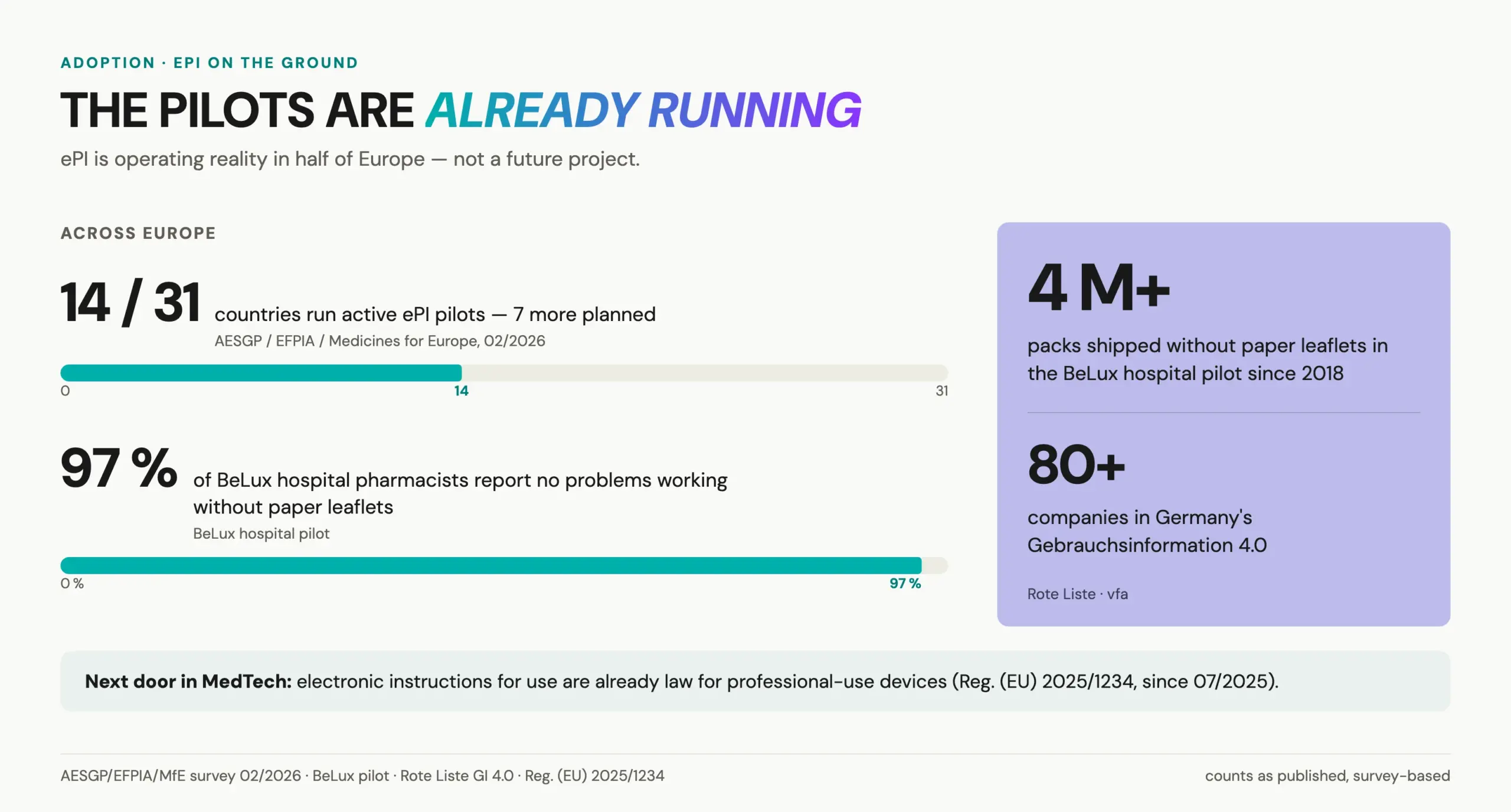
A February 2026 AESGP/EFPIA/Medicines for Europe survey of 31 European countries found 14 with active ePI pilots and 7 more planned, including Belgium-Luxembourg’s hospital pilot (since 2018, 4 million+ packs) and Germany’s Gebrauchsinformation 4.0.
Where Europe already stands: pilots on the ground
The legal timeline understates how much is already moving. A joint AESGP, EFPIA and Medicines for Europe report (February 2026), surveying 31 European countries, found 14 with active ePI pilots and 7 more planned. The Belgium-Luxembourg hospital pilot has been running since 2018 and has covered more than 4 million packs. Ninety-seven percent of hospital pharmacists there reported no problems from the absence of a paper leaflet.
Germany illustrates the direction of travel. Gebrauchsinformation 4.0, the digital leaflet initiative run via Rote Liste, counts more than 80 pharmaceutical companies, and the diGItal hospital pilot starts in Q3 2026 (per vfa and Pharmazeutische Zeitung, 2026).
We ran our own audit of 25 DACH and EU pharma companies in July 2026 (results aggregated, no companies named), scoring each on four pillars: data sovereignty, accessibility, multilingual coverage and structured patient video. Call it the four-pillar readiness test. Twenty-three of the 25 had monolingual national patient touchpoints, the industry average readiness score came out at 66 out of 100, and not one company scored strongly on all four pillars at once. Sovereignty was the weakest: a separate measurement across 160 DACH pharma patient touchpoints (our own measurement, August 2026) found 77 of 160 loading a US-based tracker before any consent interaction, 13 loading a US video platform before consent. Regulatory ePI compliance and patient-facing readiness are not the same project, and most companies are currently running only the first.
Adjacent legislation points the same way. Since 16 July 2025, electronic instructions for use (eIFU) are permitted for all medical devices intended for professional users under Implementing Regulation (EU) 2025/1234. The paper phase-out is already operational in medtech law. On the packaging side, QR codes linking to compliant, non-promotional content, explicitly including videos, are already permitted under Article 62 of Directive 2001/83/EC and the EMA’s mobile scanning guideline in force since 2015. The code itself needs no separate authorisation (per BfArM’s FAQ). The EMA’s draft reflection paper (EMA/95076/2025, March 2025) describes patient access to ePI via a 2D code scanned from the pack. With GS1 Digital Link and the global Sunrise 2027 migration to 2D codes, one code can resolve to batch-specific and language-specific digital content, while the FMD verification DataMatrix remains untouched. Teams that want to understand how a single code can carry authorisation-compliant material can start with the mechanics of how to share a video link via QR code before layering on the regulatory workflow.
What regulatory teams should prepare now
Waiting for the Official Journal is a strategy, but not a good one. New authorisations expected between 2026 and 2028 hit the mandatory window directly, and portfolio remediation for 2031 takes years. Five workstreams are worth starting in 2026.
1. Build the structured-content foundation
Audit how product information is authored and stored today. If the answer is “Word files and PDFs per market”, begin the move toward structured content management aligned with the EU ePI Common Standard. The pilot’s 5.2-hour creation benchmark was achieved with tooling. Replicate that, do not hand-craft.
2. Decide your voluntary-phase posture
Vaccines and oncology teams should evaluate joining the voluntary go-lives sketched in the EMA’s draft roadmap. Early participation buys process learning under low stakes and a seat at the table while conventions form. The downside risk is contained because these go-lives are voluntary and initially English-only.
3. Map the member state patchwork
Track national paper-versus-digital decisions market by market and model the artwork and variation implications of each scenario. A market that goes electronic-first changes your packaging logic; a market that stays paper-default does not. Both need to be served from the same structured source.
4. Connect packaging, regulatory and digital early
The 2D code on the pack sits at the intersection of packaging engineering, regulatory affairs, IT and patient engagement. Establish that cross-functional forum now. The buying and approval decisions of 2027 and 2028 will be made jointly or not at all.
5. Plan the comprehension layer, not just the compliance layer
An ePI makes information available. It does not make it understood — that is pillar four of the readiness test, and the one all 25 audited companies treated as optional rather than core. In Germany, 58.8 percent of adults have limited health literacy (per HLS-GER 2, Bielefeld University), 6.2 million adults are functional illiterates (LEO 2018, University of Hamburg), and non-adherence is estimated to cost around EUR 125 billion and roughly 200,000 premature deaths per year in Europe (OECD estimate, Health Working Paper 105). A short video explaining correct use, in the patient’s own language, with WCAG-compliant subtitles and audio description, is the most direct comprehension layer on top of an ePI, reachable from the same 2D code.
Multilingual obligations are not new. Article 63 of Directive 2001/83/EC already requires product information in the official languages of each member state, up to 24 language versions across the EU, and Article 56a has required formats for blind and partially sighted patients since 2004. The accessibility floor is well defined: for video, subtitles map to WCAG Level A and audio description to Level AA, the same standards behind WCAG 2.2 accessibility for enterprise video. Serving up to 24 languages from one link, with automatic language selection rather than 24 separate URLs, is the same pattern alugha uses for an automatic language switcher in a single player.
The economics used to be the blocker. AI-supported dubbing has changed that. As a model calculation, a 3-minute video localised into 24 EU languages runs to roughly EUR 10,800 with classic studio dubbing versus around EUR 360 with AI dubbing in a best-case setup, a factor of about 30. Human medical review remains mandatory either way, and the model calculation is a best-case illustration, not a quote. If the mechanics of that shift are new to you, our primer on what AI dubbing is covers the workflow.
| Paper leaflet | QR video linked from the pack | |
|---|---|---|
| Languages | One per pack | Up to 24 EU languages from one link |
| Accessibility | Text only | Subtitles + audio description |
| Comprehension | Reading-dependent | Visual and audio demonstration |
| Update | Requires a reprint | Update once at the source |
| Reach | In-box only | Scannable at point of use |
Teams that treat ePI purely as document conversion will pass the regulatory bar and nothing else. I will concede the counterargument here: compliance is the actual mandate, comprehension is not, and nobody is legally required to run a four-pillar test. Some regulatory consultants treat the FHIR data model itself as the multilingual fix, since ePI can technically carry any language version. Our audit says otherwise: 23 of 25 companies had that technical capability and shipped monolingual anyway. The standard enables multilingual, accessible patient information; it does not produce it. Teams that build the comprehension layer alongside the compliance layer are the ones patients actually understand.
Frequently asked questions
When will electronic product information (ePI) become mandatory in the EU?
Around 2028 for new marketing authorisations, and around 2031 for existing products already on the market. The 2028 date is 24 months after the expected entry into force in autumn 2026; existing products then get a further three years to comply. Claims of a 2026 obligation are wrong: 2026 is the expected year of formal adoption, not application.
Does ePI replace the paper package leaflet?
No. Member states decide individually whether leaflets are provided on paper, electronically, or both. Where a market goes electronic-only, patients keep the right to a free paper copy on request, and antimicrobials still carry a paper awareness card.
What is the EU ePI Common Standard?
It is the common technical format for ePI, based on HL7 FHIR. It structures product information as machine-readable data, updatable centrally and displayable across devices, languages and channels. It was tested in the EMA’s 2023 to 2024 pilot, which published 23 ePIs and recommended a phased, initially voluntary introduction.
What is FHIR, and why does ePI use it?
FHIR (Fast Healthcare Interoperability Resources) is the HL7 data standard behind the EU ePI Common Standard. It encodes leaflet content as structured, machine-readable resources, so one update propagates across portals, pharmacy systems and apps.
Is ePI the same as an eIFU?
Not quite. ePI is the electronic package leaflet and summary of product characteristics for medicines, governed by pharmaceutical law. An eIFU is the electronic instructions for use for medical devices, permitted for professional-use devices since 16 July 2025 under Implementing Regulation (EU) 2025/1234. They are parallel digitalisation tracks in adjacent legal frameworks, moving in the same direction.
Can companies already link a QR code on the pack to digital content?
Yes. Under Article 62 of Directive 2001/83/EC and the EMA’s mobile scanning guideline (2015), QR codes may link to authorisation-compliant, non-promotional content. BfArM’s FAQ explicitly names educational material and videos. The code is added via the normal variation procedure, and the FMD verification DataMatrix remains separate.
Is ePI the same as eIFU?
No. ePI covers the package leaflet and SmPC for medicines under the EU pharma package (~2028/2031). eIFU covers instructions for use for medical devices, already permitted for professional users since 16 July 2025 under Regulation (EU) 2025/1234 — separate legal tracks.
Does a QR code on the pack need separate authorisation?
No separate authorisation: the code is added via the normal variation procedure under Article 62 of Directive 2001/83/EC. It must link to compliant, non-promotional content and stays distinct from the FMD verification DataMatrix.
Does a QR code linking to a video need its own authorisation?
No. The QR code itself is not subject to separate authorisation. What matters is that the content it resolves to is authorisation-compliant and non-promotional. The linked material follows the same rules as any other product information, and adding the code follows the normal variation procedure.
What is the FHIR standard and why does it matter for ePI?
FHIR (Fast Healthcare Interoperability Resources) is the HL7 data standard used across European e-health infrastructure. It encodes product information as structured resources instead of formatted text, so the same dataset can feed portals, pharmacy systems, hospital tools and patient apps, and a single update propagates to all of them. That is why ePI is a data discipline rather than a document one.
How many EU countries are already piloting ePI?
According to a joint AESGP, EFPIA and Medicines for Europe survey of 31 European countries (February 2026), 14 have active ePI pilots and 7 more are planned. The Belgium-Luxembourg hospital pilot alone has covered more than 4 million packs since 2018, with 97 percent of hospital pharmacists reporting no problems from the absence of a paper leaflet.
What should a regulatory team do first in 2026?
Three things. Audit whether product information is managed as structured content or as documents. Decide whether to join the voluntary ePI phase, especially for vaccines and oncology portfolios. Set up the cross-functional forum between regulatory, packaging, IT and patient engagement, because the packaging decisions of 2027 and 2028 depend on it.
Where does multilingual video fit into an ePI strategy?
Video is the comprehension layer on top of the compliance layer. An ePI makes the leaflet available and searchable; a short, accessible, multilingual video reachable from the same 2D code helps patients who struggle with dense text or who do not read the local language. Hosting it on EU-sovereign infrastructure keeps the patient interaction inside the same data-protection perimeter as the rest of the ePI.
—
Preparing your ePI roadmap and want the comprehension layer solved too? alugha hosts multilingual, accessible patient videos on EU-sovereign infrastructure: one link, one player, automatic language selection across 200+ languages, subtitles and audio description included. Keeping that patient interaction on GDPR-compliant video hosting keeps it inside the same EU data-protection perimeter as the ePI itself. Contact sales for custom pharma arrangements.
What role does video play in the ePI comprehension layer?
ePI makes information available but not necessarily understood, especially given Germany’s 58.8 percent limited-health-literacy rate. A short multilingual video reachable from the same 2D code, with WCAG-compliant subtitles and audio description, adds the layer ePI alone doesn’t provide.
This article is part of alugha’s Pharma QR Code Patient Information series on compliant multilingual video.