
Key takeaways
- A pharma video pilot is a rollout rehearsal, not a marketing experiment. Its second job, next to helping patients, is generating the internal evidence that unlocks budget for brand, business-unit and market expansion. Design it for scale from day one or it proves nothing about a 24-language portfolio.
- The approval chain, not the technology, decides the outcome. QR-linked patient videos touch regulatory affairs, medical affairs, packaging, IT, data protection and pharmacovigilance at once. Assign four named roles early and the pilot moves; consult them late and it stalls.
- The regulatory window is open now and closing into a mandate. QR codes linking to approved, non-promotional video have been permissible for years, and the EU pharma package is expected to make electronic product information mandatory for new medicines from around 2028. A pilot in 2026 or 2027 meets that obligation with a tested playbook.
- Multilingual scope is a design decision, not a budget fight. AI video dubbing has collapsed the cost of adding languages, so the pilot can go where the paper leaflet cannot: the patient’s own language, with subtitles and audio description.
- Infrastructure chosen for the pilot is inherited by the whole portfolio. EU-sovereign hosting without a US parent, one stable link per product with automatic language selection, and WCAG-conformant playback are the three decisions that hurt most if you get them wrong. alugha was built around exactly this combination.
I’ve sat in the kickoff meeting for a pharma video pilot where regulatory affairs found out about the launch date from a press release. That is not a rollout, that is a countdown to a stalled variation filing. The good pilots I have seen start the opposite way: packaging, medical affairs and IT in the room before the first storyboard, and a scope small enough that nobody needs an emergency meeting to sign off on it.
A QR code on a medicine pack that opens a patient video in the viewer’s own language sounds like a small feature. Inside a pharmaceutical company, it touches regulatory affairs, medical affairs, packaging, IT, data protection and pharmacovigilance at once. Most QR-video initiatives fail not on technology but on rollout design: a pilot never built to scale, stakeholders consulted too late, an update process nobody planned for.
A pharma video pilot is a deliberately small first project, usually one product in one market, that produces a QR-linked patient video in several languages while exercising every regulatory, medical, packaging and data-protection process a full portfolio rollout will later need at scale. Read that way, the pilot is a rehearsal, and the point of a rehearsal is that nothing in it is throwaway.
The regulatory window makes this worth getting right now. QR codes linking to approved, non-promotional content, explicitly including videos, have been permissible for years under Article 62 of Directive 2001/83/EC (confirmed in the BfArM’s FAQ), and the EMA has allowed mobile scanning on centrally authorised products since 2015. The EU pharma package agreed politically in December 2025 is expected to make electronic product information (ePI) mandatory for newly authorised medicines from around 2028, existing products following by roughly 2031. Run a well-designed pharma video pilot in 2026 or 2027 and you meet that obligation with a tested playbook, not a blank page.
Why the pilot design decides everything
A pilot has two jobs: prove value to patients, and generate the internal evidence that unlocks budget for the next stage. Pilots scoped as marketing experiments achieve neither, because the people who approve packaging changes and product information sit in regulatory affairs, not marketing.
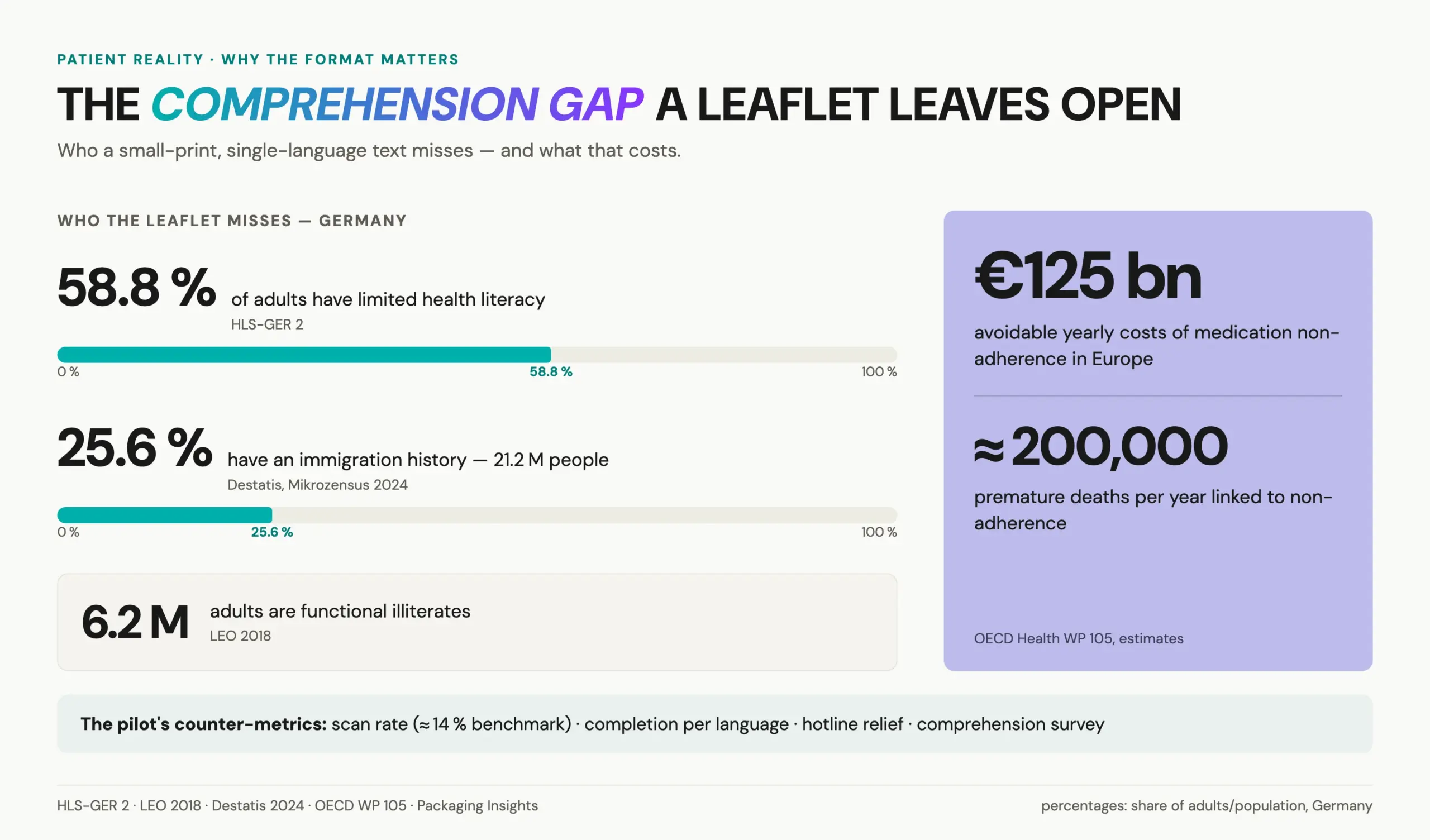
The patient need is well documented. Per HLS-GER 2 (University of Bielefeld), 58.8 percent of people in Germany have limited health literacy, and roughly 6.2 million adults are functional illiterates (LEO 2018, University of Hamburg). The OECD estimates non-adherence causes roughly 125 billion euros in avoidable costs and around 200,000 premature deaths a year in Europe (Health Working Paper 105, 2018), and the WHO puts non-adherence in chronic long-term therapy near 50 percent (2003). A leaflet in small print, in one language, is a weak instrument against numbers like these.
This is where patient education on medication adherence stops being a slogan and becomes a format problem. Comprehension depends not only on what the leaflet says but on whether the patient can read it, in their language, at the moment they hold the pack. A video behind a QR code answers that directly: it shows rather than tells, speaks the patient’s language, and is available at the point of use. The pilot turns that potential into a rollout only if it is designed for expansion from day one: narrow scope, measurable outcomes, and a stakeholder map that mirrors the real approval chain.
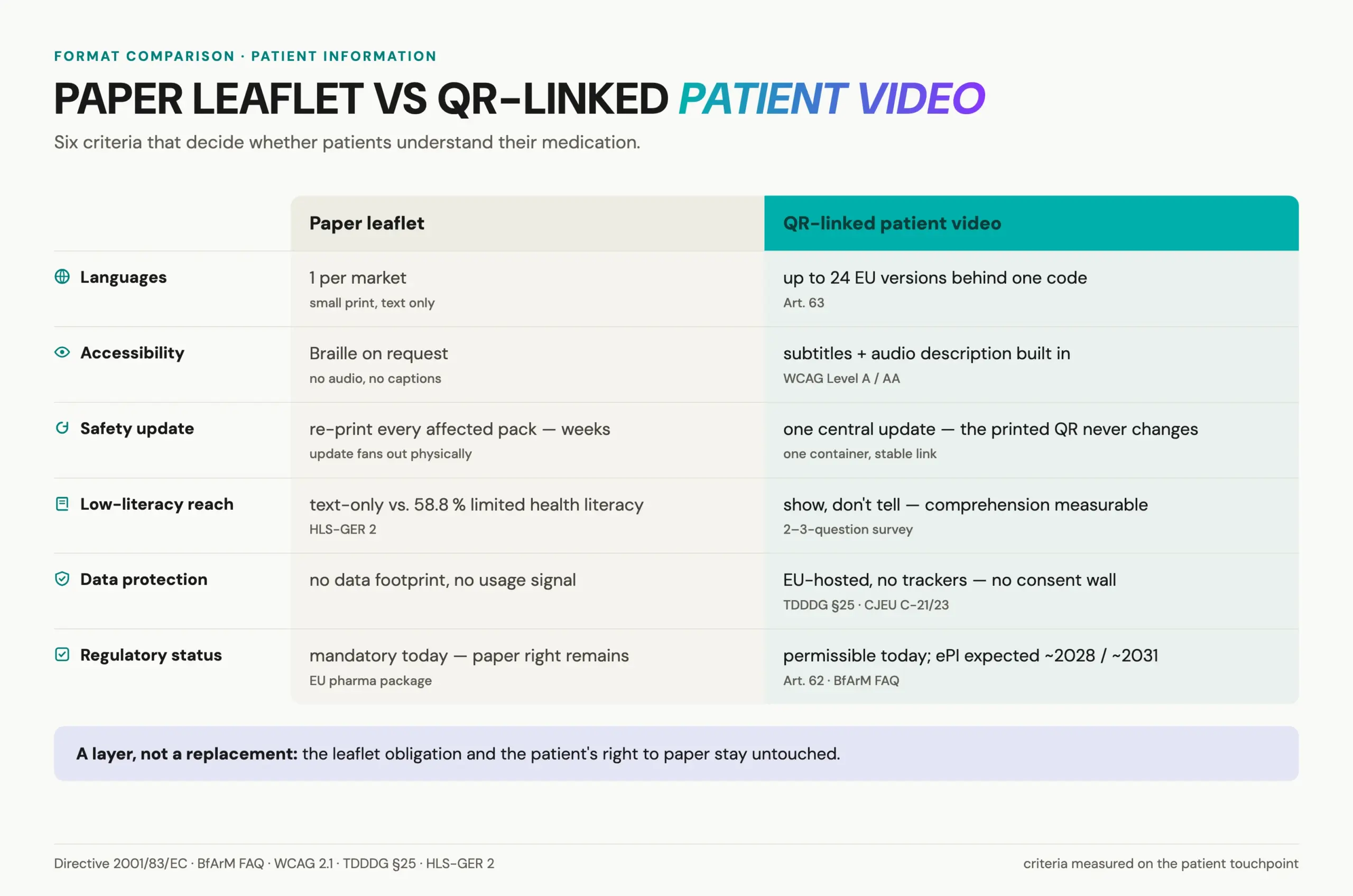
The contrast with the paper leaflet is worth making explicit, because it is the argument your steering committee will test first.
| Dimension | Paper leaflet | QR-linked patient video |
|---|---|---|
| Languages per product | Typically 1 (the market’s official language) | Up to 24 EU languages behind one code |
| Accessibility | Small print; Braille on request (Art. 56a) | Subtitles (WCAG Level A) + audio description (Level AA) |
| Update after a safety change | Reprint and redistribute | Central update once; printed QR unchanged |
| Format for low literacy | Text-only | Show-don’t-tell demonstration |
| Comprehension check | None | Optional post-video survey |
| Cost to add a language | Layout, proofing, reprint | AI video dubbing plus medical review |
The leaflet does not disappear; the video sits on top of it as a comprehension layer, reaching the patients it structurally cannot.
Designing a pharma video pilot that can scale
Scope: one product, one brand, one market
The strongest pilot configuration is deliberately small: one product, one brand, one market. That keeps the regulatory footprint manageable, one variation or notification, one health authority conversation, while still exercising every process you will need later at scale.
Language scope is where the pilot should be ambitious. Producing the video in 5 to 10 languages reflects the patient population: per the German Mikrozensus 2024 (Destatis), 21.2 million people in Germany, 25.6 percent, have an immigration history, and for millions German is not their first language. Broad scope also stress-tests the localisation workflow that becomes the core of every later expansion step. A pilot that only proves you can publish one video in one language proves very little about a 24-language portfolio.
The QR code itself deserves a design decision, not an afterthought. A GS1 Digital Link structure lets the same printed code later resolve batch-specifically or language-specifically once you scale. Treating the code as infrastructure from the first pilot, rather than a static image, keeps the reprint out of every future update.
How much does multilingual video for a pharma video pilot cost?
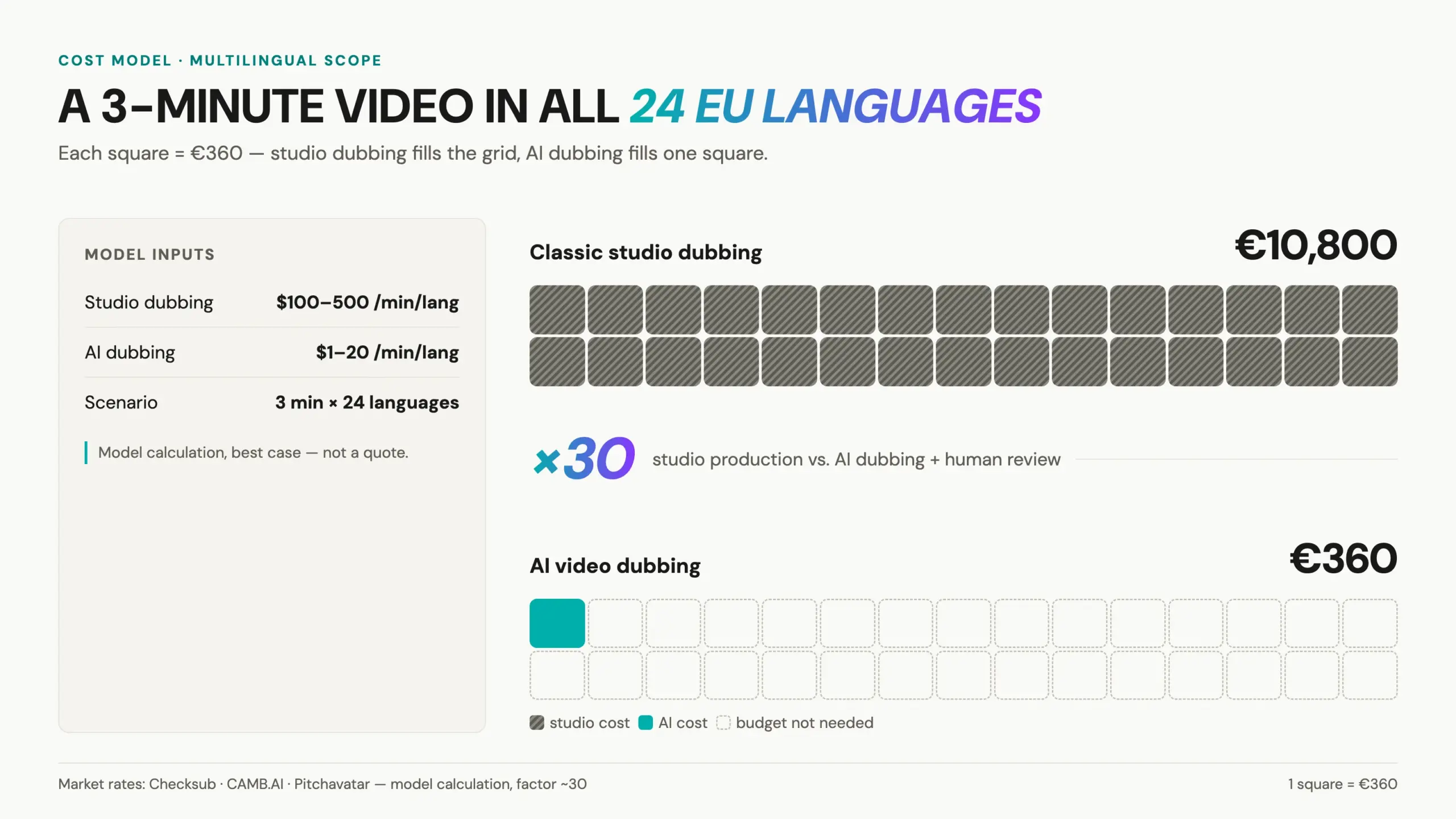
Cost is no longer the blocker it used to be. As a model calculation based on published market rates: classic studio dubbing runs at roughly 100 to 500 US dollars per video minute per language, AI video dubbing at around 1 to 20. For a three-minute video in all 24 EU official languages, that is roughly 10,800 euros versus, in the best case, around 360 euros, a factor of about 30. An illustrative model, not a quote, but the direction is clear: multilingual scope is now a design decision, not a budget fight.
The caveat that keeps this credible in a pharma context is the review step. AI can produce ten language versions in days, but each still passes through medical review before publication. The cost advantage buys reach; the human-in-the-loop workflow keeps that reach compliant. For the mechanics of how machine translation and synthetic voices assemble a multilingual video, our explainer on what AI dubbing is and how it works covers the pipeline the pilot will run on.
Which metrics prove a pharma video pilot worked?
Define the success metrics before the first QR code is printed, and anchor them to questions your steering committee will actually ask. Four metric families have proven useful:
- Scan rate. How many packs led to a scan? Connected-packaging implementations have reported scan rates around 14 percent with 2 to 3 minutes of engagement per session (Packaging Insights, 2023/24 benchmarks). Treat that as an orientation point, not a promise, and set a first-pilot target below it.
- View completion. Scans are curiosity; completed views are comprehension opportunities. Track completion per language to learn which versions your patient population actually needs.
- Hotline and medical information relief. Count product-related calls to your medical information line before and during the pilot. A measurable drop in routine “how do I use this” questions converts patient benefit into an operational number, one of the most persuasive internal arguments.
- Comprehension proxy. A short optional survey after the video (two or three questions on correct usage) gives a comprehension signal without turning the pilot into a clinical study. Keep it anonymous and consent-based, and involve your data protection officer in the design.
One warning on measurement: a QR scan on a medicine pack can plausibly count as health data under Article 9 GDPR. That is a defensible conclusion, not a literal court holding, drawn from the European Court of Justice’s Lindenapotheke ruling (C-21/23, October 2024), which found that even order data for non-prescription medicines qualifies as health data because the mere possibility of inference suffices. A cautious data protection officer will apply exactly that reading. Design your analytics accordingly: no third-party trackers, no consent walls between scan and video, EU-based infrastructure, the same reasoning we lay out for GDPR-compliant video hosting in regulated environments.
alugha’s own measurement of 160 pharma patient-information touchpoints in August 2026 found much the same pattern: 96 of 160 offered only one language, and 77 of 160 loaded US-based trackers before any consent step, precisely what a Lindenapotheke-literate data protection officer would flag first.
For context on where the industry stands, alugha’s own audit of 25 DACH and EU pharma companies in July 2026, scored against the four-pillar readiness test from our companion piece on pilot readiness, found that 23 of 25 published patient information in one language only, the average readiness score was 66 out of 100, just 7 of 25 had a structured patient video at all, and not one company scored strong across all four pillars. That gap is exactly what a well-metered pilot is built to close.
The stakeholder setup: four roles, clearly assigned
Labeling and leaflet processes in pharma are led by regulatory affairs with mandatory involvement of quality, legal, medical and marketing functions. A pilot that ignores this structure stalls. A pilot that mirrors it moves. Four roles need explicit owners:
- Regulatory affairs: the gatekeeper and process owner. Nothing reaches a pack without RA sign-off. RA owns the variation or notification pathway and the health authority dialogue, so bring RA in before the concept phase ends. RA approves but rarely pays; pair this role with a budget owner from the brand or patient engagement side.
- Medical affairs: the content owner. Every script, claim and language version needs medical review. AI can produce 10 language versions in days, but each still passes through medical review before publication. That review step is a feature of the process, not friction.
- Packaging engineering and artwork: the QR owner. The patient-facing QR code is an additional code alongside the mandatory FMD DataMatrix used for verification, which remains untouched (BfArM FAQ). Packaging owns code placement, print quality and artwork versioning.
- IT and the data protection officer: the veto role. Hosting location, player technology and tracking behaviour are approval criteria, not implementation details. Under Section 25 of the German TDDDG, embedded US video players require consent before loading, putting a consent banner between scan and video; an EU-hosted player without third-party tracking avoids that break. Consumer platforms also fail GxP vendor assessments, offering neither audit rights nor a data processing agreement at eye level. Clearing this veto early is cheaper than discovering it in month six.
Enterprise approval groups typically span 5 to 16 stakeholders, and per a 2025 Gartner survey, 74 percent of buying teams show internal conflict. The countermeasure is standard project hygiene: one named owner per role, one steering group, one decision log.
A side note while we are on this lane: alugha posts daily on LinkedIn about EU compliance dates, ePI timelines and multilingual delivery. If that is the cadence your regulatory and packaging teams need, follow alugha on LinkedIn.
Plan the variation, not just the video
Because linked content must remain consistent with the approved product information, the QR code and its linked material follow the regulatory change process: a variation or notification handled by RA, depending on procedure and market. The BfArM’s FAQ confirms that video files and links can be submitted with a dedicated form.
Budget calendar time for this step and treat it as part of the pilot, not overhead. The variation process you exercise once is the same one you will run dozens of times during rollout, so documenting it (timelines, templates, review loops) is one of the pilot’s most valuable deliverables. The pilot’s real output is a repeatable procedure with the edge cases already found.
From one product to the portfolio
The expansion ladder
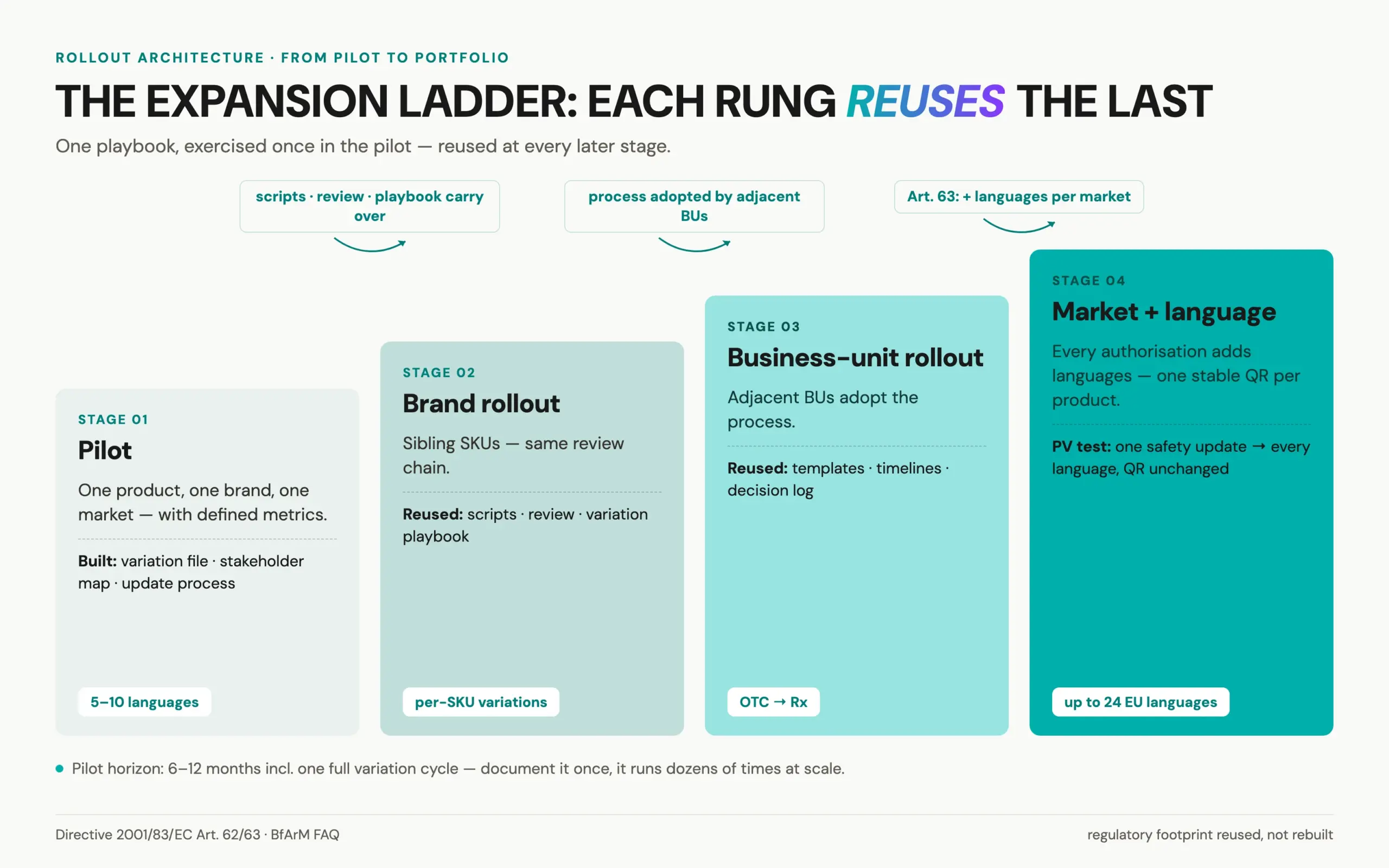
Successful rollouts climb a predictable ladder, and each rung reuses the assets of the previous one:
- Pilot: one product, one market, 5 to 10 languages, defined metrics.
- Brand rollout: extend to sibling SKUs of the same brand. Scripts, review workflows and the variation playbook carry over almost unchanged.
- Business-unit rollout: adjacent BUs adopt the process, typically moving from OTC toward prescription products as confidence grows.
- Market and language expansion: each new country authorisation adds required languages under Article 63 of Directive 2001/83/EC, up to 24 language versions across the EU. A multilingual video layer scales along exactly this axis, making each new market a built-in next step rather than a new project.
Climbing this ladder beats starting fresh each time. Expansion is consistently cheaper than net-new work: a single group can carry five to ten brand or business-unit deployments off one proven process, and the 200-plus languages a mature video layer supports turn every new country authorisation into an incremental step, not a fresh procurement.
Pharmacovigilance updates: the hidden scaling test
Every safety-relevant change to the product information triggers an update obligation across every language version of every video. This is where architectures diverge.
| Separate file per language | One container, one stable link | |
|---|---|---|
| A single safety update means | Dozens of re-uploads and re-links | One central revision |
| The printed QR code | May need reprinting if links change | Never changes |
| Medical review | Per file, tracked manually | Per language, in one place |
| Risk at scale | Compliance backlog | Bounded, auditable |
That single architectural choice, made during the pilot, is what decides whether pharmacovigilance video updates stay manageable at portfolio scale.
Agree the update process with pharmacovigilance and RA during the pilot: who triggers, who revises, who approves per language, and the target turnaround. A rollout without this answer is a compliance backlog waiting to happen.
Where to start: three segments with tailwind
Not every product is an equally good first candidate. Three segments currently combine patient need with regulatory momentum:
- Self-injection biologics and other combination products. Pens and autoinjectors carry the highest instruction complexity, and the MedTech rulebook is already moving away from paper. Under the eIFU regulation, since 16 July 2025 electronic instructions for use are permissible for all medical devices intended for professional users (Implementing Regulation (EU) 2025/1234). A demonstration video is a natural fit where a folded paper insert struggles.
- OTC products. Non-prescription medicines avoid the advertising restrictions that apply to prescription products in lay communication, which simplifies content review, and their high volumes make comprehension gains visible fastest.
- Vaccines and oncology products. The EMA’s draft ePI roadmap (March 2026) foresees a voluntary ePI go-live for vaccines from Q3 2026 and oncology medicines from Q4 2026. A video layer aligns directly with infrastructure these manufacturers are about to build anyway. This is a draft roadmap, not a confirmed mandate.
Momentum across Europe supports an early start: per the AESGP, EFPIA and Medicines for Europe survey published in February 2026, 14 of 31 European countries run active ePI pilots with seven more planned, and in the long-running BeLux hospital pilot, 97 percent of hospital pharmacists reported no problems working without paper leaflets.
Choosing infrastructure that survives the rollout
The pilot decisions that hurt most later are infrastructure decisions; three requirements follow from everything above.
First, EU-sovereign hosting by a provider without a US parent, so the scan-to-video journey works without consent banners and withstands data protection review. A US company’s EU servers do not resolve this: under the CLOUD Act, US authorities can compel access regardless of where the data sits, which is why the distinction is corporate ownership, not server location.
Second, one stable link per product with automatic language selection, holding all audio tracks, subtitles and audio description in a single container, so pharmacovigilance updates and reprints stay decoupled. The automatic language switcher that resolves one link to the viewer’s language is the mechanism that makes the one-container model work at the point of scan.
Third, WCAG-conformant playback, since subtitles are a Level A and audio description a Level AA requirement. Audio description in particular is where many platforms fall short; our guide to audio description covers what conformance actually demands.
The honest counterargument: for a single-market, single-language pilot, a generalist video host or an in-house build can carry the pilot phase, and some teams choose exactly that route. The tradeoff shows up at scale, when 10 languages become 24 and one safety update has to fan out to every version at once.
This combination is the design brief alugha was built around: a multi-audio container holding every language version behind one link and one QR code, AI dubbing with human-in-the-loop review for 200-plus languages, an accessible player, and hosting in Germany by a German company. The infrastructure questions come pre-answered, so the pilot can focus on what actually needs proving: patient impact.
Frequently asked questions
How long should a pharma video pilot run?
A pharma video pilot should run six to twelve months from kickoff to evaluation: long enough to cover one full packaging and variation cycle plus a meaningful measurement window. Procurement and GxP vendor checks add lead time, so plan backwards from your target evaluation date.
Do we need regulatory approval for the QR code itself?
No. Per the BfArM’s FAQ, the QR code as such is not subject to authorisation, and a placeholder can be used in submissions. What must be compliant is the linked content: consistent with the approved product information, non-promotional, and handled through the standard variation or notification process.
Can the video replace the paper leaflet?
Not today. The EU pharma package lets member states decide whether leaflets are provided on paper, electronically or both, and patients retain a right to a paper copy where electronic-only is chosen. The video is a comprehension layer on top of the mandatory product information, not a substitute for it.
Which languages should the pilot include?
Start from your patient population, not your org chart: the local official language plus the most common first languages of patients in that market, typically 5 to 10 in total. Multilingual patient videos are the pilot’s chance to go where the single-language leaflet cannot.
What happens to published videos when safety information changes?
Every language version must be updated. With all tracks behind one stable link, the update runs once centrally, each language passes medical review, and the QR code on packs already in the market keeps pointing to the current version. Per-file architectures turn the same event into dozens of re-uploads.
How does a QR-linked video support medication adherence patient education?
It meets the patient at the point of use, in their language, in a format that shows correct usage rather than describing it in small print. Given that limited health literacy and non-native language are documented adherence barriers, a comprehension layer at the moment the pack is opened targets exactly where paper falls short.
Is AI video dubbing accurate enough for regulated patient content?
Accuracy is answered by process, not just the model. AI produces the draft language versions quickly and cheaply, then each passes medical review before publication. That human-in-the-loop step is what makes AI video dubbing usable for regulated content: the speed comes from automation, the compliance from review.
What is the difference between a pilot and a full rollout?
A pilot deliberately limits scope to one product in one market while exercising every process (regulatory variation, medical review, packaging, data protection, pharmacovigilance) that a rollout uses at scale. The rollout then reuses those proven processes and assets across sibling products, business units and additional markets.
How does the EU pharma package change the timeline?
The package agreed politically in December 2025 is expected to make ePI mandatory for newly authorised medicines from around 2028, with existing products following by roughly 2031. It does not require video, but it makes electronic, updatable product information the default. A video layer built during a 2026 or 2027 pilot slots into that infrastructure rather than competing with it.
Does the eIFU regulation apply to medicines or only devices?
The eIFU regulation (Implementing Regulation (EU) 2025/1234) covers medical devices for professional users, not medicines. It matters here because combination products like autoinjectors sit at the device-medicine boundary, and the regulatory direction of travel toward electronic instructions makes them strong first candidates for a video pilot.
—
Does a pharma video pilot actually improve medication adherence and patient education?
Indirectly, yes, and it is measurable. The WHO’s widely cited estimate is that roughly half of patients with chronic conditions in developed countries do not take medicines exactly as prescribed, part of why the OECD ties non-adherence to an estimated EUR 125 billion in avoidable costs across Europe each year. A pilot cannot prove causation by itself, but a drop in routine hotline questions and a positive comprehension-survey trend give patient education a number your steering committee can act on.
How accurate is AI video dubbing for pharma patient videos?
Accurate enough for pilot use when human medical review sits after every language version, not instead of it. AI dubbing gets tone, terminology and lip-sync close on a well-written script, which is why the cost comparison above assumes AI dubbing plus review rather than AI dubbing alone. Medical affairs still signs off on every language before it reaches a patient.
This article is part of alugha’s Pharma QR Code Patient Information series on compliant multilingual video.