
Key takeaways
- GDPR video hosting for pharma is an architecture decision, not a plugin choice. The moment a viewer arrives by scanning a medicine package, the file stops being marketing content and becomes a processing question a data protection officer has to sign off.
- The scan itself can be health data. After the CJEU’s Lindenapotheke ruling, even order data for non-prescription medicines counts as Article 9 health data because inference is possible. Reading a package scan the same way is our conclusion, not the court’s, but it is the conservative assumption a release committee will work with.
- The transfer basis under US platforms is structurally unstable, not illegal. The EU-US Data Privacy Framework is the third transatlantic arrangement in ten years, is already before the CJEU, and was further destabilised by the US Supreme Court in June 2026. It is formally valid today. Its two predecessors both collapsed overnight.
- EU data residency from a US vendor changes latency, not jurisdiction. Under the CLOUD Act, a US parent company can be compelled to produce data regardless of server location. The only structural answer is a European provider with no US parent.
- A consent wall in front of patient information defeats the channel’s purpose. Section 25 TDDDG forces a consent dialog before a third-party player loads. The patients the video exists for, older, lower-literacy, second-language readers, are exactly the ones a legalese banner turns away.
- A compliant setup already exists and is not exotic. EU hosting under an EU parent, a player with no third-party trackers, one link per product resolving language automatically, subtitles and audio description built in. alugha is built on that model.
Consumer video platforms are very good at what they were built for. YouTube runs a global delivery network no European provider attempts to match, and Vimeo’s encoding pipeline is excellent. Nobody in digital patient communication should pretend otherwise, and I will not.
Picture the actual moment: a brand manager pastes a YouTube embed code into the product page behind a package QR code, ships it before the next sprint review, and only then does legal ask whether that counts as GDPR video hosting or an open door to a data protection complaint. That question, asked six weeks too late, is the one this article answers before it gets asked.
The question a pharmaceutical company has to answer is a different one. It is not “which player has the best reach?” It is “which infrastructure survives a data protection review when the content is patient information and the viewer arrived by scanning the QR code on a medicine package?”
GDPR-compliant video hosting for pharma means keeping patient-facing video on infrastructure whose data location, corporate ownership, transfer basis, consent behaviour, and vendor auditability all pass a data protection review at once. For a channel reachable from a medicine package, that is a stricter test than any consumer platform was designed to meet.
The gap between those two questions is where QR-to-video projects in pharma quietly die: not in a courtroom, but in an internal release meeting where legal, regulatory affairs and the data protection officer look at the same architecture diagram and cannot sign it off.
This article walks through that review the way a release committee would: not as a legal opinion but as a risk assessment, because that is what your DPO will actually produce. If you want the general enterprise version of the argument first, our pillar on GDPR-compliant enterprise video hosting sets out the processing-versus-publishing distinction that everything below builds on.
GDPR video hosting means playing patient-facing video without sending viewing data to a platform outside the EU’s legal reach, and without loading trackers before the visitor consents. For pharma, that means EU-owned infrastructure, no third-party cookies before consent, and a data processing agreement a GxP audit can actually accept.
The scan itself is the sensitive event
Start with the moment that makes pharma different from every other industry putting QR codes on packaging.
When someone scans the code on a cereal box, the platform learns that a person looked at cereal. When someone scans the code on a medicine package, the platform can learn that a specific device, at a specific location, at a specific time, requested information about a specific drug. That is not marketing telemetry. That is a data point from which a health condition can be inferred.
The European Court of Justice has already shown how strictly it reads this category. In the Lindenapotheke ruling (CJEU, C-21/23, October 2024), the court held that order data for pharmacy-only medicines counts as health data under Article 9 GDPR even when the medicines are non-prescription, because the mere possibility of inferring something about a person’s health is enough. It added a second finding that gets too little attention: competitors can bring GDPR violations to court under unfair competition law.
Does a QR scan on a medicine package really count as health data?
The CJEU has not ruled on that exact question. Its Lindenapotheke judgment concerned pharmacy order data, not package scans. Treating a scan as Article 9 data is our own conclusion, not the court’s. But it follows the court’s stated logic almost mechanically. If ordering an over-the-counter nasal spray is health data because of what it might reveal, a scan that says “this person holds this medication in their hand right now” is hard to argue into a less protected category. A release committee will not bet the project on that argument, and neither would I.
Why this question lands now, not in some future compliance cycle
There is a reason pharma teams are having this conversation in 2026 rather than shelving it. Two clocks are running at once.
The first is regulatory. The EU pharmaceutical package reached political agreement in December 2025, the largest reform of EU medicines law in over two decades. Electronic product information becomes mandatory for new authorisations from roughly 2028, with existing products following by roughly 2031. The EMA’s 2025 reflection paper describes exactly this interaction: a 2D code on the box resolving to patient information. QR codes on packaging are already permitted today for approval-compliant content, including video. The infrastructure decision you make now will still be carrying patient traffic when the mandate arrives.
The second clock is human. Non-adherence to medication is estimated by the OECD to cost European health systems around EUR 125 billion a year and to contribute to roughly 200,000 premature deaths. Around 58.8% of adults in Germany have limited health literacy, and millions read German as a second language. A video explaining how and when to take a medicine is not a nice-to-have on this evidence. It is a genuine intervention, which is exactly why the channel carrying it cannot be the weak point in a data protection review.
The legal ground under US transfers keeps moving
Assume for a moment the scan-data question were settled. The transfer question is not.
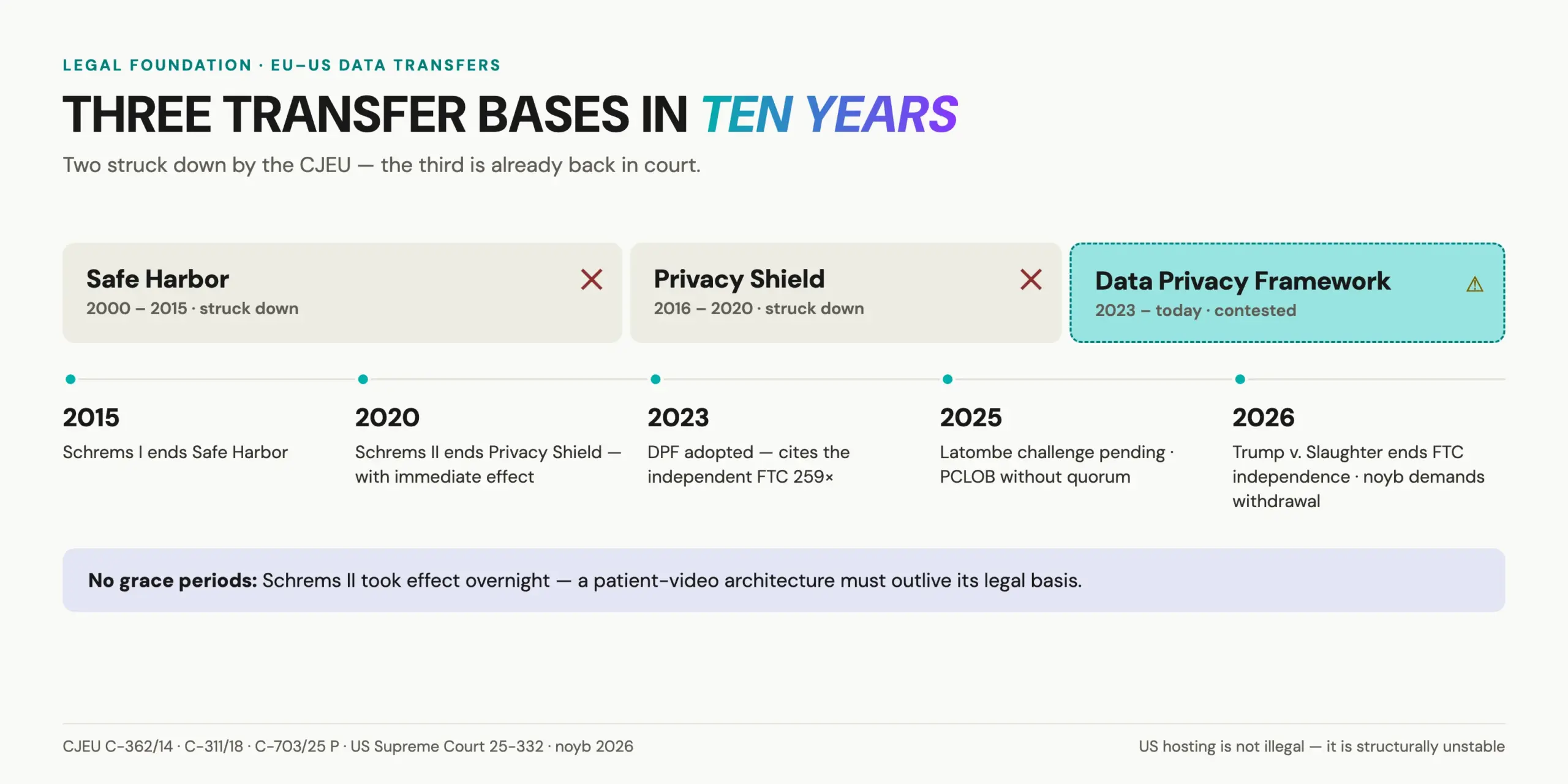
Data flowing to a US-owned platform currently rests on the EU-US Data Privacy Framework, the third legal basis for transatlantic data transfers in ten years. The first two, Safe Harbor and Privacy Shield, were both struck down by the CJEU. The third is already before that same court (Latombe, C-703/25 P, pending since October 2025), and there is no grace period built into any of this. When Schrems II ended Privacy Shield in 2020, it ended it with immediate effect. The mechanics of that instability are worth understanding in their own right, which is why we treat data sovereignty and Schrems II for enterprise video as its own topic.
Then came June 29, 2026. In Trump v. Slaughter, the US Supreme Court ruled that the FTC’s independence from the president is unconstitutional. Why does an American administrative law case matter in Mannheim or Basel? Because the EU’s adequacy decision for the Data Privacy Framework references the independent FTC 259 times. The privacy oversight board (PCLOB) that the framework also relies on has lacked a quorum since January 2025. Within days, noyb sent the European Commission a formal demand to withdraw the framework and announced a CJEU challenge (noyb, 2026).
What is the Data Privacy Framework and why is it called unstable?
The Data Privacy Framework is the adequacy arrangement that lets EU personal data flow to certified US companies without extra safeguards. It is called unstable because its two predecessors were both annulled by the CJEU, it is under fresh legal challenge, and the US oversight bodies it depends on have been weakened by domestic rulings. It is valid today. It has never been durable.
None of this makes US hosting illegal. The framework is formally valid as I write this, and honesty requires saying so. It makes US hosting structurally unstable: a legal construction whose two predecessors failed, whose current version is under attack from two directions at once, and whose collapse would take effect overnight. An architecture decision for a patient information channel has a lifespan of five to ten years. The legal basis it stands on has never lasted that long.
Consent walls where patients expect answers
There is a third layer, and it applies even if the framework holds.
Under Section 25 of the German TDDDG, embedding a third-party player that stores or reads anything on the user’s device requires consent before the player loads. The supervisory authorities’ prevailing position, stated among others by the data protection authority of Baden-Württemberg, is that YouTube’s “nocookie” domain does not remove this obligation. The German federal data protection commissioner instructed federal agencies in a 2023 circular to embed video in a compliant way and announced compliance checks (BfDI, December 2023).
Translate that into the patient’s experience. A 74-year-old scans the code on her blood pressure medication because the package promises a video explaining how to take it. What she gets first is a consent dialog asking her to accept data transfers to a US corporation, in the same legalese she hoped the video would spare her. This is the audience the video exists for: older patients, people with limited health literacy, people reading in their second language. A consent wall in front of patient information is not a formality for them. It is the end of the session.
The precedent already exists. The European Data Protection Supervisor formally reprimanded the European Parliament in January 2022 because a COVID test booking site used Google Analytics and a US payment provider without equivalent safeguards (EDPS, 2022). No fine was issued. A reprimand was enough to establish the template: health context plus US embed equals finding.
A European player that sets no third-party trackers needs none of this. One scan, one video. The compliance architecture and the patient experience stop being opposites.
We tested this ourselves. Across 160 DACH pharma touchpoints measured in August 2026, 77 loaded a US tracker before consent, 13 loaded a US video platform before consent, Vimeo more often than YouTube, and 96 offered only one language. The consent wall is not a theoretical risk case. It is the default configuration.
US consumer platform versus EU-sovereign player, dimension by dimension
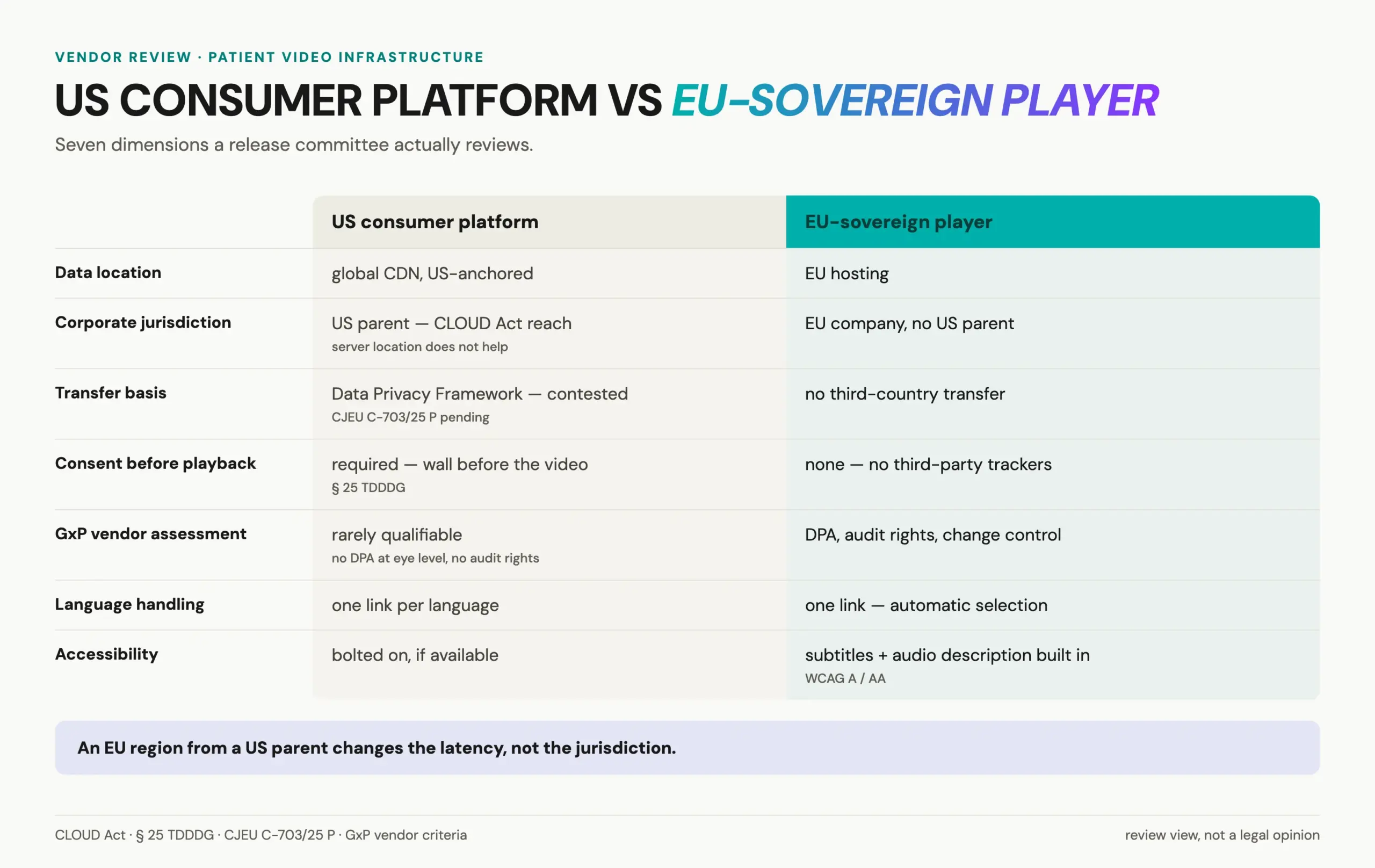
Most SERP results on this topic compare features. A release committee compares exposure. Here is the same decision laid out the way a DPO would score it.
| Review dimension | US consumer video platform | EU-sovereign player |
|---|---|---|
| Data location | Global CDN, US-anchored | EU hosting |
| Corporate jurisdiction | US parent, CLOUD Act reach | EU company, no US parent |
| Transfer basis | Data Privacy Framework (contested) | No third-country transfer needed |
| Consent before playback | Required under Section 25 TDDDG | None, no third-party trackers |
| Health-context precedent | EDPS reprimand template applies | Outside the template |
| GxP vendor assessment | Rarely qualifiable | DPA, audit rights, change control |
| Language handling | One link per language, or manual | One link, automatic language selection |
| Accessibility | Bolted on, if available | Subtitles and audio description built in |
No single row is fatal on its own. The problem is the column. Every dimension where a consumer platform is convenient is a dimension where a patient-information channel is exposed.
Why an EU server from a US provider does not close the file
The standard rebuttal at this point in the meeting is: “Our US vendor offers EU data residency.” It sounds like a solution. It is a smaller improvement than it appears.
The CLOUD Act obliges US companies to produce data in their possession, custody or control regardless of where the servers stand. Anton Carniaux, director of public and legal affairs at Microsoft France, testified under oath before a French Senate inquiry in June 2025 that he could not guarantee data of French citizens would never be handed to US authorities without French consent (Forbes, July 2025). That testimony concerned a hyperscaler’s EU-hosted infrastructure; every US-owned platform operates under the same framework.
Does EU data residency from a US provider solve the problem?
It shortens the network path, not the legal one. Under the CLOUD Act, US-parented companies can be compelled to produce data regardless of server location. A structural answer requires a European provider with no US parent company, which is the whole point of made-in-Germany secure video hosting.
An EU data center owned by a US parent changes the latency, not the jurisdiction. A DPO reviewing vendor architecture knows this distinction, which is why “EU region selected” satisfies procurement checklists and fails vendor assessments.
There is a related, more mundane problem: consumer platforms are generally not qualifiable in a GxP vendor assessment at all. No negotiated data processing agreement on equal terms, no audit rights, no change control. The review does not even reach the transfer question.
What the enforcement record actually shows
I want to be careful here: this is where vendors reach for fear, and fear is a poor basis for architecture decisions.
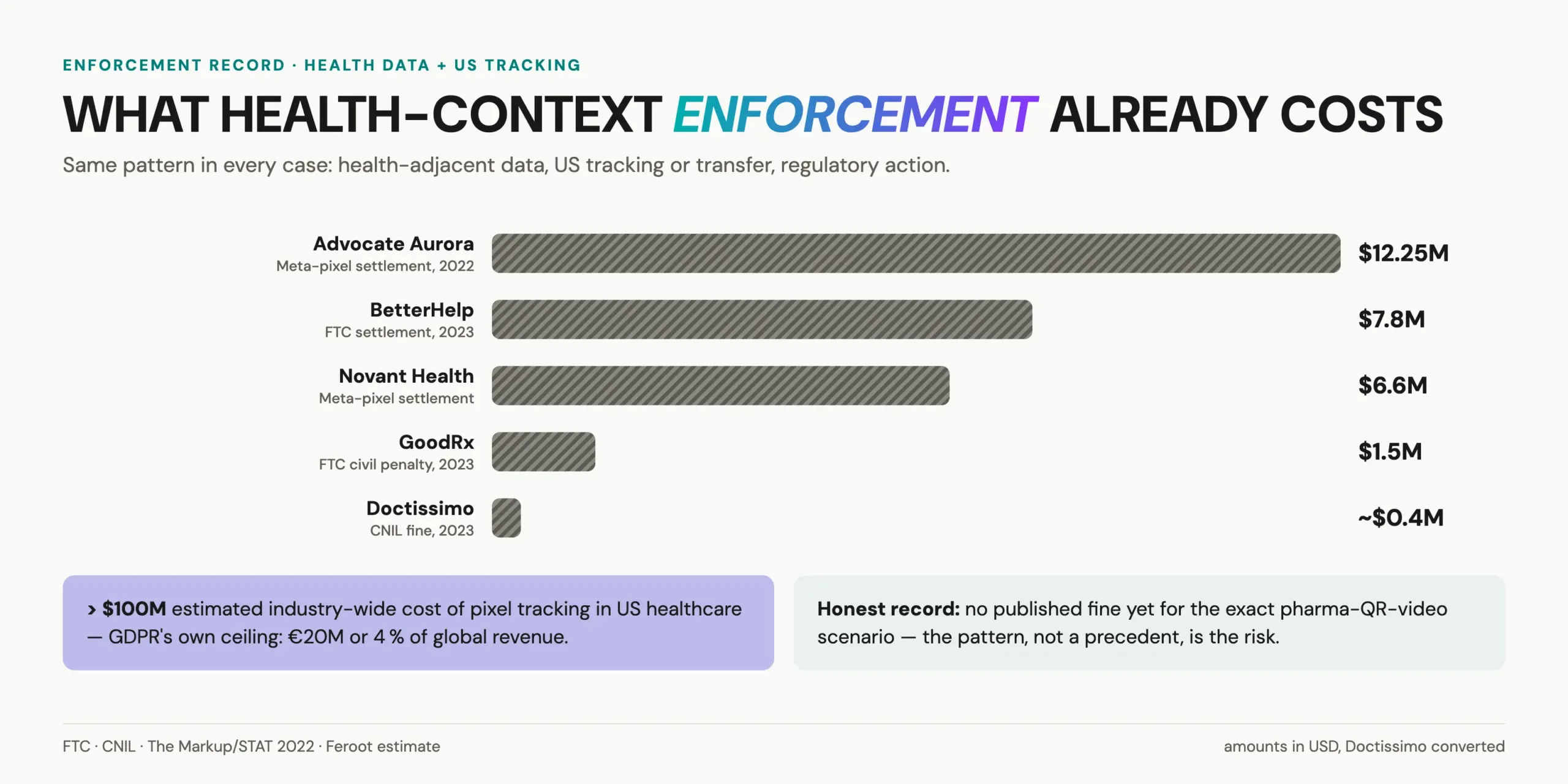
The sober record: the FTC imposed a 1.5 million dollar civil penalty on GoodRx in 2023 for sharing medication search data via advertising pixels, the first enforcement of the Health Breach Notification Rule. BetterHelp settled with the FTC for 7.8 million dollars the same year. In France, CNIL fined the health portal Doctissimo 380,000 euros in 2023. Researchers found the Meta pixel on 33 of the top 100 US hospital websites (The Markup/STAT, 2022), and the resulting settlements, including Advocate Aurora at 12.25 million dollars and Novant Health at 6.6 million dollars, have pushed the industry-wide cost of pixel tracking in US healthcare past an estimated 100 million dollars (Feroot). The GDPR’s own ceiling is 20 million euros or four percent of global annual revenue, whichever is higher.
Our own audit adds a data point to that pattern. Of 25 pharma groups we reviewed in July 2026, 6 ran a US video platform before consent and 19 carried at least one US tracker. That is the same architecture named in the enforcement cases above, already the default in roughly a quarter of the industry. It is also why the four-pillar readiness test we introduced earlier in this series treats tracker-free hosting as a precondition, not a nice-to-have.
Now the honest concession: there is, to date, no published fine for the specific scenario “pharmaceutical company embeds a US video player behind a package QR code.”
But look at what a release committee does with that fact. The pattern in every case above is the same: health-adjacent data, US tracking or transfer infrastructure, regulatory action. The committee is not asked to predict which case becomes the precedent, only a simpler question: given that a compliant alternative exists, why take this risk at all? On a project built to earn patient trust, that question answers itself. The absence of a precedent is not a safety margin. It is an invitation to become one, with competitors newly entitled, after Lindenapotheke, to bring the claim themselves.
GDPR video hosting for pharma is an architecture decision
Here is the concession I opened with, completed. US platforms are not bad products. For brand marketing, congress recordings, recruiting videos, they are often the rational choice, and a pharma company that uses them there is not being reckless.
Patient information is a different asset class. It carries Article 9 exposure at the moment of the scan, a transfer basis with a documented failure history, a consent obligation that damages exactly the users the channel is meant to serve, and a jurisdiction question that server location cannot resolve. Each of these is manageable in isolation. Stacked, they turn every internal review into a negotiation, and every geopolitical headline into a re-review.
That list will only get longer. The EU’s parallel shift to mandatory electronic product information is phasing in from roughly 2028 to 2031 depending on product category, adding a second regulatory clock running alongside the data protection one. We cover what that timeline means for video assets in our ePI timeline piece.
The alternative is not exotic. European hosting under a European parent. A player that loads without third-party trackers. One link per product that resolves to the right language automatically, so a single code on the box can serve up to two dozen EU language versions without a menu, the pattern we describe under automatic language switching. Subtitles and audio description built into the file rather than bolted on, not run as a separate project. AI dubbing produces those language tracks at a fraction of studio cost. That is the architecture we built alugha around, and it is why our QR-to-video conversations with pharma teams start with the DPO relaxed instead of alarmed.
If you want to pressure-test this against your own setup, talk to our team, and I will happily lose the deal where a US platform genuinely is the better fit. For patient information reachable from a medicine package, I have not seen that case yet.
Frequently asked questions
Is GDPR video hosting for pharma possible on US platforms at all?
It is not prohibited, and claiming otherwise would be wrong. It is a risk position. Transfers rest on the Data Privacy Framework, which is under legal challenge (CJEU case C-703/25 P) and further destabilised by Trump v. Slaughter (2026), while Section 25 TDDDG forces a consent dialog before the player loads. Most pharma release committees conclude the risk is not worth taking when compliant EU alternatives exist.
What makes patient video different from ordinary corporate video?
The arrival context. A package scan can reveal that a specific person holds a specific medicine, which after Lindenapotheke is best treated as Article 9 health data. Ordinary corporate video rarely carries that inference. The special category raises the stakes on every downstream question: transfers, consent, retention, and who can be compelled to hand the data over.
Is the EU-US Data Privacy Framework still valid?
Yes, as of writing. It has not been annulled. The honest framing is that it is valid but fragile: two predecessor frameworks were struck down by the CJEU, the current one is under challenge in case C-703/25 P, the PCLOB has lacked a quorum since January 2025, and the June 2026 Trump v. Slaughter ruling undermined the FTC independence the adequacy decision relies on 259 times.
Why is a consent banner such a problem for patient videos?
Because it lands on the wrong audience at the wrong moment. Section 25 TDDDG requires consent before a third-party player loads. The people scanning a medicine package are disproportionately older, lower-literacy, or second-language readers. A US-transfer consent dialog in front of the video is precisely the friction that ends their session, defeating the adherence purpose the channel was funded for.
Has any pharma company actually been fined for this exact setup?
No published fine exists for “pharma company embeds a US video player behind a package QR code.” Anyone claiming otherwise is overstating the record. What exists is a consistent enforcement pattern around health-adjacent data plus US tracking or transfer infrastructure: GoodRx, BetterHelp, Doctissimo, the hospital pixel settlements. The absence of a precedent is not protection when a compliant alternative is available.
What should a compliant patient video setup look like?
No third-party trackers, so the video plays without a consent wall. Hosting and corporate ownership inside the EU. One link per product that resolves language automatically, with subtitles and audio description for accessibility. And a vendor that can pass a GxP assessment: data processing agreement, audit rights, documented change control.
Can AI dubbing be part of a compliant pharma video workflow?
Yes, provided the processing stays on EU-sovereign infrastructure. AI dubbing is how a single source video becomes up to two dozen EU language tracks without a studio for each one. The compliance question is not whether dubbing is automated but where the audio and voice data are processed and who owns the company doing it. Keep both inside the EU and the language layer inherits the same protection as the hosting layer.
How does the ePI transition change the urgency?
The EU pharmaceutical package agreed in December 2025 makes electronic product information mandatory for new authorisations from roughly 2028 and existing products by roughly 2031. Package scans resolving to patient information move from optional to expected. Infrastructure chosen now for a QR-to-video pilot will still be carrying regulated patient traffic when the mandate lands, so the data protection review is worth doing properly the first time.
—
Is a YouTube nocookie embed GDPR-compliant for pharma video?
No, not on its own. German supervisory authorities, including the LfDI Baden-Württemberg, take the position that YouTube’s nocookie domain does not remove the Section 25 TDDDG consent requirement, because the obligation attaches to loading the third-party player itself, not to which cookies it happens to set. A nocookie embed still needs a consent gate before it loads.
This article is part of alugha’s Pharma QR Code Patient Information series on compliant multilingual video.