Key takeaways
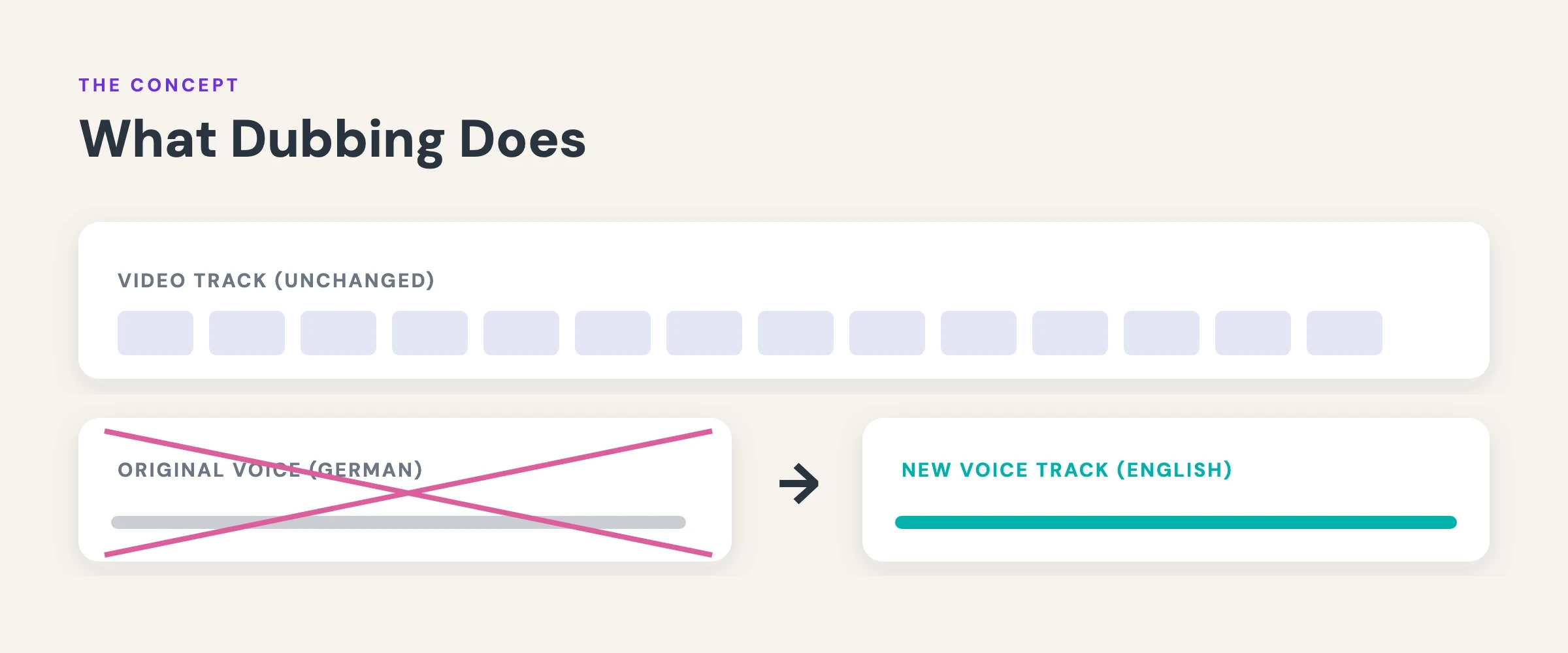
- Dubbing replaces the original voice track — a new recording in the target language takes the place of the source audio, so viewers listen instead of reading.
- Lip sync is the visual benchmark — the closer the new voice matches the on-screen mouth movement, the less the audience notices the replacement.
- Studio dubbing prices by the human hour — translators, adaptation writers, voice actors, directors, and mixing engineers all scale with runtime, cast size, and language count.
- AI dubbing collapses the pipeline into software — speech-to-text, machine translation, and text-to-speech produce a voice track in hours rather than weeks.
- Dubbing and subtitles solve different problems — the comparison table below maps viewer experience, cost, accessibility, and production time for both approaches.
Skip the studio quote for your first test. alugha plans include monthly credits for the AI dubbing workflow this guide describes. See alugha plans ?
What is dubbing? A working definition
Dubbing is the replacement of a video’s original voice track with a newly recorded voice track, usually in another language. The picture stays untouched. Only the audio changes. A viewer in Madrid watches the same footage as the audience in London but hears Spanish dialogue timed to the actors’ lips and pauses. That single substitution carries most of the world’s film and television across language borders, and it increasingly carries corporate training, e-learning, and product video as well. It is also serious economics: dubbing and subtitling sit inside a global language-services industry that market researcher Nimdzi sized at $72.6 billion in 2025. This guide answers what is dubbing in practical terms: where the craft comes from, what lip sync and ADR actually mean, how a studio production runs, and what changes when AI dubbing trades the recording booth for software.
Two readers usually arrive at this topic from opposite directions. A creator wants to know whether an AI voice track can open a second language market without a studio budget. An enterprise team wants to know whether dubbed training videos will hold up in front of employees in twelve countries, and what the workflow costs at that scale. Both routes run through the same fundamentals, so the definitions come first and the production economics follow.
A short history of dubbing
Why Germany, Spain, France, and Italy dub
Sound film created the problem in the late 1920s. A silent film crossed borders cheaply: swap the intertitle cards and the story played anywhere. Talkies ended that portability overnight. Studios tried the brute-force fix first, re-shooting entire films scene by scene in foreign-language versions, and the approach collapsed under its own cost within a few years. Dubbing emerged as the cheaper industrial answer, and the largest European language markets built permanent industries around it.
Germany, Spain, France, and Italy could spread the cost of a full studio dub across tens of millions of viewers, so the arithmetic worked. Language policy in several of those countries during the 1930s reinforced the habit, and audience expectation did the rest. Today a German cinema audience treats the dubbed version as the film itself, served by a professional voice-acting industry in which a well-known international actor keeps the same German voice for decades. The voice becomes part of the star.
Why the Netherlands and Scandinavia subtitle
The subtitling countries ran the same arithmetic and reached the opposite answer. The Netherlands, the Scandinavian countries, and Portugal serve smaller language communities. A full dub costs roughly the same to produce for a small market as for a large one; subtitles cost a fraction of either. Spread across fewer viewers, the dub never paid for itself. Subtitling became the norm, and generations of viewers grew up reading their television without thinking of it as reading. EU survey data puts numbers on the habit: over 90% of respondents in Sweden, Finland, Norway, Denmark, and the Netherlands prefer to watch foreign films with subtitles, against under 20% in Germany. The split that looks cultural today began as production economics. In short: large language markets could afford to dub, small ones could not, and both habits hardened into viewer expectation.
Key dubbing terms explained
Lip sync meaning
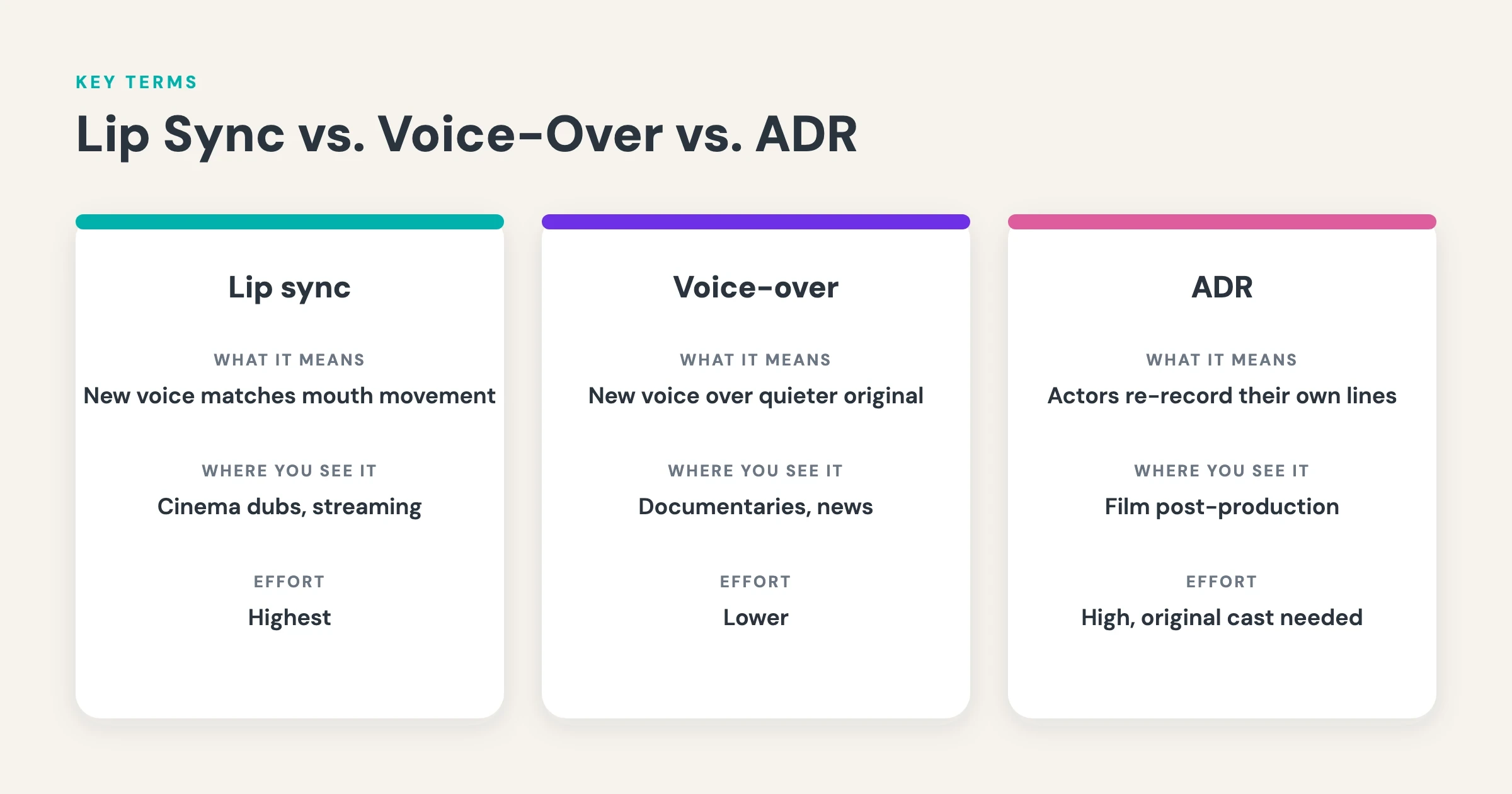
Lip sync, short for lip synchronization, means matching a recorded voice to the visible mouth movements of the person on screen. In dubbing, lip sync describes how closely the translated dialogue follows the timing, the pauses, and the mouth shapes of the original performance. Good lip sync lets the viewer forget the voice was ever recorded in a studio. Poor lip sync is the mismatch an audience spots within seconds.
Studio dubbing employs specialist adaptation writers for exactly this reason. They rewrite the translation until it fits the actor’s mouth: a line that opens on a visible “m” or “b” needs a target-language word that closes the lips on the same frame. Fidelity to the picture beats fidelity to the dictionary, so the adaptation often drifts from the literal translation to protect the illusion.
Voice-over vs. dubbing
Voice-over lays a new voice on top of the original audio instead of replacing it. The original speaker stays audible at low volume underneath the narration, a convention every viewer knows from documentaries and news interviews. Dubbing removes the original voice entirely and substitutes a performance that aims to sound native to the footage. Voice-over makes no attempt at lip sync, which keeps it fast and cheap to produce. Dubbing carries the full illusion. Most AI voice tracks technically sit between the two, a distinction that matters later in this guide.
ADR: re-recording dialogue, not translating it
ADR stands for automated dialogue replacement, and it is a same-language technique rather than a translation step. Actors return to the studio after filming to re-record lines that location audio ruined: traffic, wind, an aircraft passing overhead. The new take is synchronized to the existing picture, which is precisely the mechanical skill dubbing applies across languages. Film crews sometimes call the process looping. Understand ADR and you understand the recording half of dubbing.
How traditional studio dubbing works
The studio workflow
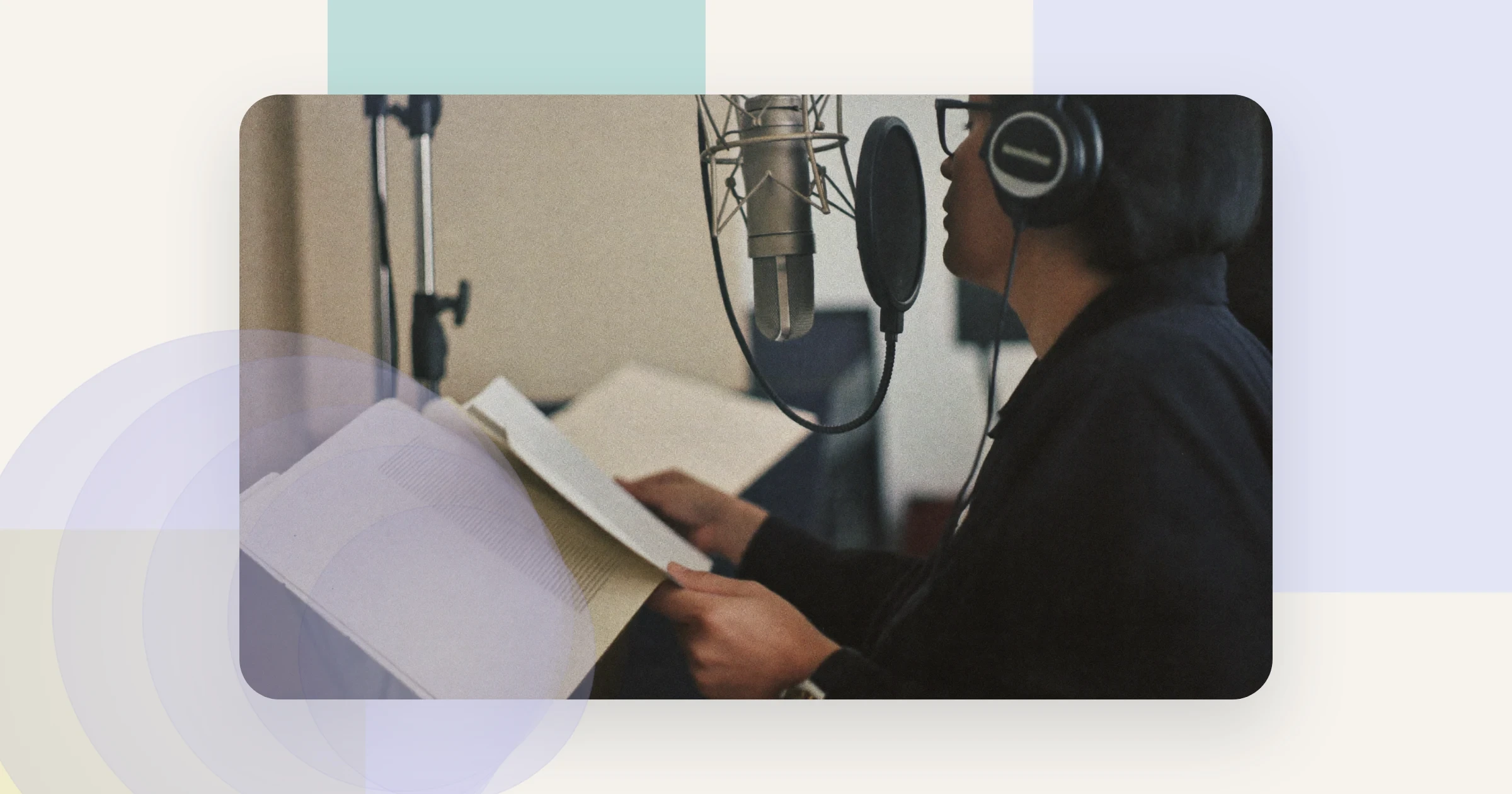
A studio dub is a relay of specialist human work. Translation comes first. Dialogue adaptation follows, with a writer reshaping every line to fit the on-screen mouth movements. Casting matches target-language voices to the original actors, and recording sessions put a dubbing director in the booth to guide each voice actor line by line against the picture. Editors synchronize the takes; a mixing engineer blends the new dialogue with the music-and-effects track, the version of the soundtrack that contains everything except the original voices. No stage can be skipped, because each one feeds the next. The result, at its best, is a performance an audience accepts as native.
What drives the cost
Studio dubbing prices by the human hour, and the hours multiply along three axes. Runtime is the first: every stage of the pipeline scales with the length of the video. Cast size is the second, because each speaking role needs its own casting, its own sessions, and its own direction. Language count is the third and steepest, since every additional language repeats the entire pipeline from adaptation to final mix. A ten-language studio rollout is not one production with ten outputs; it is ten productions. In short: the craft is priced per minute, per voice, and per language, which is why full studio dubbing has historically been reserved for content with cinema-scale returns.
Put a number on the alternative before you request a studio quote. alugha plans include monthly credits for speech-to-text, translation, and AI voice-over, so the cost of a language track is visible before you confirm it. Compare alugha plans ?
AI dubbing: how text-to-speech voice-over works
The AI dubbing pipeline
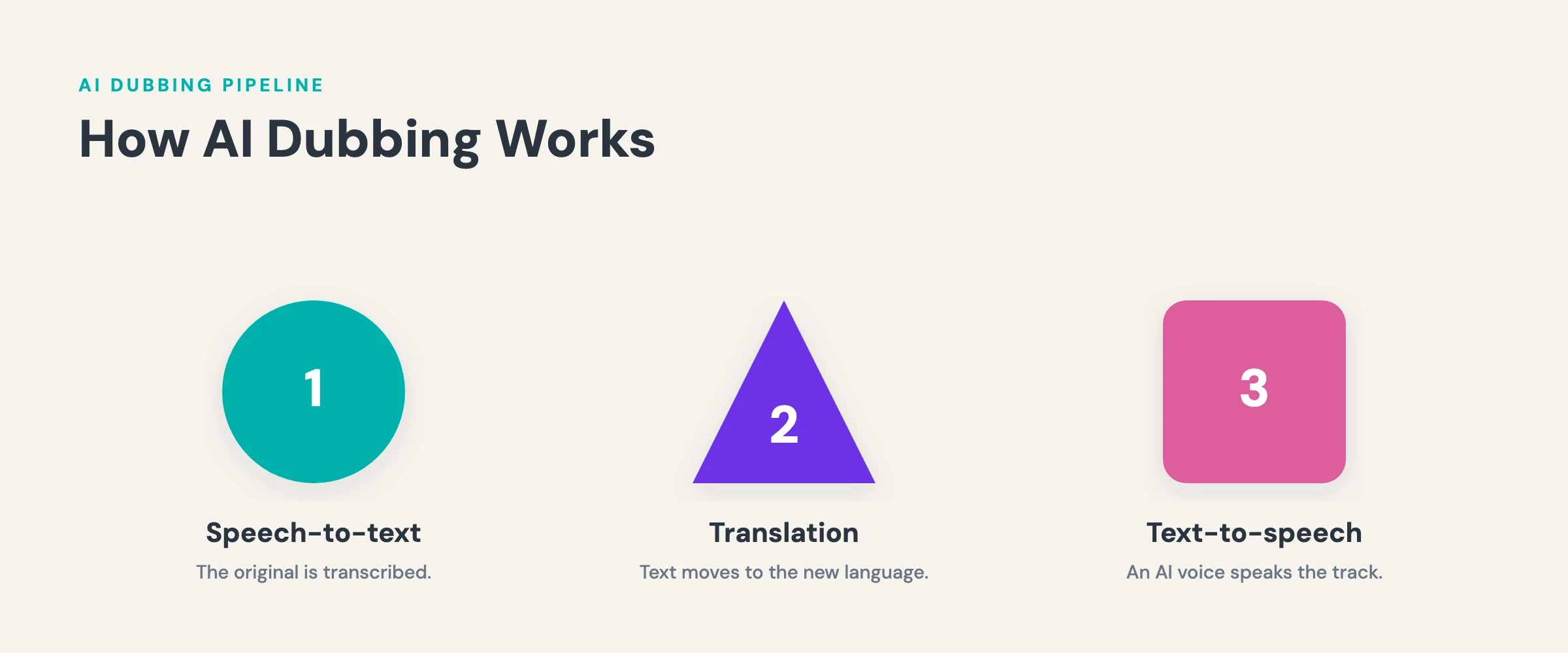
AI dubbing compresses the studio pipeline into three software stages. Speech-to-text converts the original audio into a time-coded transcript, the same step you would use to transcribe your video for subtitles or documentation. Machine translation carries that transcript into the target language while keeping the timing information intact. Text-to-speech then renders the translated script as a synthetic voice track aligned to the original timing. The stages mirror the studio sequence of translation, adaptation, and recording, with software standing in for the booth. Platforms that offer the full chain let you translate a video and generate its voice track in one workflow instead of shuttling files between tools.
What AI dubbing does well
Speed and scale are the structural advantages. A pipeline that runs as software can produce a dozen language tracks in the time a studio needs to schedule its first casting session, and each additional language adds compute rather than a full production crew. Modern text-to-speech has also closed much of the old quality gap. alugha’s text-to-speech draws on 400+ AI voices, voice cloning can preserve the original speaker’s identity across languages, and emotion cloning carries the tone of the delivery rather than flattening it into a neutral reading. For instructional and corporate content, where the value sits in the information, the results are publishable at a cost structure studios cannot match. The audience follows: YouTube reported in September 2025 that creators who publish multi-language audio tracks see over 25% of their watch time come from views in a language other than the video’s original. That shift is why AI video dubbing has moved from novelty to standard practice for business video.
The honest limitations
The limits are worth stating plainly, and they cluster in two places. Emotional performance is the first. A directed voice actor builds a performance take by take; synthetic voices reproduce tone convincingly but do not yet replace a dramatic performance in fiction, which is why theatrical film remains studio territory. Lip sync accuracy is the second. Standard AI dubbing aligns the voice to the original timing, not to the mouth shapes, so the result sits closer to a high-quality voice-over than to a frame-accurate cinema dub. For a talking-head training video the difference is minor. For a close-up dialogue scene it is visible. In short: AI dubbing wins where the message matters more than the performance, and that covers most business video.
“A ten-language studio rollout is not one production with ten outputs; it is ten productions. AI dubbing turns that multiplication back into addition.”
Dubbing vs. subtitles: which fits your video
The dubbing-or-subtitles decision is older than AI, and the trade-offs have stayed stable enough to map. The comparison below stays at the approach level: viewer experience, cost, accessibility, and production time for each route, independent of any specific tool or vendor.
| Criterion | Dubbing | Subtitles |
|---|---|---|
| Viewer experience | Viewers listen; eyes stay on the picture; works for children and screen-away viewing | Viewers read; attention splits between text and image; the original performance stays audible |
| Cost level | High for studio productions; moderate for AI voice tracks | Low; translation plus timing work |
| Accessibility | Reaches viewers who cannot read subtitles quickly, such as young children and low-literacy audiences | Essential for deaf and hard-of-hearing viewers; works with the sound off |
| Production time | Weeks per language in a studio; hours with an AI pipeline | Hours to days per language |
The two approaches solve different accessibility problems, which is why the strongest localization setups ship both: a dubbed track for listeners, subtitles for readers and sound-off contexts. Treating the choice as either-or usually means one audience segment was never considered.
How alugha handles multilingual audio
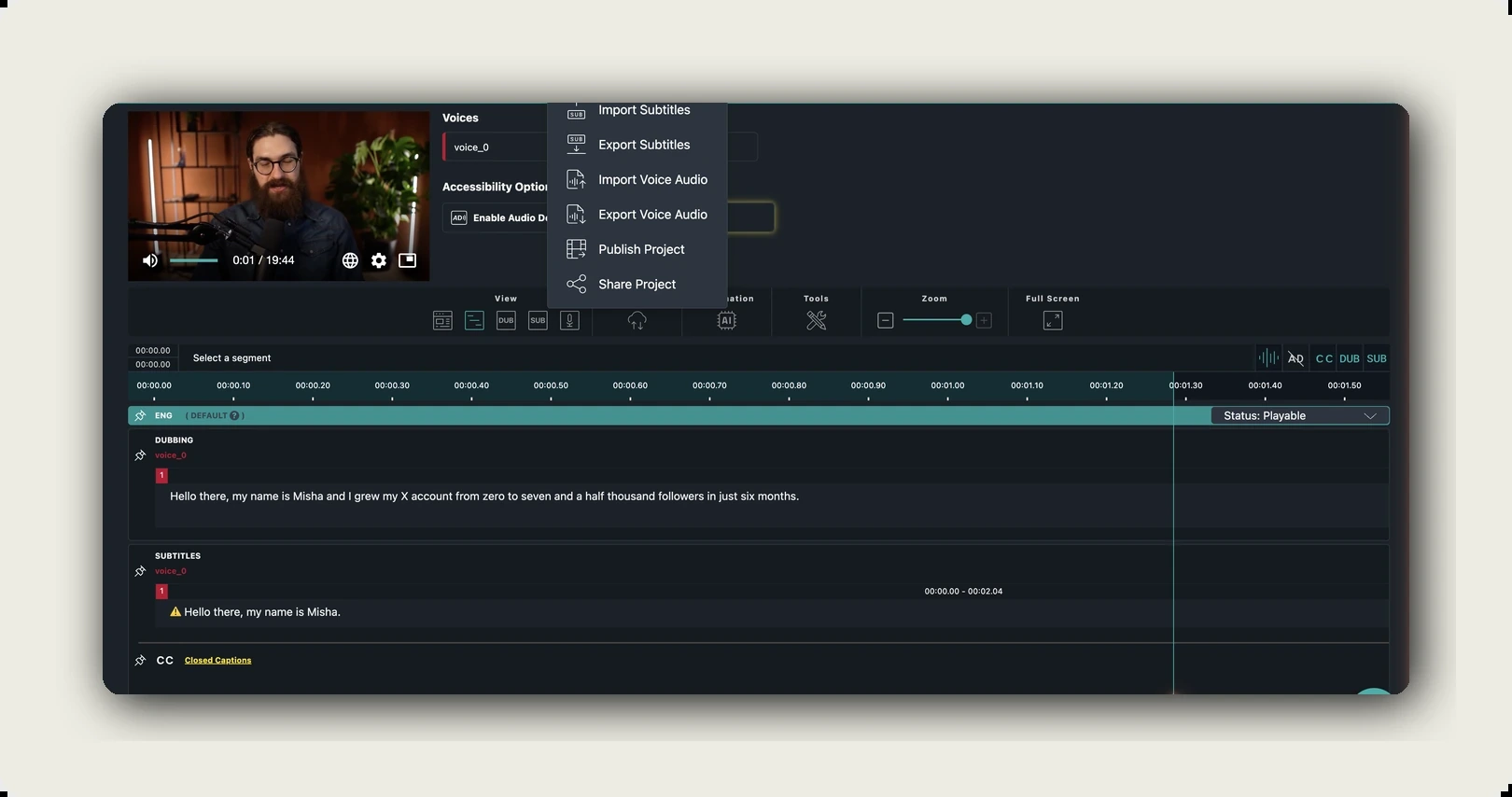
alugha approaches dubbing from the platform side: multilingual audio is the founding problem the company was built around, not a feature bolted onto a video host. The AI workflow lives in the dubbr workspace and follows the three-stage pipeline described above. Speech-to-text delivers 98% speech accuracy, with speaker detection and color coding to keep different speakers apart. Automated translation covers 200+ languages and supports a custom glossary, so product names and fixed terminology survive every language pass. Text-to-speech renders the result with 400+ AI voices, including voice cloning to preserve the original speaker and emotion cloning to keep the delivery.
The output stays attached to the source video instead of fragmenting into separate uploads. Language tracks belong to one video, so a single link serves every audience, and alugha generates AI metadata per language, which makes each track searchable in its own language. Every AI action costs credits, and each dialog shows the credit balance, the cost of the action, and the remainder before you confirm. The per-language cost is visible up front rather than arriving later as an invoice.
Frequently asked questions
What is dubbing in film and video?
Dubbing is the process of replacing a video’s original voice track with a newly recorded voice track in another language, while the footage stays unchanged. The new dialogue is timed to the on-screen performance so the audience can listen instead of reading subtitles. The term covers cinema and television as well as corporate, training, and marketing video.
What is the difference between dubbing and voice-over?
Dubbing fully replaces the original voice and aims to match the on-screen performance, including its timing and, in high-end productions, the mouth movements. Voice-over adds a new voice on top of the original audio, which remains quietly audible underneath, and makes no attempt at lip sync. Documentaries and news interviews typically use voice-over; films and series use dubbing.
What does lip sync mean in dubbing?
Lip sync, short for lip synchronization, is the matching of a voice recording to the visible mouth movements of the speaker on screen. In dubbing, it measures how closely the translated dialogue follows the original actor’s timing and mouth shapes. Close lip sync makes the dub feel native; weak lip sync is what audiences notice first.
Is AI dubbing as good as studio dubbing?
For performance-driven fiction, no. A directed voice actor still delivers a dramatic range that synthetic voices do not fully reproduce, and standard AI dubbing aligns to timing rather than mouth shapes. For instructional, corporate, and marketing video, the gap narrows sharply: voice cloning preserves the original speaker’s identity, and the speed and cost advantages usually outweigh the remaining difference.
What is English dubbing?
English dubbing is the production of an English voice track for content originally recorded in another language. The workflow is identical to any other dub: translation, adaptation, and recording or AI voice generation. Demand has grown with the international audience for non-English series, films, and animation, which has made English one of the most requested target languages in dubbing.
Should you dub or subtitle your videos?
Ship both where budget allows, because they serve different audiences: a dubbed track for viewers who listen, and subtitles for deaf and hard-of-hearing viewers and for sound-off playback. If you must choose, match the format to how your audience watches. Dubbing suits content viewers consume while doing something else; subtitles suit short social clips and fast turnaround.
Getting started with alugha
Multilingual audio is an infrastructure decision, not a post-production afterthought. alugha combines the chain this article walked through in one platform: speech-to-text transcription, automated translation into 200+ languages, and AI voice-over with voice cloning, with every language track attached to the same video. For creators, that means a second or a tenth language market opens from the browser, with credits included in the monthly plan.
For enterprise teams, the same workflow scales across departments: one upload, one pipeline, and a language track for every region the organization serves. Plan names and current conditions are listed on the pricing page, and the dubbr workspace shows the credit cost of every AI action before it runs.
Get started with alugha’s free tier ? alugha.com/plans
For teams that need multilingual video at scale ? compare alugha plans