
This year I audited pharma packs across DACH markets: QR codes that resolve to nothing, leaflets nobody opens, patients left to guess at dosing. That is what pulled me into medication adherence video work, not as a marketing add-on, but as the plainest fix I have found for a problem regulation alone cannot solve. Every pack tells a patient what to do. Almost none show them how, or why it matters.
Every pharmaceutical company in Europe ships a legally perfect document with every pack: indications, contraindications, interactions and dosing in precise regulatory language, printed in the official language of each market. And then roughly half of the patients it was written for do not follow the therapy it describes.
That gap between what the leaflet says and what the patient actually does has a name: non-adherence. It is one of the most expensive, most preventable problems in European healthcare, and at its core it is a comprehension problem. This guide walks through the evidence on health literacy and adherence, explains why the package leaflet fails a majority of the people it is meant to protect, and shows how a medication adherence video behind a QR code on the pack can close the gap the paper never could.
Key takeaways
- A medication adherence video is a short, approved, plain-language video reached by scanning the QR code on the pack. It demonstrates purpose, correct use and warning signs, and supplements the statutory package leaflet as a comprehension layer. It never replaces it.
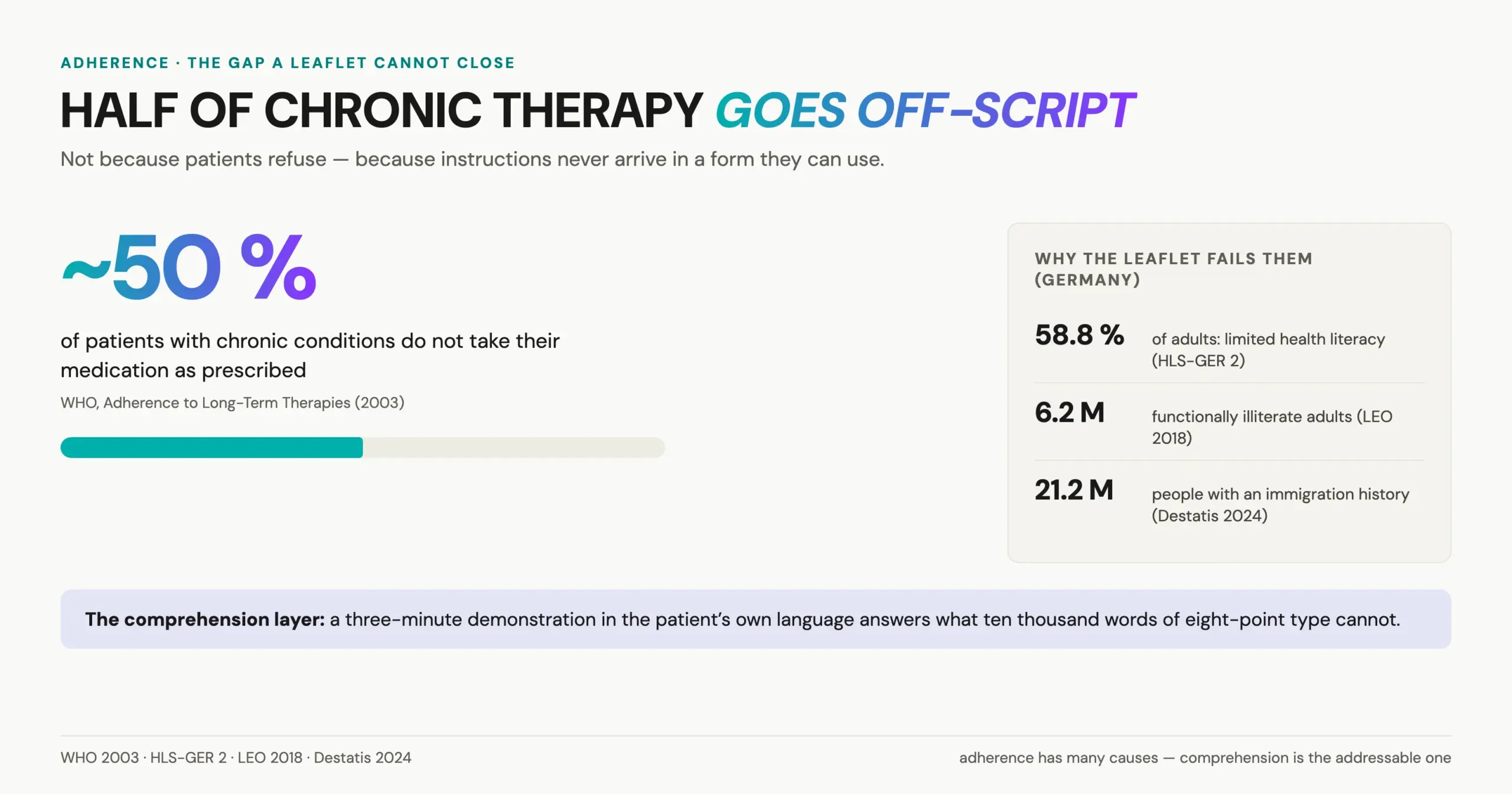
- Non-adherence is a comprehension problem before it is a behaviour problem. Around 50% of chronic patients do not take long-term medication as prescribed (WHO, 2003), and 58.8% of people in Germany have limited health literacy (HLS-GER 2, 2021). The leaflet is legally complete and communicatively broken for most of its audience.
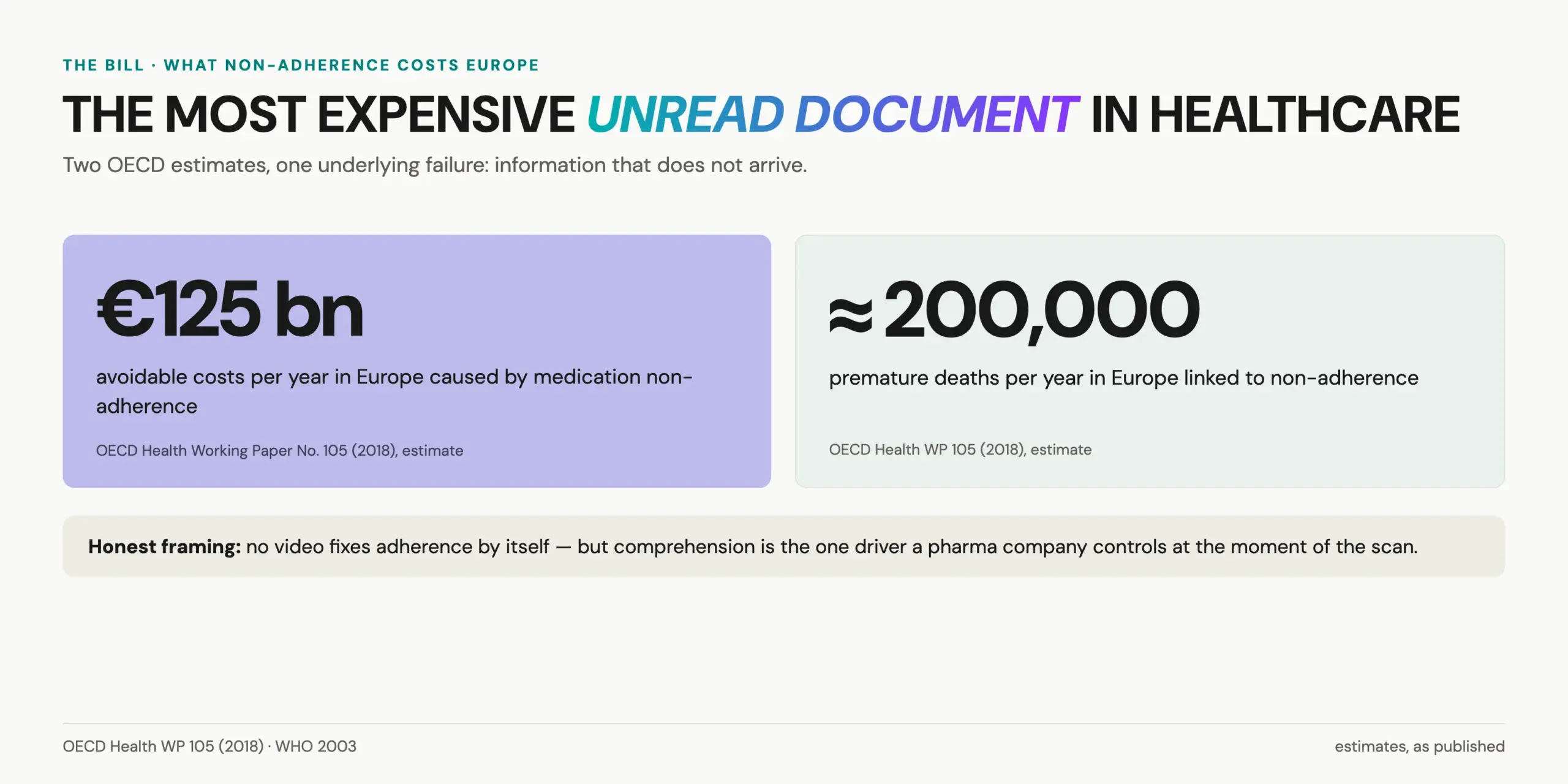
- The cost is measurable. Non-adherence drives an estimated EUR 125 billion in avoidable costs and around 200,000 premature deaths a year in Europe (OECD estimate, 2018). Even single-digit adherence gains carry enormous leverage.
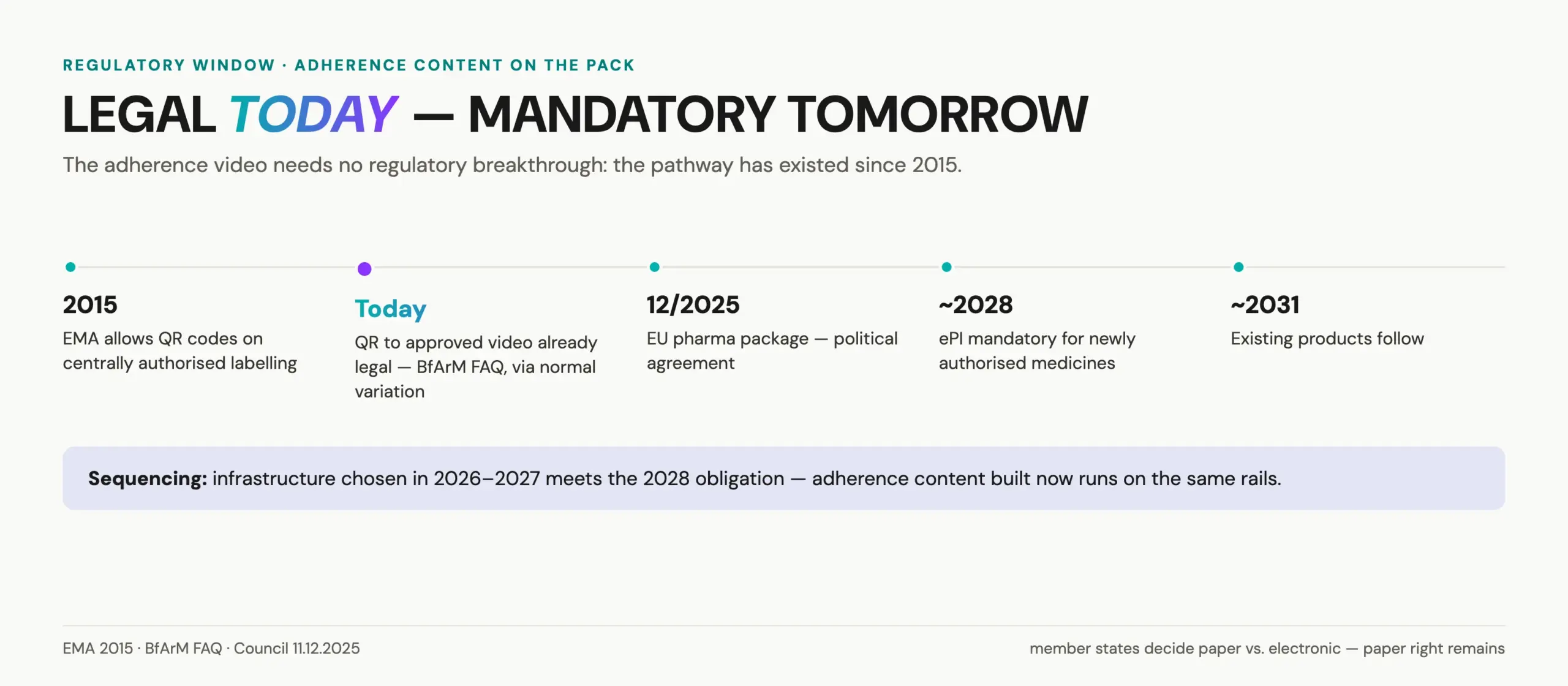
- A QR-linked video is legal to deploy today, not in 2028. The BfArM permits QR codes linking to approved, non-promotional educational material and videos, and the EMA has allowed QR codes on centrally authorised labelling since 2015. The upcoming ePI obligation (roughly 2028 for new medicines) digitises the document. It does not make the text easier to understand.
- The multilingual, accessible layer now scales economically. AI dubbing with human review takes a 24-language build from weeks and thousands of euros to a fraction of that (a model calculation, best case), while a single QR code resolves to one video that plays in the patient’s own language with captions and audio description built in. This is the layer alugha builds, hosted in Germany.
What is medication adherence?
Medication adherence is the degree to which a patient’s actual medicine-taking matches the plan agreed with their clinician: right dose, right timing, for the full course. The World Health Organization frames it as behaviour that corresponds with agreed recommendations. When that behaviour diverges from the plan, the term is non-adherence to medication.
That 40-to-60-word definition is where most confusion starts, because a second word is often used in its place.
Medication adherence vs compliance: what is the difference?
Medication adherence and medication compliance describe the same outcome from two different worldviews. Compliance frames the patient as obeying a clinician’s instructions, a passive act of following orders. Adherence frames the patient as an active collaborator who agrees to a plan and follows it. The shift from compliance to adherence is the shift to patient-centred care, and it matters here because a leaflet commands while a video can explain.
The distinction is not academic. If you believe patients simply fail to comply, you write sterner warnings. If you accept that adherence depends on understanding, you invest in comprehension. Everything in this guide follows from the second view.
The cost of not understanding: what non-adherence does in Europe
The headline numbers are stark and well documented. The World Health Organization estimated in its adherence report (2003) that around 50 percent of patients with chronic conditions in developed countries do not take their long-term medication as prescribed. Two decades later, that figure remains the standard reference in adherence research.
The economic consequences were quantified by the OECD in its Health Working Paper No. 105 (2018): non-adherence causes an estimated 200,000 premature deaths and an estimated 125 billion euros in avoidable costs every year in Europe, through hospitalisations, emergency care and disease progression that better medication use would have prevented.
Read those two numbers together. Half of chronic patients are not taking their medicines correctly, and the system pays with money and lives. Any intervention that moves adherence even a few percentage points carries enormous leverage. In a full audit of 25 European pharma groups we ran in July 2026, only 7 of 25 had a structured patient video behind their packaging at all: the adherence opportunity sits largely unclaimed, not undiscovered. The instinctive industry answer has long been “the information is in the leaflet.” Which brings us to the uncomfortable part.
Health literacy: the assumption the leaflet gets wrong
A package leaflet assumes an adult who reads confidently, understands medical and legal vocabulary, and can translate abstract instructions into correct daily behaviour. The population data for Germany dismantles that assumption.
58.8 percent: limited health literacy is the majority case
The second German Health Literacy Survey, HLS-GER 2 (Bielefeld University, commissioned by the Federal Ministry of Health, 2021), found that 58.8 percent of the population in Germany has limited health literacy: difficulty finding, understanding, appraising and applying health information. The first survey wave (2014, published 2016) had measured 54.3 percent. Limited health literacy is not an edge case; it is the statistical majority. The European picture is similar: the original HLS-EU study (2011) found limited health literacy in 47.6 percent of respondents across eight EU countries.
Millions who cannot rely on reading at all
Health literacy presumes basic literacy, and even that cannot be taken for granted. The LEO study (University of Hamburg, funded by the Federal Ministry of Education and Research, 2018) counted 6.2 million adults in Germany, 12.1 percent of the working-age population, as functionally illiterate. A further 10.6 million adults write only with significant errors. For these readers, a leaflet in small print and nested legal clauses is not difficult. It is inaccessible.
A population that does not read German first
Language adds a third layer. According to the Microcensus (Destatis, 2024), 21.2 million people in Germany, 25.6 percent of the population, have an immigration history. For millions of them, German is not their first language. The leaflet in the box, however, is printed in the official language of the market, as Article 63 of Directive 2001/83/EC requires: legal compliance in up to 24 official EU languages, with no guarantee that the person holding the pack understands a word of it.
Our own scan of 160 pharma pack touchpoints across DACH markets in August 2026 found 96 of 160 offering no language beyond the market’s official one: not an edge case, a default. Stack the three data points and the conclusion is hard to avoid: the leaflet is legally complete and communicatively broken for a very large share of its audience.
Why paper fails even the patients who can read it
Fairness demands a concession: the package leaflet is not badly made. It is precisely made for a purpose that is not patient comprehension. Its primary function is regulatory and legal completeness, and completeness and comprehensibility pull in opposite directions. In the leaflet, completeness wins by design.
European law has quietly acknowledged the accessibility gap for years. Article 56a of Directive 2001/83/EC has required since 2004 that the medicine name appear in Braille on the pack and that the leaflet be made available on request in formats suitable for blind and partially sighted patients. The need for formats beyond print is written into pharmaceutical law itself. What has been missing is a format that scales.
Text on paper also cannot demonstrate. A leaflet can state “inject subcutaneously into the abdominal wall at a 90-degree angle,” but it cannot show a hand doing it. For inhalers, pens and autoinjectors, the difference between reading a procedure and watching it is the difference between assumed and actual technique. The evidence supports the intuition: a review of video-integrated patient education found that roughly 57 percent of studied interventions improved medication adherence measurably (de Gruyter review, 2023). Video is not a nice-to-have. It is a proven comprehension mechanism.
Paper leaflet vs QR video: a direct comparison
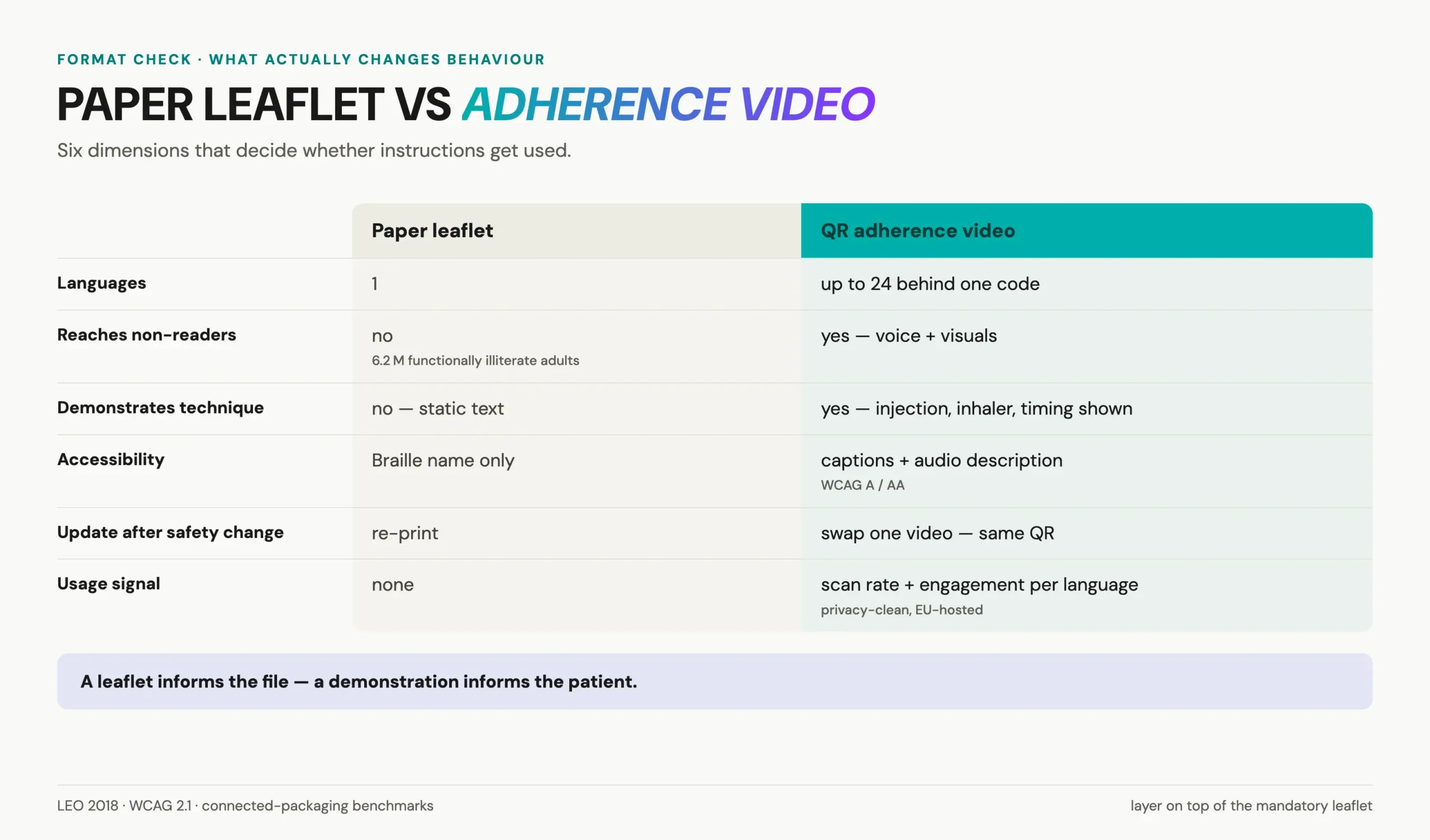
The two formats are not competitors. One satisfies the law, the other satisfies the patient. Seen side by side, the division of labour is obvious.
| Dimension | Paper leaflet | QR-linked adherence video |
|---|---|---|
| Languages per pack | 1 (official market language) | Up to 24, auto-selected by device |
| Reaches non-readers | No | Yes (spoken plus demonstrated) |
| Demonstrates technique | No | Yes (injection, inhaler, pen) |
| Accessibility for blind/low-vision | Braille name only | Captions plus audio description |
| Update after a safety change | Reprint and redistribute | Swap one video behind the link |
| Usage data | None | Scan rate, completion, engagement |
| Legal/regulatory completeness | Yes (primary function) | No (supplement, not a replacement) |
The leaflet keeps its job. The video takes on the one the leaflet was never designed to do.
The ePI is the obligation, the video is the understanding
Regulation is now moving the leaflet into the digital age, and precision matters here.
The EU pharmaceutical package, on which the Council and Parliament reached political agreement in December 2025 (Council of the EU, 2025), anchors the electronic product information (ePI) in law: the largest overhaul of EU pharmaceutical legislation in over 20 years. Based on the final compromise texts, electronic availability of the package leaflet becomes mandatory for newly authorised medicines around 2028, with existing products following within roughly three years after that. Member states decide whether paper, electronic or both formats are dispensed. The groundwork is already laid: the EMA’s ePI pilot with four member states published 23 ePIs in the FHIR-based EU ePI Common Standard, and the pilot report (EMA, December 2024) recommends a phased rollout. An industry survey by AESGP, EFPIA and Medicines for Europe (February 2026) counts active ePI pilots in 14 of 31 European countries, with 7 more planned.
Here is the strategic point most adherence discussions miss: the ePI digitises the document. It makes the same text searchable, updatable and machine-readable, which is genuinely valuable. It does not make the text more understandable for the 58.8 percent. Whoever struggles with a paper leaflet will struggle with the identical wording on a smartphone screen.
That is why the formula worth internalising is: the ePI is the obligation, the video is the understanding. The QR code that regulation is putting on the pack for document access is the same door through which a comprehension layer can enter, and that layer is already legal today. The BfArM’s FAQ on QR code implementation explicitly permits QR codes linking to approved, non-promotional content, naming educational material and videos, and the EMA has allowed QR codes on labelling of centrally authorised products since its mobile scanning guideline (2015). The mechanics of resolving one code to the right content are well established, as our guide to sharing a video by QR code sets out. No company needs to wait for 2028 to put understanding behind the code.
A side note while we are on this lane: alugha publishes daily updates on LinkedIn on EU compliance dates, accessibility standards and multilingual delivery patterns. If that is the cadence your regulatory and patient-engagement teams need, follow alugha on LinkedIn for the running thread.
How a medication adherence video works in practice
A medication adherence video is a short, approved video, typically two to four minutes long, reached by scanning the QR code on the medicine pack. It explains in plain language and demonstration what the leaflet states in text: purpose, correct use, warning signs and when to contact a doctor. It supplements the leaflet and does not, on its own, guarantee adherence; done properly, it has five defining characteristics.
One code, one link, every language. A single QR code resolves to a single video page that plays in the language of the patient’s device, with all approved language versions held as audio tracks of one video object. That is the difference between managing one asset and reprinting a code for every market. An automatic language switcher selects the right track at play time, so one link to print serves every language the population speaks and no per-country reprint is needed when a video is updated.
Accessibility built in, not bolted on. The relevant benchmark is WCAG 2.1 Level AA, the standard the European Accessibility Act made the operative norm for digital services in the EU. For video that means captions (Level A, success criterion 1.2.2) and audio description (Level AA, success criterion 1.2.5) as baseline requirements (W3C). Building to WCAG accessibility from the first version is far cheaper than retrofitting, and a video with captions and an audio description track finally gives Article 56a a scalable answer for blind and partially sighted patients.
Approved content, human-reviewed translations. The video is a regulated artefact: non-promotional, consistent with the authorised product information, submitted through the established variation route. AI dubbing makes the multilingual part economically feasible, but every language version passes medical and regulatory review before release. Human oversight is the feature that makes the workflow approvable, not a compromise.
Economics that finally scale. Classic studio dubbing runs at roughly 100 to 500 US dollars per video minute per language with weeks of turnaround; AI video dubbing runs at roughly 1 to 20 US dollars per minute (Checksub, CAMB.AI, Pitchavatar). As a model calculation under best-case assumptions: a 3-minute video in all 24 official EU languages costs around 10,800 euros with classic dubbing versus around 360 euros AI-assisted, a factor of roughly 30. The same economics apply to every pharmacovigilance update, which must propagate through all language versions for the life of the product.
Measurable engagement. Connected packaging implementations report scan rates around 14 percent and engagement times of 2 to 3 minutes per session (Packaging Insights, 2023/24). No printed leaflet generates any usage data at all. A QR-linked video gives patient engagement, medical affairs and brand teams their first real signal of whether patients are reaching and consuming the information.
The patient-centricity business case
Pharmaceutical companies have talked about patient centricity for a decade. Adherence support via pack-linked video is one of the few places where the rhetoric converts into a measurable programme with a defensible business case, and the value logic runs on three rails. First, therapy outcomes: adherence is the precondition for real-world effectiveness, and against an OECD-estimated 125 billion euro annual cost of non-adherence in Europe, even single-digit improvements justify serious investment. Second, differentiation: where molecules are comparable, the manufacturer whose pack answers “how do I actually use this?” in the patient’s own language earns loyalty a leaflet never will. Third, operational relief: a video that answers the ten most common usage questions offloads medical information hotlines and patient support programmes.
Before scoping a pilot, we run the product through the four-pillar readiness test outlined in our companion piece on pack-linked video generally: regulatory route, content ownership, language footprint and measurement plan. A sensible pilot keeps the scope narrow and the metrics honest: one product, one market, a defined set of languages, and pre-agreed measurements such as scan rates, viewing completion, hotline volume and, where feasible, an adherence proxy like refill persistence. Strong first candidates are self-administered biologics, OTC brands and products with imminent new authorisations.
Getting started: a practical sequence to improve medication adherence
Use this as a condensed version of our pharma video pilot rollout playbook:
- Pick a pilot product where comprehension visibly drives outcomes: an injectable, an inhaler, a paediatric OTC product.
- Involve regulatory affairs first. The QR code and linked video travel the variation route; RA owns the process from day one.
- Script from the approved product information, in plain language, with medical affairs sign-off on the master version.
- Produce once, localise with AI plus human review, holding every language as an audio track of one video behind one link.
- Build to WCAG 2.1 AA from the start: captions, audio description, an accessible player. Retrofitting means building twice.
- Measure and expand. Report scans, engagement and hotline impact after two or three quarters, then scale across SKUs, markets and languages.
The thesis here is simple: a QR-linked video is the fastest, cheapest way to close the comprehension gap the leaflet cannot close on its own. The fair counter-position is that this is unproven at scale, that scan rates around 14 percent mean most patients still never watch, and that a video programme adds a governance burden many teams are not staffed for. Both points hold. Video will not lift adherence on its own, and a pilot that skips regulatory affairs, translation review or accessible captions will underperform its own promise. The honest case for building it anyway is that the alternative, a leaflet format the data above shows a majority of the population already struggles to use, is worse, not that video is a solved problem.
Frequently asked questions
What is a medication adherence video?
A short, regulator-compliant video, usually reached via a QR code on the medicine pack, that explains a medicine’s purpose, correct use and key warnings in plain language and demonstration. It supplements the statutory package leaflet as a comprehension layer; it never replaces it.
What does medication adherence mean?
Medication adherence means taking a prescribed medicine the way it was agreed with the clinician: correct dose, correct timing, for the full course. It is an active, collaborative behaviour rather than passive obedience, which is why the field prefers “adherence” over the older term “compliance.”
What is the difference between medication adherence and compliance?
Compliance frames medicine-taking as obeying a doctor’s orders; adherence frames it as a plan the patient agreed to and follows. The definitions describe the same behaviour, but adherence reflects patient-centred care and shared decision-making. The practical implication is that adherence responds to better understanding, not sterner instruction.
Is it legal to put a QR code linking to a video on a pharmaceutical pack today?
Yes. The BfArM’s FAQ confirms that QR codes may link to approval-compliant, non-promotional content, explicitly naming educational material and videos; the EMA has permitted QR codes on centrally authorised products since 2015. The route is the standard variation process, and the mandatory serialisation DataMatrix remains untouched.
Does the ePI requirement mean adherence videos become mandatory?
No. The EU pharmaceutical package makes electronic availability of the leaflet mandatory for new medicines around 2028 (existing products around 2031, per the final compromise texts). Video is not mandated. The point is complementary: the ePI fulfils the legal duty, while a medication adherence video addresses the comprehension gap the document format cannot close.
Do videos actually improve medication adherence?
The evidence is encouraging. A review of video-integrated patient education found roughly 57 percent of studied interventions improved adherence measurably (de Gruyter, 2023). Video works because it demonstrates technique and reaches non-readers, two things text cannot do. It is most effective as one layer in a broader patient-support programme, not a standalone fix.
Why not simply write easier leaflets instead of producing videos?
Plain-language efforts help, but the leaflet’s legal function caps how simple it can become, and text cannot demonstrate a technique or reach the 6.2 million functionally illiterate adults in Germany (LEO, 2018). Video works for readers and non-readers alike.
How many languages does a medication adherence video need?
As many as the patient population speaks, not just the official market language. The video’s job is reaching real patients, including the 21.2 million people in Germany with an immigration history (Destatis, 2024). AI dubbing with human review makes 20 or more language versions economically realistic, as the model calculation above shows.
How is a medication adherence video kept compliant across updates?
Every version is scripted from the approved product information and cleared by medical and regulatory review before release, then submitted through the established variation route. When a pharmacovigilance change lands, the video behind the link is updated and re-reviewed rather than reprinted, so all language versions stay consistent with the current authorised text.
Where should the video be hosted?
In a data arrangement the company can defend to procurement and regulators. For patient-facing health content, EU-based hosting without a US parent avoids the transfer and consent complications that come with consumer video platforms, and it keeps the accessible player, language tracks and engagement data under one governable roof.
—
Multilingual, accessible patient video is the layer alugha builds: one QR code resolving to one video with every approved language as an audio track, automatic language selection, captions and audio description in a WCAG-conformant player, hosted in Germany. Enterprise setups are custom arrangements; contact sales to scope a pilot.
This article is part of alugha’s Pharma QR Code Patient Information series on compliant multilingual video.