Key takeaways
- eIFU for medical devices is live, not a forecast. Since 16 July 2025, manufacturers may supply electronic instructions for use instead of paper for every device intended for professional users. Implementing Regulation (EU) 2025/1234 deleted the old product-category list that had limited the option since 2021.
- Combination products sit at the center of the shift. Autoinjectors, prefilled pens and inhalers are governed by device law and pharma law at once. The device side allows electronic instructions today; the pharma side is moving toward electronic product information on its own timetable.
- Video is the comprehension layer, not the legal document. Neither eIFU nor the coming ePI framework makes a film the instructions for use. The document stays the compliance artifact. A QR-linked demonstration video is permitted supplementary content today under existing rules.
- The European Accessibility Act raised the baseline. For consumer-facing digital instruction content, WCAG 2.1 AA is now the normal condition in Europe. Captions are a Level A requirement, audio description a Level AA requirement.
- One code can serve everyone. With GS1 Digital Link and the Sunrise 2027 migration, a single printed QR can resolve to batch-specific, language-specific content for professionals, patients and the supply chain at once.
- Hosting is a compliance decision. Instruction content for medicines and devices lives in a health context, which makes an EU-sovereign, tracking-free player a governance question rather than an IT afterthought. A platform like alugha is built for exactly this layer.
I sat in a regulatory affairs review last month watching a labeling manager circle a shelf of paper instruction booklets and ask why half of them would be pulped within the year. The answer: eIFU medical devices are no longer a future compliance project. Since 16 July 2025, professional-use devices can drop the paper insert entirely, and the teams still printing by default are the ones who have not read the regulation.
While the pharmaceutical industry still debates when electronic package leaflets will arrive, medical device law has quietly moved first. The exit from paper is no longer a projection. It is an applicable regulation.
This guide explains what changed, why drug-device combination products such as autoinjectors, pens and inhalers sit at the center of the shift, how video instructions fit into the new framework, and what the European Accessibility Act adds to the requirements list. It is written for regulatory affairs, labeling, packaging and digital teams in MedTech and pharma companies planning the next two to three years.
What are eIFU for medical devices?
Electronic instructions for use (eIFU) are the manufacturer’s instructions supplied in electronic form, on a website, a device screen or a downloadable file, instead of a printed booklet in the box. Under Regulation (EU) 2025/1234, applicable since 16 July 2025, eIFU is an option for every medical device intended for professional users in the EU, with paper remaining the default for lay users outside software.
That definition is the snippet-shaped answer most teams are asking for in 2026. Why it now matters for pharma as much as for MedTech is what follows.
What changed on 16 July 2025
Is eIFU allowed for medical devices?
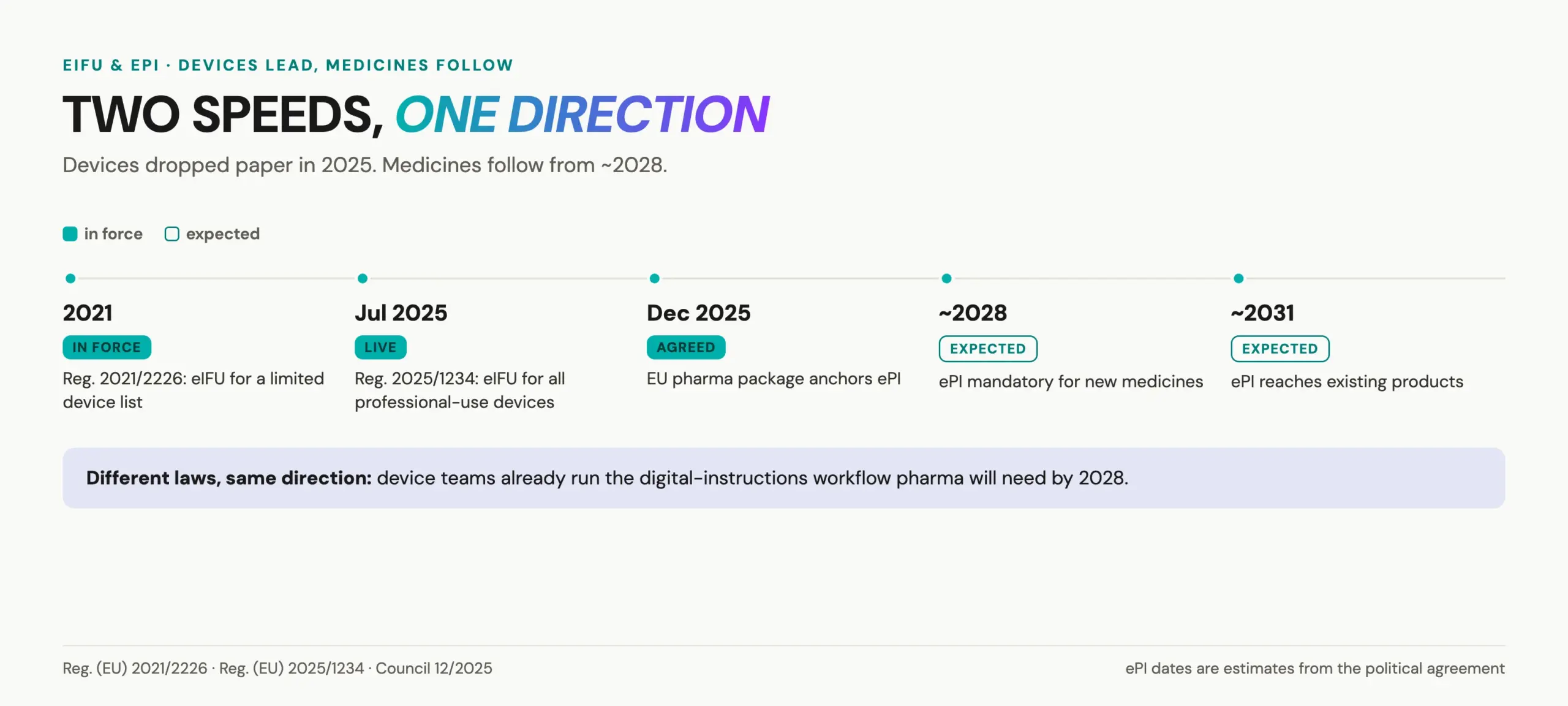
Yes. Since 16 July 2025, Implementing Regulation (EU) 2025/1234 allows manufacturers to replace paper instructions with electronic instructions for use (eIFU) for any medical device intended for professional users. Lay-use devices keep paper as the default, except software, which may use eIFU for lay users too.
The legal basis for electronic instructions for use in Europe is Implementing Regulation (EU) 2021/2226, adopted under the Medical Device Regulation. That regulation allowed manufacturers to replace paper instructions with electronic ones, but only for a defined list of product categories. Most general-purpose devices were not on it.
Implementing Regulation (EU) 2025/1234 changed the architecture of that permission. Published in the Official Journal on 26 June 2025 and applicable since 16 July 2025, it deletes the product-category list entirely. The result, per the text on EUR-Lex and analyses by the Johner Institute, reuschlaw and BVMed:
- eIFU is now an option for all medical devices intended for professional users, including the Annex XVI products without a medical purpose.
- For software, electronic instructions may also be provided to lay users.
- For devices intended for patients and other lay users outside software, paper remains the default.
The direction is unambiguous. Wherever the user is a trained professional, European law no longer insists on a printed booklet in the box.
The obligations that remain are practical rather than restrictive. The manufacturer still publishes the instructions on its own website, registers the device in EUDAMED, keeps a version history with withdrawn versions traceable, and provides a paper copy on request within seven days. A labeling symbol per ISO 15223-1 signals that instructions are electronic. None of it reintroduces the printed booklet as a default for professional-use products.
The pharmaceutical side offers supporting evidence from practice. In hospital pilots that dispensed medicines without paper leaflets, 97 percent of hospital pharmacists reported no problems, according to a joint AESGP, EFPIA and Medicines for Europe position published in February 2026. Professionals already work from digital systems.
Why the eIFU medical devices shift matters for combination products
Autoinjectors, prefilled pens and inhalers live in two legal worlds at once. The medicine inside is governed by pharmaceutical law. The delivery device is governed by medical device law. Teams responsible for these combination products therefore watch both regimes, and right now both regimes point in the same direction, just at different speeds.
On the device side, the paper exit is live today for professional-use products. On the pharma side, the EU pharma package reached political agreement on 11 December 2025, the largest overhaul of EU medicines law in more than 20 years per the Council of the EU. It anchors electronic product information (ePI), with the obligation expected to apply to newly authorized medicines from roughly 2028 and to existing products about three years later, based on analyses of the final compromise texts (Baker McKenzie, March 2026). Member states will decide whether leaflets are provided on paper, electronically or both, and a paper copy must remain available on request where electronic-only is chosen.
How much does AI dubbing cost compared to studio dubbing?
Classic studio dubbing for instruction video runs roughly 100 to 500 US dollars per video minute per language. AI dubbing runs roughly 1 to 20 dollars per minute, a reduction of about 90 to 95 percent, based on published market benchmarks. Human-in-the-loop medical and regulatory review remains necessary for every language version regardless of production method.
How accurate is AI dubbing for regulated medical content?
AI dubbing output is not authorization-ready on its own. The cost bands above assume mandatory human-in-the-loop review by medical and regulatory staff for every language before publication; the accuracy claim applies to the draft, not to the compliance record. For regulated content, AI dubbing is best treated as a first-pass draft generator, not a final translation authority.
For a combination-product portfolio, this creates a planning reality rather than a distant scenario:
- Products administered by professionals, such as many hospital-use injectables and their devices, can move to electronic instructions now.
- Products self-administered by patients, such as biologic autoinjectors used at home, keep their paper leaflet for the time being, but the digital layer around them is already permitted and will become standard infrastructure as ePI arrives.
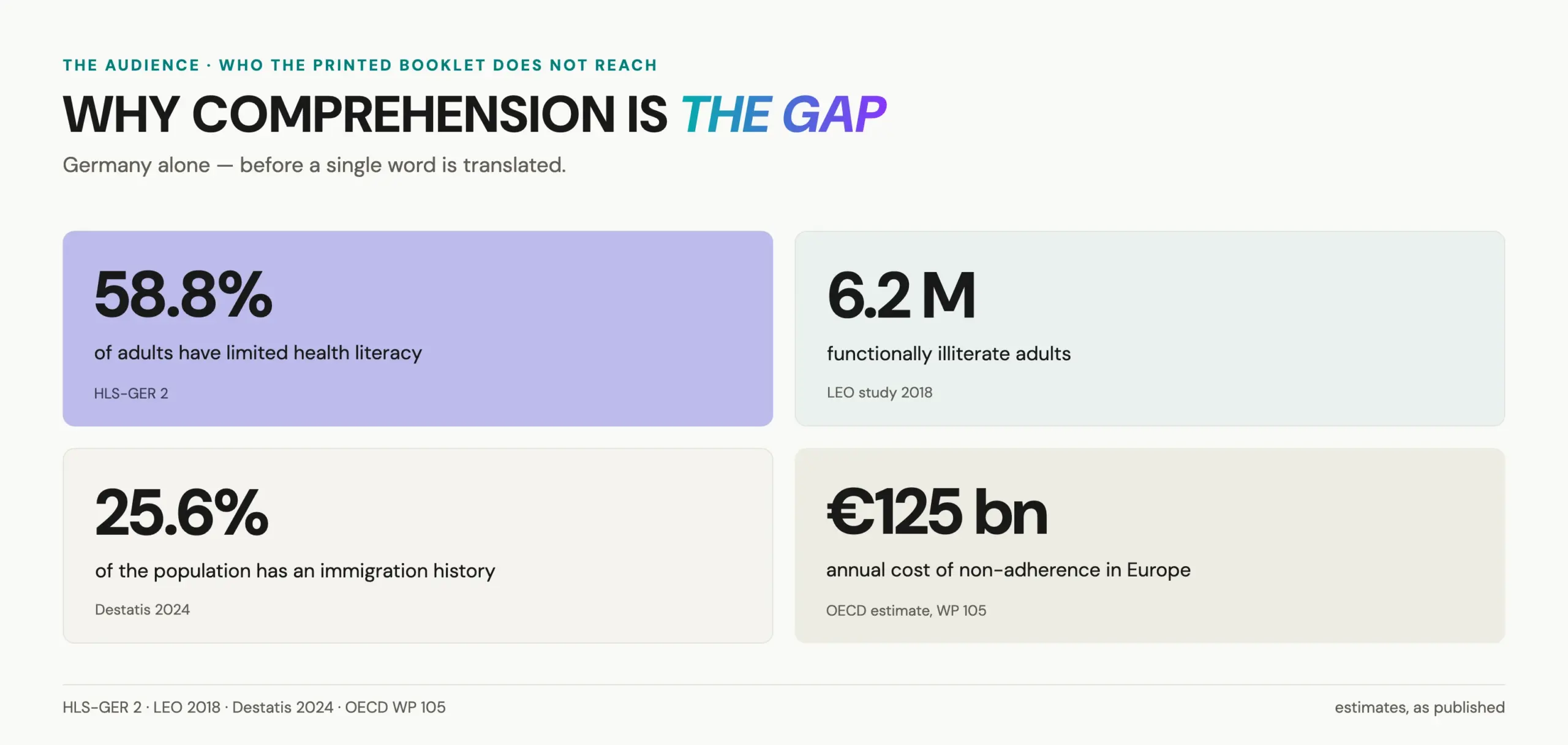
Self-injection biologics are arguably the most interesting first segment. The device is complex enough that written instructions demonstrably struggle, the regulatory tailwind from eIFU exists, and the therapy is long-term, which is exactly where adherence economics bite hardest. The WHO estimated as far back as 2003 that around 50 percent of patients on chronic long-term therapies do not take their medicines as prescribed, and the OECD has put the cost of non-adherence in Europe at roughly 125 billion euros and about 200,000 premature deaths per year (OECD Health Working Paper 105, 2018 estimate).
The readiness gap behind these numbers is not theoretical. In a full audit of 25 DACH and EU pharma companies with combination products, run in July 2026, only 7 of 25 provided a structured patient video for their autoinjector or pen, and 23 of 25 published instructions in a single language only. Measured against the four-pillar readiness test introduced earlier in this series, most portfolios are still failing on video and language before they even reach the accessibility pillar.
How does video support medication adherence for combination devices?
Poor technique is a known driver of non-adherence for injectables and inhalers, and it is the failure mode written instructions are worst at preventing. Most published tools for medication adherence, from the Morisky scale used to measure it to reminder apps that prompt patients to dose, address timing and memory. A demonstration video addresses a different gap: whether the patient can perform the administration step correctly at all. Among strategies for medication adherence, a technique video sitting one QR scan from the pack is one of the few that targets competence rather than reminders, and it scales to every language on the label without reprinting anything.
Video instructions as the comprehension layer
Video does not replace the legal document. Neither the eIFU regulation nor the coming ePI framework makes a film the instructions for use. The document remains the compliance artifact. Video is the comprehension layer on top, and the regulatory system already has a place for it.
What regulators already permit
On the pharmaceutical side, Article 62 of Directive 2001/83/EC allows additional, non-promotional, patient-relevant information on packaging and leaflets. Germany’s BfArM states in its FAQ on QR code implementation that QR codes may link to authorization-compliant content and explicitly names training material and videos among the permissible targets; the QR code itself is not subject to a separate authorization. The EMA has permitted QR codes on labeling of centrally authorized products since 2015 under its mobile scanning guideline. The process runs through a variation or notification handled by regulatory affairs, not through new legislation.
In other words, a QR code on a pack that opens a demonstration video of an inhaler technique or an autoinjector sequence is legally available today. Companies waiting for the pharma package before acting are waiting for permission they already have.
One code, one package, many languages
The infrastructure question is converging as well. The falsified-medicines DataMatrix used for verification (securPharm in Germany) remains untouched; a patient-facing QR code is a permissible additional code per the BfArM FAQ. With GS1 Digital Link, a single QR can encode the product identifier plus batch data as a web URL and resolve to batch-specific, language-specific content, including video landing pages. GS1’s Sunrise 2027 program is pushing 2D codes toward becoming the global packaging standard, with retail points of sale in 48+ countries expected to accept them by the end of 2027. The pattern already exists in consumer video, where one shared link resolves to the viewer’s language automatically.
For instruction content this means one printed code can serve the professional pulling up the eIFU, the patient opening a how-to video in their own language, and the supply chain scanning the same symbol, so packaging engineering only has to win the artwork battle once.
Paper leaflet versus QR-linked video: what actually differs
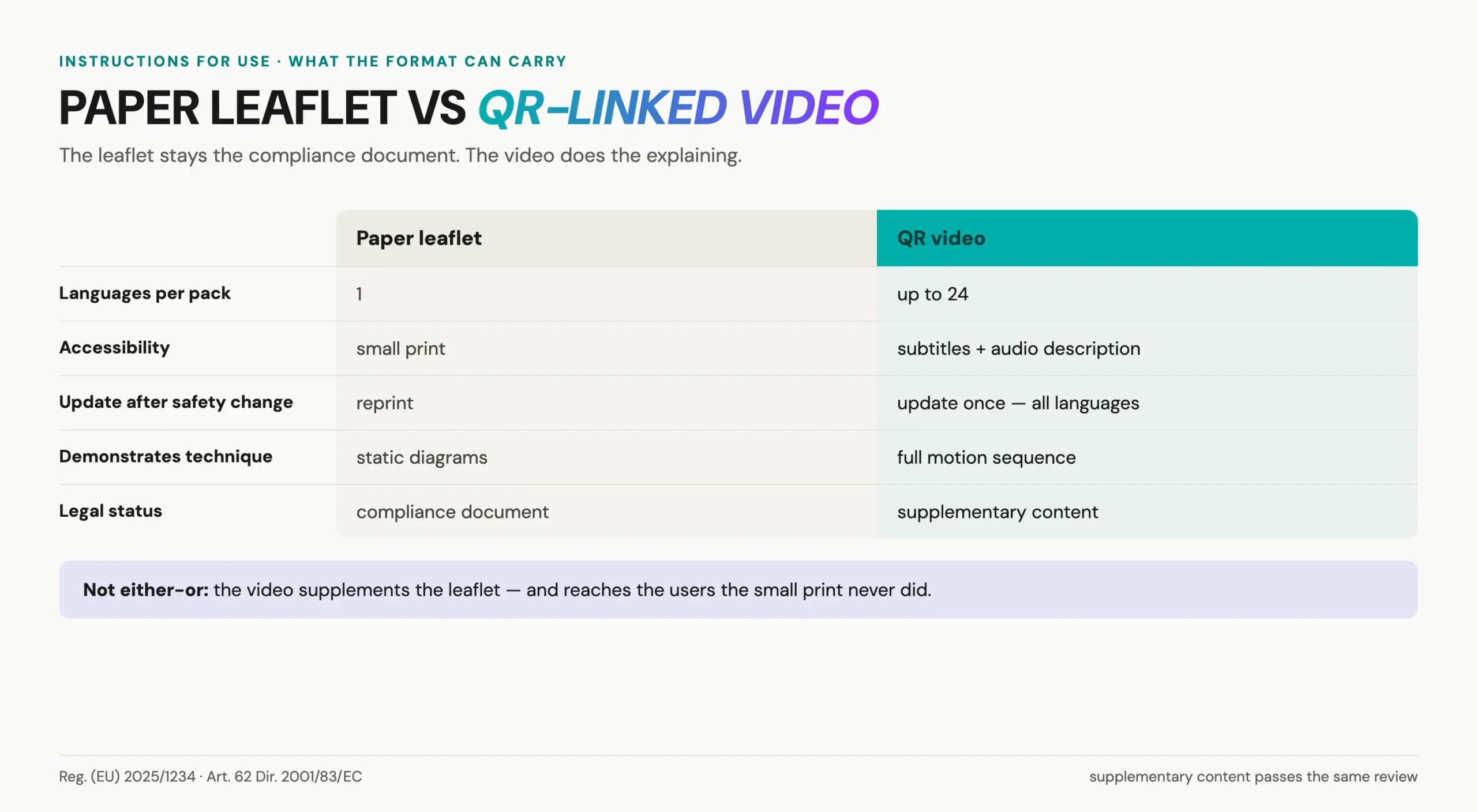
The comparison below is the one packaging and regulatory teams reach for when scoping a first pilot. It is not an argument that video replaces the leaflet; it sets the two layers side by side so the gap the video fills is visible.
| Dimension | Paper leaflet | QR-linked instruction video |
|---|---|---|
| Languages per pack | 1 (plus what fits the box) | up to 24 EU languages from one link |
| Accessibility for low-literacy users | small print only | captions, audio, audio description |
| Update after a safety change | reprint and redistribute | update once, propagates to all languages |
| Demonstrates technique | static diagrams | full motion sequence |
| Cost to add a language | new print run | AI dubbing plus human review |
| Legal status | compliance document | supplementary, non-promotional content |
The leaflet stays. What the table shows is that the comprehension work, whether a patient uses an autoinjector correctly, is exactly where paper does worst and video does best.
The accessibility connection: the EAA raises the baseline
The European Accessibility Act, implemented in Germany as the BFSG, has been in force since 28 June 2025, with fines of up to 100,000 euros for certain violation categories and no transition period for websites and apps (BMAS; bfsg-gesetz.de). The operative technical standard is EN 301 549, which points to WCAG 2.1 Level AA.
Honesty matters here, because accessibility law is often oversold in vendor communication. The paper instructions in the box do not fall under the BFSG, and the Act does not force manufacturers to produce videos. Its scope centers on consumer-facing digital services. But that is precisely where QR-linked patient content lives: portals, apps and QR-based service offerings aimed at consumers move into scope. The practical conclusion for anyone building digital instruction content is simple: the EAA has made WCAG 2.1 AA the normal condition for digital products in Europe. Build the video layer accessible from day one, or build it twice.
A note while we are on this lane: alugha publishes daily updates on LinkedIn on EU compliance dates, accessibility standards and multilingual delivery patterns. If that is the cadence your team needs, follow alugha on LinkedIn for the running thread.
For video specifically, WCAG is concrete: captions are a Level A requirement (SC 1.2.2), audio description is required at Level AA (SC 1.2.5), and sign language sits at AAA as a differentiator rather than an obligation (W3C). Building the video layer to a documented WCAG 2.2 accessibility standard for enterprise video from the start is cheaper than retrofitting it, and audio description in particular is the element most instruction videos skip and then have to add later. Pair that with a player that works with keyboard navigation and adequate contrast, and the accessibility file is in order.
The audience case behind these rules is not niche. In Germany, 58.8 percent of adults have limited health literacy (HLS-GER 2, Bielefeld University), 6.2 million adults are functionally illiterate (LEO study 2018, University of Hamburg), and 21.2 million people, 25.6 percent of the population, have an immigration history (Mikrozensus 2024, Destatis). A demonstration video with subtitles, multiple audio languages and audio description reaches people a small-print leaflet structurally cannot.
This is also the environment the DACH MedTech sector operates in. Companies of the scale of Siemens Healthineers, Dräger or Ottobock ship devices to professional users across dozens of markets and language regions; the eIFU option, the 2D code migration and the EAA baseline apply to that entire landscape at once. Manufacturers that treat these three developments as one program, rather than three separate compliance projects, spend less and move faster.
How to plan an eIFU and video rollout: six steps
1. Map the portfolio by user type. Separate devices intended for professional users from lay-use products. The first group is eIFU-eligible today under Regulation (EU) 2025/1234; the second group keeps paper but can already carry a QR-linked comprehension layer. This one split determines everything downstream, so do it before any content work starts.
2. Put regulatory affairs in the lead. Labeling and leaflet processes are owned by regulatory affairs, with mandatory involvement of quality, legal, medical affairs and marketing. On the pharma side, linked video content runs through a variation or notification. A project that starts in the marketing department without RA sponsorship will stall at first review.
3. Decide the code strategy once. Keep the verification DataMatrix untouched, add a patient- or user-facing QR, and evaluate GS1 Digital Link so the same code can resolve by batch and language. Align with the Sunrise 2027 timeline so artwork is not reworked twice. A single, well-planned QR that links a pack to language-specific video content is cheaper than three separate code projects bolted on later.
4. Build accessibility in from the start. Specify WCAG 2.1 AA as the acceptance criterion for every video and player: captions, audio description, keyboard-operable player, no autoplay. Retrofitting accessibility after a 24-language rollout multiplies the cost of every fix.
5. Scale languages with AI plus human review. Classic studio dubbing runs at roughly 100 to 500 US dollars per video minute per language; AI dubbing runs at roughly 1 to 20 dollars per minute, a reduction of about 90 to 95 percent (Checksub, CAMB.AI, Pitchavatar). As a model calculation, best case: a 3-minute video in all 24 EU official languages costs around 10,800 euros with classic dubbing versus roughly 360 euros AI-supported, a factor of about 30. The non-negotiable counterpart is human-in-the-loop review by medical and regulatory teams for every language version, and a workflow that lets a pharmacovigilance update propagate to all languages without re-producing 24 separate files.
6. Treat hosting as a compliance decision, not an IT afterthought. Instruction content for medicines and devices sits in a health context. Consumer video platforms are generally not qualifiable in GxP vendor assessments, and under Germany’s ¬ß 25 TDDDG an embedded US player requires a consent banner before it loads, which places a click between the scan and the instruction. Choosing an EU-sovereign hosting arrangement with a tracking-free player turns the same scan into a one-step path to the video, and keeps the vendor assessment defensible.
Where alugha fits
alugha is a German video platform built for exactly this layer: one video container holds all audio languages, subtitles and audio description, delivered through a WCAG-conformant player under a single link that selects the viewer’s language automatically, with AI dubbing into 200+ languages and human review workflows for regulated content. Hosting is EU-sovereign, operated by a German company without a US parent. To be precise about the market rather than overclaiming: no reviewed competitor documents all four elements together, EU-sovereign hosting plus AI dubbing plus accessibility including audio description plus one-link automatic language selection. Enterprise setups are custom arrangements; contact sales to scope a pilot for an instruction-video use case.
The tradeoff, honestly stated
The eIFU medical devices shift is a genuine efficiency win: less print, less waste, faster updates, and a legal opening for video where none existed before. The counter-argument deserves airtime too: digital-only instructions assume reliable device access, connectivity and digital literacy that not every professional user, in every country, actually has, and a QR code that fails to resolve at the point of use is worse than a paper booklet that is merely inconvenient. The concession: eIFU and video do not remove that risk. They only make the paper-on-request fallback and a genuinely accessible player non-negotiable rather than optional.
Frequently asked questions
Is eIFU now mandatory for medical devices?
No. Regulation (EU) 2025/1234 makes electronic instructions an option, not an obligation. Since 16 July 2025 manufacturers may choose eIFU for any device intended for professional users; for lay-use devices, paper instructions remain the default, with software as an exception.
Does the eIFU medical devices framework cover combination products like autoinjectors?
The device constituent of a combination product falls under medical device law, so the eIFU logic applies where the user is a professional. A patient-used autoinjector keeps its paper materials for now, but manufacturers can already add QR-linked training videos as supplementary, non-promotional content under pharmaceutical rules (Article 62 of Directive 2001/83/EC; BfArM FAQ).
What is the difference between eIFU and ePI?
eIFU (electronic instructions for use) belongs to medical device law and covers the instructions for a device. ePI (electronic product information) belongs to pharmaceutical law and covers a medicine’s product information, including the package leaflet. For a combination product, both apply: the device follows eIFU rules, the medicine follows ePI rules, on separate timetables.
Can a QR code on a medicine package legally link to a video today?
Yes. BfArM’s FAQ explicitly lists training material and videos as permissible linked content, and the EMA has allowed QR codes on centrally authorized products since 2015. Content must be authorization-compliant and non-promotional, and the addition runs through a variation or notification via regulatory affairs.
Does a patient-facing QR interfere with the falsified-medicines DataMatrix?
No. The verification DataMatrix under the Falsified Medicines Directive (securPharm in Germany) stays untouched. A patient-facing QR is a permissible additional code per the BfArM FAQ, and GS1 Digital Link lets a single 2D code carry both the identifier the supply chain scans and the URL a patient opens.
What accessibility level do instruction videos need?
The operative European benchmark is WCAG 2.1 Level AA via EN 301 549. For video that means captions (Level A, SC 1.2.2) and audio description (Level AA, SC 1.2.5), plus an accessible player. Sign language is a AAA-level differentiator, not an obligation.
When do electronic package leaflets become mandatory for medicines?
Based on the EU pharma package agreed politically in December 2025, the ePI obligation is expected to apply to newly authorized medicines from around 2028 and to existing products roughly three years later. Member states decide whether leaflets are paper, electronic or both, and a paper copy must remain available on request where electronic-only is chosen.
How much does it cost to translate an instruction video into every EU language?
There is no single price, but the cost bands are well documented. Classic studio dubbing runs roughly 100 to 500 US dollars per minute per language; AI dubbing with human review runs roughly 1 to 20 dollars per minute. As a model calculation in a best case, a 3-minute video across all 24 EU languages lands near 360 euros AI-supported versus around 10,800 euros classic, before the mandatory medical and regulatory review of each version.
Is AI dubbing accurate enough for regulated medical content?
AI dubbing is fast and inexpensive, but it is not a stand-alone answer for regulated content. The workable model is AI plus human-in-the-loop review: medical and regulatory teams sign off every language version, and the platform keeps a workflow that lets a single safety update propagate to all languages without re-recording. AI does the scale; humans keep the accuracy and the audit trail.
—
This article is part of alugha’s Pharma QR Code Patient Information series on compliant multilingual video.