Six of the best-known business video hosts store your files in the United States. Wistia, Vidyard, SproutVideo, Vimeo, Brightcove and Kaltura say so in their own privacy policies and help pages. That can be lawful today, under the EU-US Data Privacy Framework or standard contractual clauses, and Vimeo and Kaltura will store in the EU on enterprise terms or on request. It still matters, because of a small act you have performed many times. The embed code you paste decides more than a colour. It picks a storage country, a processor and everything that loads before play. When you reach the end, you will be able to shortlist three video hosting platforms for your use case and put eight precise questions to each of them in writing. If all you need is a free link to share a file, the free options come third, and you can stop there.
Key takeaways
- Wistia, Vidyard, SproutVideo, Vimeo, Brightcove and Kaltura, 6 of the best-known business hosts, store or process customer data in the United States by default, according to their own policies.
- Among the 10 hosts on this list, Vimeo and Kaltura offer EU storage on enterprise terms or on request. Even then, Vimeo keeps analytics, logs and video metadata outside the EU.
- Vimeo offers no data processing agreement to self-serve customers, and Google offers none for the YouTube player. Article 28 GDPR requires that contract when a host processes personal data for you.
- A default YouTube embed weighed about 1,149 KB before anyone pressed play in Zach Leatherman’s December 2023 measurement. A site owner can stop its ads only by disabling embedding.
- In Germany, section 25 TDDDG requires consent before an embed stores or reads data on the device, unless strictly necessary, and the EDPB counts local storage as well.
- Of the 10 hosts, 6 carry several audio languages in one video, 2 only through an API. They differ in who picks the first language: watch history, a menu or the browser.
- Key takeaways
- Quick picks by use case
- What a video hosting platform does
- If you only need a free link
- Eight questions that separate the hosts
- The 10 best video hosting platforms for business
- Where your video files are stored
- When YouTube is still the right choice
- Video hosting platforms for multilingual teams
- Frequently asked questions about video hosting platforms
- Getting started
Quick picks by use case
Start from the job, not the brand. A host built for sales outreach makes a poor training library, and a broadcast platform is far too much for one product page. The eight cards below match each job to the host built for it, and each card names the catch that comes with it.
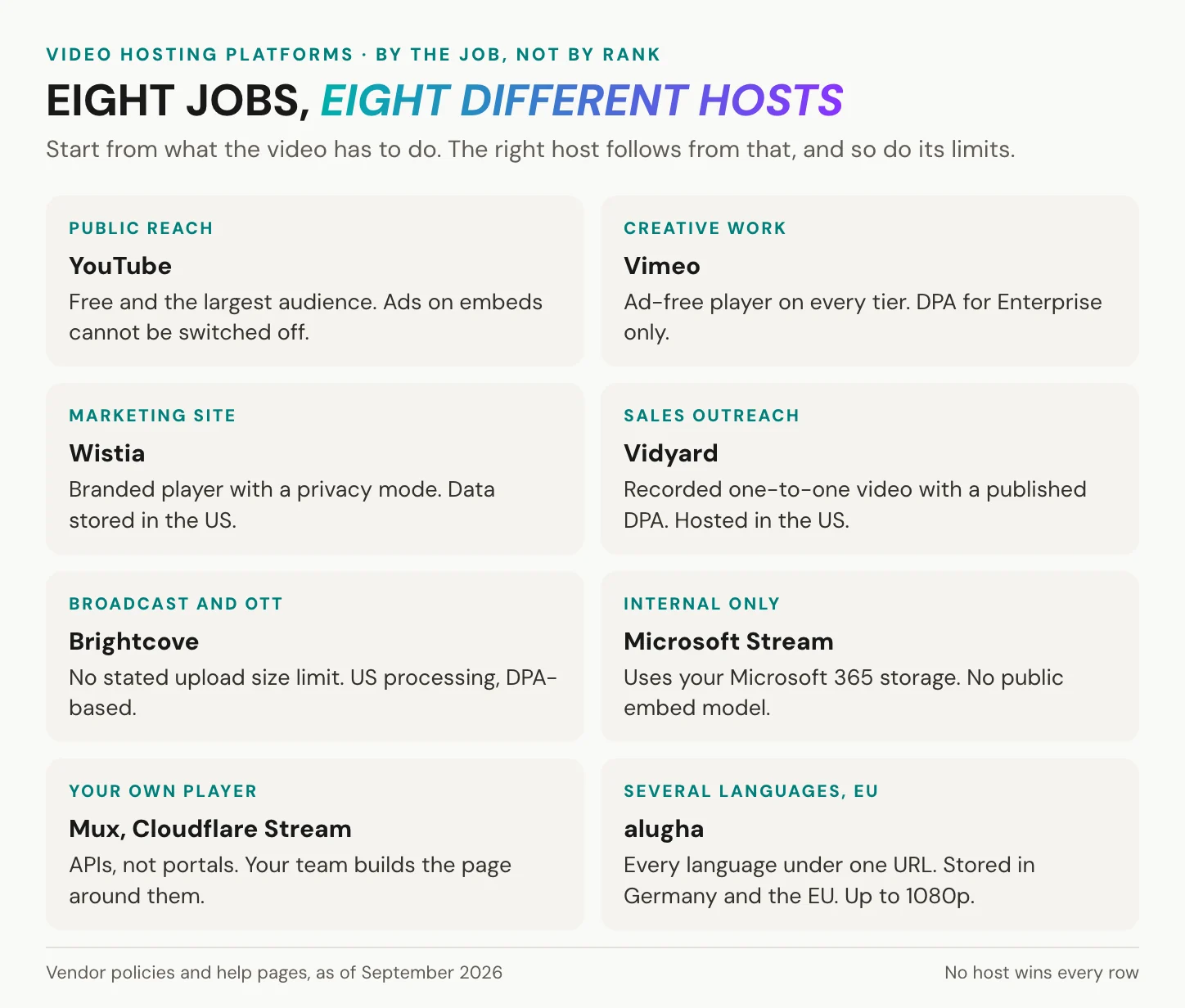
Two cards deserve a sentence more. YouTube is the right answer when the job is public reach. Nothing on this list replaces its audience. If you are leaving YouTube rather than choosing a business host, our overview of YouTube alternatives is the better starting point.
The second card is Microsoft Stream. When the audience is your own staff and they already work inside Microsoft 365, you may not need a new host at all. Stream keeps videos in the OneDrive and SharePoint storage your organisation already has and already governs.
The ten video hosting platforms further down follow the same logic as the cards: public reach, creative work, marketing, sales, broadcast, education, internal video, developers and several languages. That order describes the job each platform was built for. It is not a ranking.
What a video hosting platform does
A web server stores a file. A video hosting platform does six more jobs after that, and the difference shows the moment someone on a crowded train opens your page.
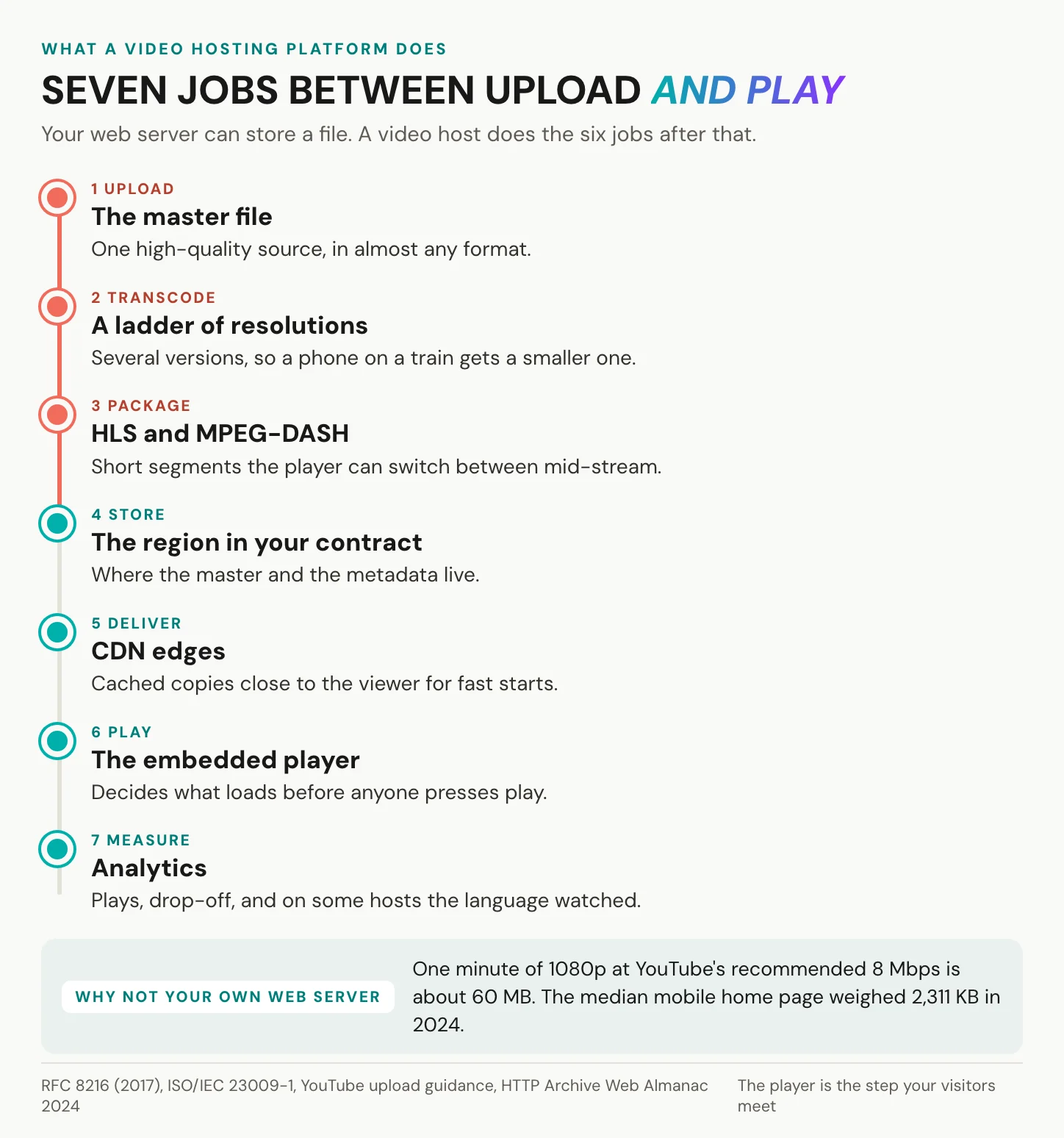
You upload one master file. The host transcodes it into a ladder of resolutions, so a phone on a weak connection gets a small version and a desktop on fibre gets the full one. Then it packages those versions into short segments in one of two common formats, HLS (RFC 8216, 2017) or MPEG-DASH (ISO/IEC 23009-1). Segments let the player climb or drop a rung mid-stream as the connection changes. The host stores the master and its renditions in a region and delivers cached copies from CDN edges close to the viewer. Finally, it plays them in an embeddable player and measures what happened.
The numbers explain why a raw file on a web server makes a poor stream. At YouTube’s recommended upload bitrate for 1080p, 8 Mbps, one minute of video is about 60 MB. The median mobile home page weighed 2,311 KB in the HTTP Archive’s 2024 Web Almanac. One minute of video is roughly 26 times that page. Multiply it by every viewer, and you see why video dominates the network. AppLogic Networks’ 2025 Global Internet Phenomena Report calls it the largest application category by volume, with users downloading an average of 5.6 GB a day.
Six of those seven steps happen out of sight. The player is the one your visitors meet.
In short: a host transcodes, packages, stores, delivers, plays and measures. The storage region and the player are where the business decisions sit.
If you only need a free link
Sometimes the job is small. A file for a client, a clip for a colleague, a link that has to work by tomorrow. Several video hosting platforms have a free way in, and each one charges for it in something other than money.
- YouTube: free, with uploads of up to 15 minutes by default and up to 12 hours once the account is verified. The price is ads, including on your embeds.
- Vimeo: a free tier with an ad-free player and a storage cap.
- Wistia: a free tier that keeps Wistia branding on the player and caps bandwidth.
- Vidyard: five recorded videos a month, new recordings limited to 30 minutes, and a limit of five embeddable videos. Deleting a video does not give the month’s slot back.
- Loom: the free tier records up to five minutes and keeps 25 videos in the library, archived ones included. It is a messaging tool more than a host, and for a quick walkthrough that is enough.
- alugha: our free tier encodes up to 720p, and the number of audio tracks per video rises with the tier. Account verification comes before the first public share or embed.
Upload tools such as Streamable, ScreenPal and VEED also hand you a shareable link. Read the retention and size limits on their own pages before a customer depends on that link.
Free always costs something. Usually it is branding, a cap or ads. Everything below is for the day the video carries your company’s name.
Eight questions that separate the hosts
Features blur after the third demo. Questions do not. Send the same eight to every vendor, in writing, and the answers line up in a way that sales decks never do. They also sort video hosting services for business from tools that merely store a file.
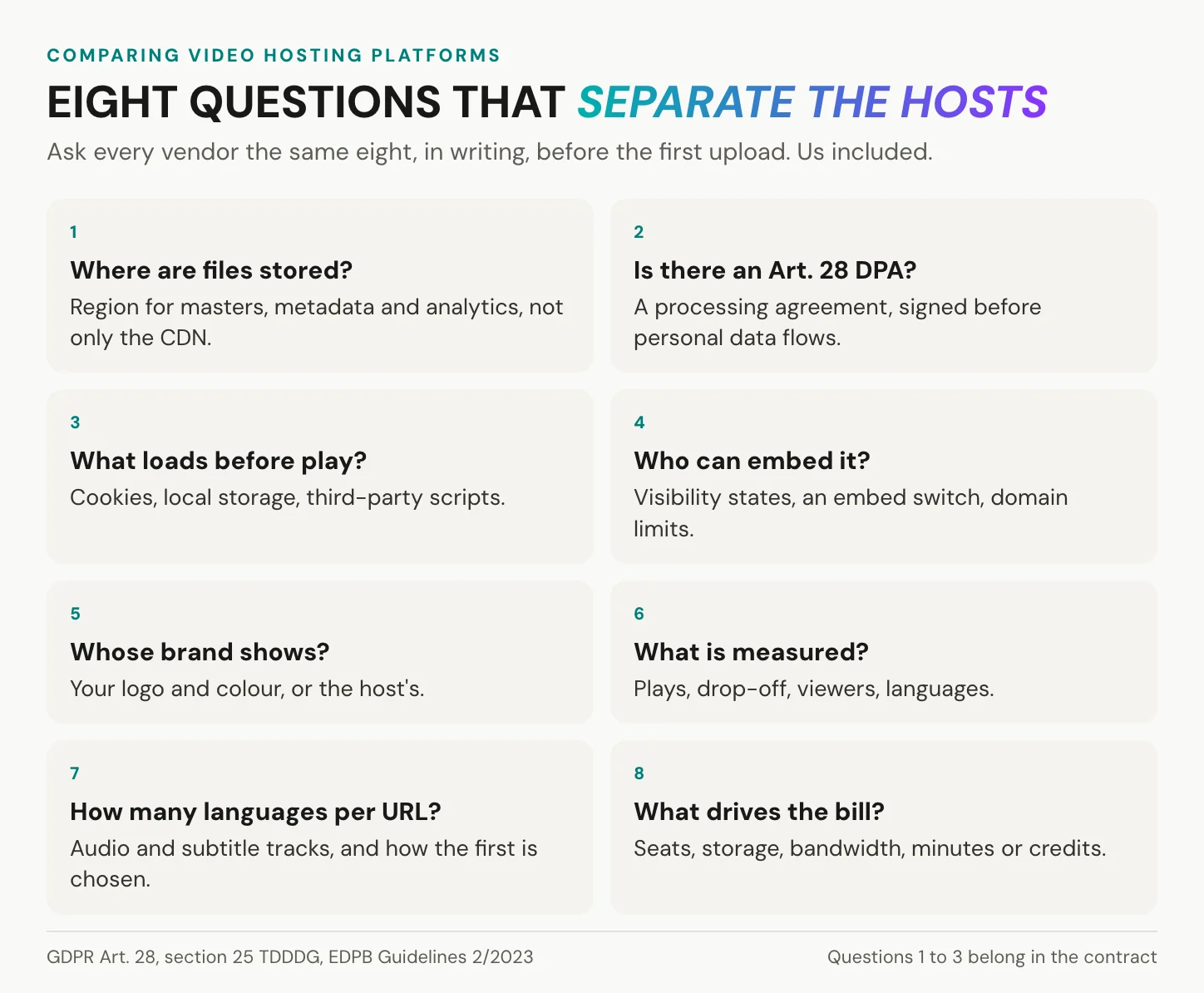
Storage is the first question, and you ask it three times: for the master files, for the metadata and for the analytics. The CDN edge that serves a viewer in Madrid says nothing about where the master sits. Vimeo’s EU option shows why the split matters: the videos stay in Germany and Belgium, while analytics, logs and video metadata stay outside the EU. The second question is whether the vendor signs an Art. 28 processing agreement. Article 28(3) GDPR lists what it must cover, from documented instructions and confidentiality to sub-processors, deletion and audits.
Question three asks what the player stores on or reads from the visitor’s device before play. The EDPB’s Guidelines 2/2023 count local storage, tracking pixels and scripts, not only cookies. Question four asks who can embed the video at all: which visibility states exist, whether one switch stops embedding, and whether there is a domain limit.
Then comes branding: whose logo shows on your page? YouTube decides its own branding treatment, and Wistia’s free tier keeps Wistia’s name on the player. Question six asks what is measured. Plays and drop-off are one thing. Viewer-level tracking is another, and it sends you straight back to question three.
Languages come seventh: ask how many audio and subtitle tracks one URL carries and how the first one is chosen. The answer decides whether a French customer hears French without touching a menu. Finally, ask what drives the bill: seats, storage, bandwidth, minutes stored and delivered, or credits. Wistia, for instance, counts player and thumbnail loads towards bandwidth.
In short: three questions belong in the contract, namely storage, the processing agreement and what the player loads. The other five decide whether your team enjoys using the host.
The 10 best video hosting platforms for business
Ten video hosting platforms follow, ordered by the job each was built for, not by rank. Every entry uses the same fields, so you compare like with like, and a table at the end puts all ten side by side. We are on the list, at number ten, and our entry names its limits first.
1. YouTube: reach no host can match
YouTube is a free, ad-funded platform built for public video that people search for, and no other host comes near its audience.
- Best for: public, searchable video whose job is reach.
- Where files are stored: ask the vendor.
- Processing agreement: Google offers none for the YouTube player.
- Languages: creator-uploaded dubbed tracks and automatic dubbing, with the first track chosen from the viewer’s watch history. Automatic captions come in the default language only, and YouTube asks creators to review them.
- Pricing model: free, funded by ads.
Strength: reach, and the habit that comes with it. In Wyzowl’s 2026 survey, 82 percent of businesses said they upload their videos to YouTube. The survey had 266 respondents, marketers and consumers combined, so the business share rests on a smaller group. Verified accounts can upload up to 256 GB or 12 hours per video, whichever is less.
Limit: embedded videos may show ads, and the only off switch is to disable embedding. Since 2018, related videos cannot be switched off. The YouTube section further down has the detail.
2. Vimeo: the ad-free generalist
Vimeo is a general-purpose host with a clean player, liked by creative teams and by companies that need somewhere tidy for everyday video.
- Best for: creative teams and general company video.
- Where files are stored: Google Cloud locations in the US. An EU data residency option on enterprise contracts keeps videos in Germany and Belgium, while metadata, analytics and logs stay outside the EU.
- Processing agreement: for enterprise and OTT customers only, or in the words of Vimeo’s help centre: “We do not offer a DPA for self-serve users.”
- Languages: several audio tracks per video, and AI audio translation covering 61 source and 27 target languages on enterprise contracts.
- Pricing model: tiers by total storage, with older accounts still on two earlier quota models.
Strength: the player shows no ads on any tier, the free one included. The EU residency option is genuine.
Limit: the contract terms stop at the self-serve line. Bending Spoons has owned Vimeo since 24 November 2025. Vimeo On Demand shuts down on 20 November 2026.
3. Wistia: the marketing team’s player
Wistia builds a player for marketing sites, with the controls around it that a marketing team asks for.
- Best for: marketing sites and landing pages.
- Where files are stored: all personal information in the US, under the Data Privacy Framework plus standard contractual clauses.
- Processing agreement: yes, through its Trust Center.
- Languages: alternate audio tracks per video, which viewers switch in the player without interrupting playback.
- Pricing model: users, storage and bandwidth, where bandwidth counts player and thumbnail loads.
Strength: a privacy mode that anonymises IP addresses and disables session tracking, and a player that has set no tracking cookies since January 2020. Its help centre adds that accounts can be made completely private and password-protected.
Limit: storage is in the US. The player uses local storage instead of cookies, and European guidance puts local storage under the same consent rule. The free tier keeps Wistia branding.
4. Vidyard: video for the sales inbox
Vidyard is built around one motion: record a video and send it to one person, usually a prospect.
- Best for: recorded one-to-one sales video.
- Where files are stored: the company is headquartered in Canada, and its services are hosted in the US.
- Processing agreement: published, with the current text dated 2 November 2023.
- Languages: ask the vendor.
- Pricing model: a free tier with limits, then paid tiers.
Strength: recording and sending sit at the centre of the product, not at its edge. A salesperson gets from camera to inbox without a detour through a media library.
Limit: the free tier stops at five embeddable videos, and deleting a recording does not restore the monthly quota. Hosting is in the US. For a marketing library or a training portal, other rows on this list fit better.
5. Brightcove: broadcast-grade delivery
Brightcove serves media companies and large organisations that run on-demand and live video at scale.
- Best for: OTT services, media companies and large live or on-demand libraries.
- Where files are stored: primary processing facilities in the US, under the Data Privacy Framework and standard contractual clauses.
- Processing agreement: yes, and Brightcove says it processes customer and viewer data only under one.
- Languages: ask the vendor.
- Pricing model: ask the vendor.
Strength: Brightcove states no file size limit for uploads and says it has tested uploads as large as 100 GB without issues.
Limit: since 4 February 2025 Brightcove belongs to Bending Spoons, the same owner as Vimeo. Two of the ten rows now share one owner. For a single product page, broadcast-grade infrastructure is more than the job needs.
6. Kaltura: education and enterprise video
Kaltura runs video portals for universities and for large organisations with big internal libraries.
- Best for: universities and large internal video libraries.
- Where files are stored: in the US by default, with regional clouds in the EU, Singapore, Australia and Canada for customers with special requirements. Transfers to countries without an adequacy decision rest on standard contractual clauses, and its EU representative is Kaltura Germany GmbH in Frankfurt.
- Processing agreement: ask the vendor.
- Languages: ask the vendor.
- Pricing model: ask the vendor.
Strength: Kaltura publishes no fixed file size limit, and a regional EU cloud exists for those who ask.
Limit: EU hosting comes on request, not by default. Ask for it before the first upload, not after the library has grown. For a university that already runs Kaltura, the useful question is which region its account sits in, not whether to switch.
7. Microsoft Stream: when the audience is already in Microsoft 365
Stream is the video layer of Microsoft 365, and the entry for teams that may not need a new host at all.
- Best for: internal-only video for staff who already work in Microsoft 365.
- Where files are stored: in your tenant’s OneDrive and SharePoint, drawing on its existing storage quota.
- Processing agreement: ask the vendor.
- Languages: ask the vendor.
- Pricing model: no separate fee, because videos consume the storage quota you already have.
Strength: adaptive streaming inside a tenant your IT team already governs, with no new vendor to onboard.
Limit: there is no model for public embeds on a marketing site. The older Stream (Classic) has been retired, and videos migrated from it received no extra storage. For a training library that never leaves the company, Stream is often enough. For public pages, it is the wrong row.
8. Cloudflare Stream: video as an API
Cloudflare Stream is a developer product, with upload, encoding and delivery behind an API on Cloudflare’s network.
- Best for: product teams building their own player page.
- Where files are stored: Stream’s storage region is not stated, while an EU metadata boundary and regional services come with Cloudflare’s enterprise data localisation features.
- Processing agreement: ask the vendor.
- Languages: additional audio tracks attach through the API, one of them marked as the default.
- Pricing model: minutes stored and minutes delivered, with encoding included, so both meters count running time rather than gigabytes.
Strength: the network, which Cloudflare’s network page put at 348 cities in September 2026.
Limit: there is no portal for a marketing team, and someone writes code before the first video plays. For a product team already building on Cloudflare, that is a small step; for a marketing team without developers, it is the whole project.
9. Mux: infrastructure with a published DPA
Mux offers streaming and viewer analytics as APIs for developers.
- Best for: developers who want streaming plus viewer analytics.
- Where files are stored: not stated for video, while Mux Data, the analytics product, has an EU ingest point in Germany. After processing, view data with truncated IP addresses goes to the US and is kept for up to 100 days.
- Processing agreement: published, last updated on 1 April 2025.
- Languages: alternate audio tracks through the API, which viewers switch in the player, usually from a menu.
- Pricing model: ask the vendor.
Strength: Mux documents where viewer data goes, step by step, down to the last octet it removes from each IP address.
Limit: it is a developer product, and viewer data ends up in the US.
10. alugha: every language under one URL, stored in the EU
alugha is our platform: hosting, a multilingual player and the AI workflow that fills it with languages.
- Best for: companies that ship one video to several language markets.
- Where files are stored: servers in Germany and the EU.
- Processing agreement: ask us, as you would any host.
- Languages: every audio and subtitle track under one URL, with the first language taken from the viewer’s browser setting.
- Pricing model: one credit balance for AI, encoding, storage and traffic, with a free tier to start.
Limit: we encode at 540p, 720p or 1080p, with no 4K, and the free tier stops at 720p. Embeds have no password protection, and account verification comes before the first public share or embed.
Strength: our player carries no third-party advertising cookies and trackers, shows no ads and makes no third-party recommendations. The multilingual section below explains how the language choice works.
The ten video hosting platforms side by side
Seven columns, ten rows, and the table reads best across, not down. There is no column for upload, encoding or playback, because every host here does those jobs. The cells that differ are the ones a legal review or a second market will ask about. Where a cell reads “ask the vendor”, treat it as the next line of your questionnaire rather than a gap. On storage and on the processing agreement, a missing answer stays a risk until the vendor puts one in writing.
| Platform | Built for | Stored by default | EU option | Art. 28 DPA | Several audio languages | Pricing model |
|---|---|---|---|---|---|---|
| YouTube | public reach | ask the vendor | ask the vendor | none for the player | yes, first from watch history | free, ad-funded |
| Vimeo | creative, general | US | enterprise contracts, Germany and Belgium; analytics outside | enterprise and OTT only | yes | storage tiers |
| Wistia | marketing | US | ask the vendor | yes | yes, manual switch | users, storage, bandwidth |
| Vidyard | sales | US | ask the vendor | yes, published | ask the vendor | free tier with limits, paid tiers |
| Brightcove | broadcast, OTT | US | ask the vendor | yes | ask the vendor | ask the vendor |
| Kaltura | education, enterprise | US | regional EU cloud on request | ask the vendor | ask the vendor | ask the vendor |
| Microsoft Stream | internal only | your Microsoft 365 tenant | ask the vendor | ask the vendor | ask the vendor | existing storage quota |
| Cloudflare Stream | developers | not stated for Stream | metadata boundary, enterprise | ask the vendor | yes, via API | minutes stored and delivered |
| Mux | developers | not stated for video; viewer data to the US after EU ingest | EU ingest for viewer data | yes, published | yes, via API | ask the vendor |
| alugha | multilingual, EU | Germany and the EU | default | ask us | yes, first from browser language | one credit balance, free tier |
Vendor details as of September 2026, from each vendor’s own policy or help pages.
In short: the rows differ less on features than on three cells. Where the files sit, whether a processing agreement exists, and how many languages one URL carries.
Put one video in three languages behind a single embed code, stored in Germany and the EU. Create a free alugha account, or book a call and walk through your shortlist with us.
Where your video files are stored
Start with the concession. For a public product video, YouTube’s reach outweighs everything in this section, and no storage region changes that. The calculation shifts for internal training, customer and patient video, and for any embed on a site that serves visitors in the EU. There, business video hosting is also a processing decision.
Storage region and transfers
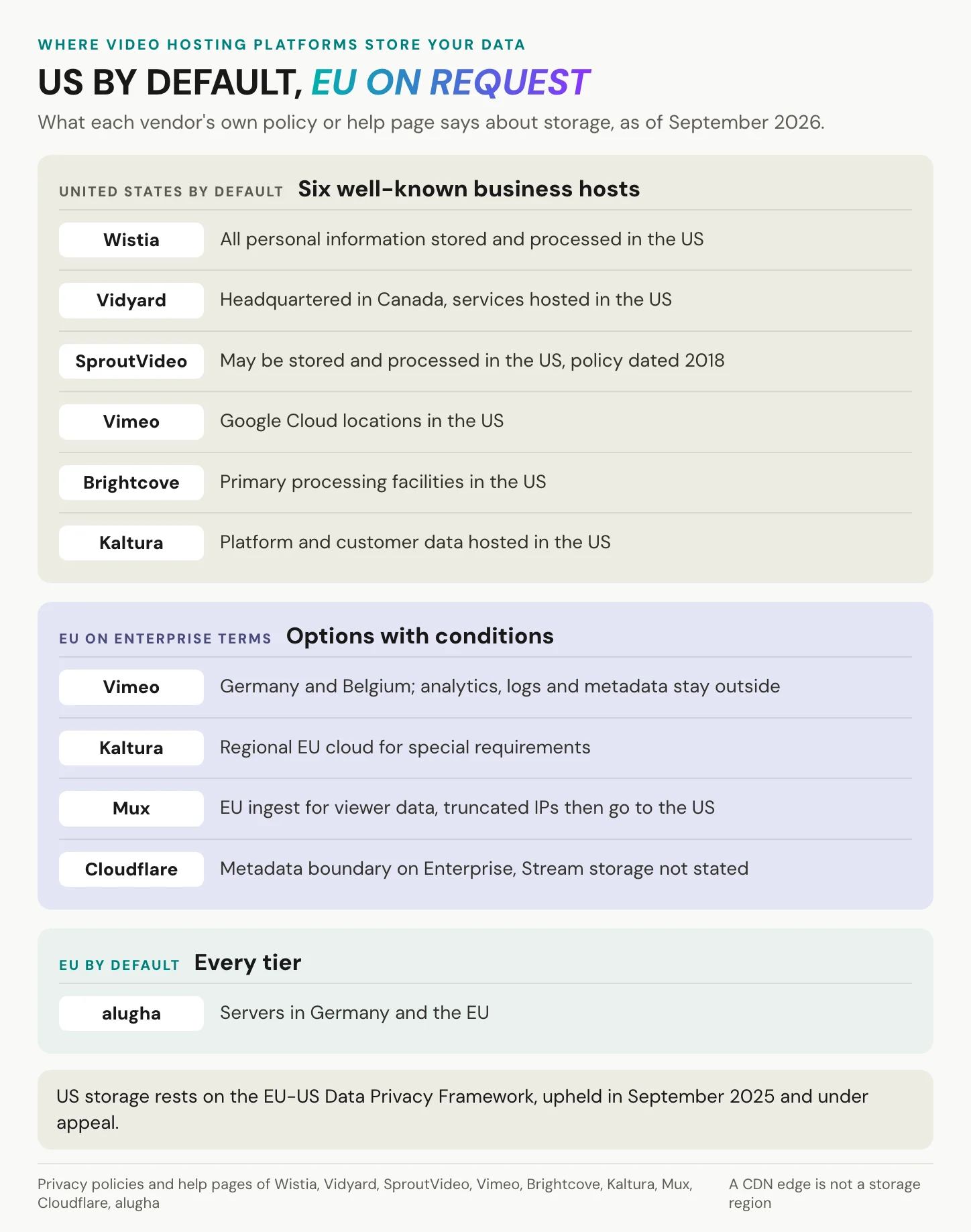
Every video hosting platform on the list delivers from edges around the world. The question is where the master files, the metadata and the analytics live, and for six well-known hosts the answer is the United States by default.
A CDN edge is not a storage region. The master file lives in one country, and your contract should name it.
That can be lawful: the EU-US Data Privacy Framework was adopted on 10 July 2023. The EU General Court upheld it in Latombe on 3 September 2025, and the case is now under appeal. Its predecessor did not survive, because the Court of Justice invalidated the Privacy Shield in Schrems II on 16 July 2020. US storage rests on the Data Privacy Framework or standard contractual clauses today, while EU storage does not depend on how the appeal ends.
One policy in the group is older than the others. SproutVideo’s privacy policy was last updated on 24 May 2018 and names no transfer mechanism, though a processing agreement may still exist on request.
The Art. 28 agreement
A host that stores your uploads and your viewers’ IP addresses on your behalf is a processor. Article 28(1) GDPR says you may only use processors that give sufficient guarantees. Article 28(3) requires a contract covering instructions, confidentiality, security, sub-processors, help with data-subject requests, deletion or return, and audits.
Wistia, Vidyard, Brightcove and Mux offer one, and Vimeo offers one to enterprise and OTT customers only. Google offers none for the YouTube player. A missing or incomplete processor contract falls under Article 83(4), with fines of up to 10 million euros or 2 percent of worldwide annual turnover, whichever is higher. Ask any host, us included, for the signed agreement before the first upload. Our article on GDPR-compliant video hosting walks through the rest of that checklist.
What the player loads before play
Fewer cookies are a real improvement. Hosts that removed them deserve credit, and Wistia’s player, for one, has set no tracking cookies since 2020. The legal test is broader, though.
Section 25 TDDDG, the German transposition of the ePrivacy rule, requires consent before anything is stored on or read from the visitor’s device. The exception covers only what is strictly necessary for a service the visitor explicitly asked for. Germany’s data protection conference treats embedded videos as additional services a visitor only wants once they use them. The EDPB’s Guidelines 2/2023 count local storage, pixels and scripts, not just cookies. Under the Court of Justice’s Fashion ID ruling of 29 July 2019, a site that embeds a third-party plug-in can be joint controller for collecting and transmitting visitor data. That was a Facebook button, and it applies to players by analogy. In January 2022, a Munich regional court ruled that loading Google Fonts from Google’s servers sent visitors’ IP addresses to Google without consent. It awarded 100 euros in damages, and that case, too, applies to players only by analogy.
A figure of up to 60 percent of video views lost to consent banners circulates in vendor comparisons. No named study stands behind it. The legal mechanism is the part you can plan with.
Our own row, in one sentence: we store in Germany and the EU, and our player carries no third-party advertising cookies and trackers. That narrows the consent question to one jurisdiction. It does not remove it.
In short: ask every host for the storage region of files, metadata and analytics, a signed Art. 28 agreement, and a list of what the player stores or reads before play.
When YouTube is still the right choice
YouTube earns its place. It is free, it holds the audience, and most businesses in Wyzowl’s 2026 survey already upload there. For a public product video whose job is to be found, it is the right host.
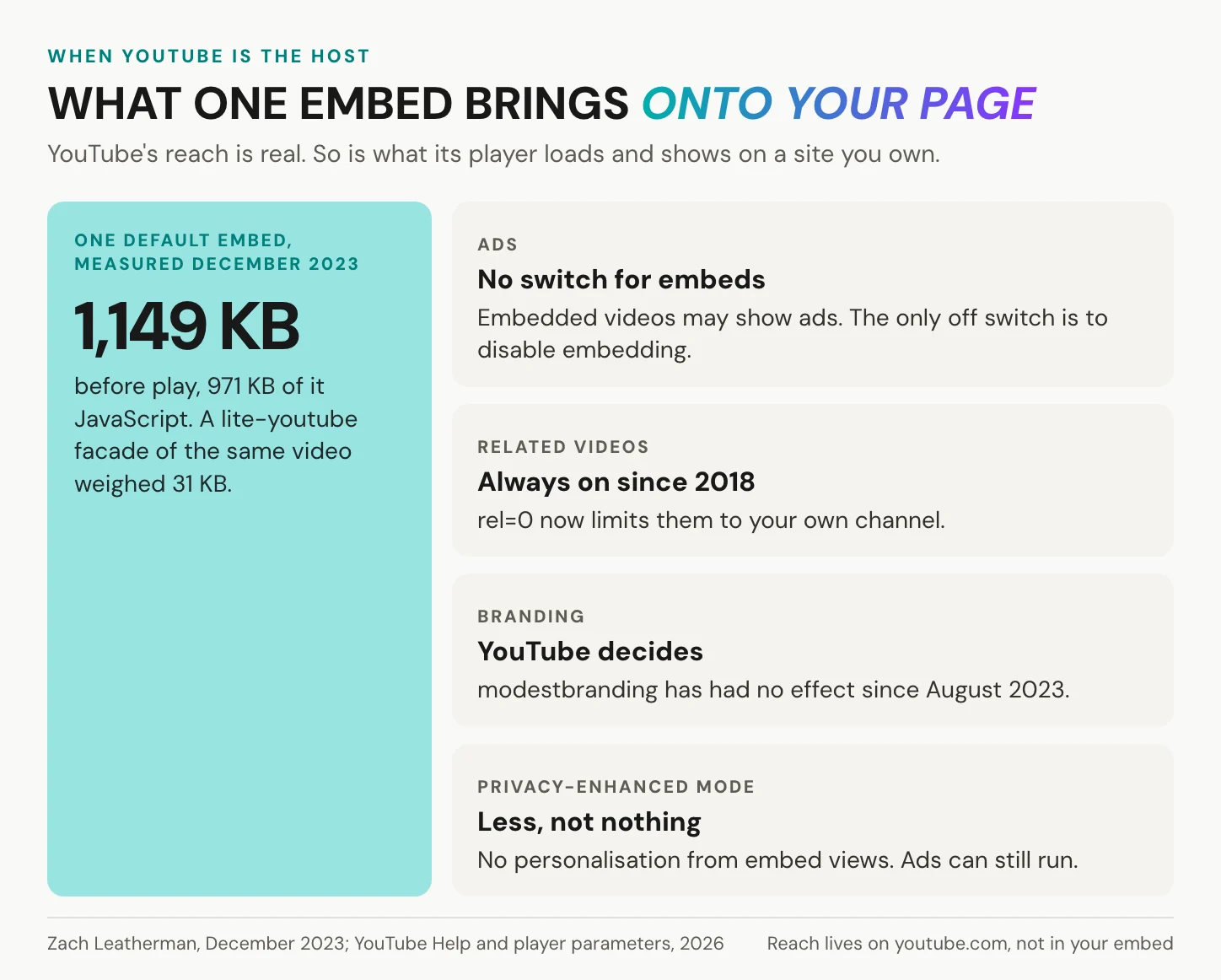
The costs appear on your own page. Embedded YouTube videos may show skippable or non-skippable ads. YouTube’s help page is plain about the remedy: there is no way to turn off ads on embeds only, so the switch is to disable embedding altogether. The site owner earns no share. Related videos cannot be disabled since September 2018, and the rel=0 parameter now limits them to the channel of the embedded video. The modestbranding parameter has had no effect since August 2023, so YouTube decides its own branding.
Privacy-enhanced mode helps, within limits: it stops embed views from personalising the viewer’s YouTube experience and makes any ads non-personalised. It does not remove the ads.
Then there is weight. Zach Leatherman measured a default embed at 1,149 KB before play in December 2023, 971 KB of it JavaScript. A lite-youtube facade of the same video weighed 31 KB. Google may also index the video on YouTube’s own page as well as on yours, so your embed can end up competing with its source.
The resolution is not either-or. Put the public, reach-driven cut on YouTube, and host the product, training and customer versions where you control the player. If you are leaving YouTube altogether, our overview of YouTube alternatives groups the options. For sales follow-ups, how to embed a video in an email shows the route that survives the inbox.
In short: YouTube is a distribution channel. The embed on your own page is where its costs appear.
Video hosting platforms for multilingual teams
Languages are where the rows split. A German training video that also has to work in France, Spain and Poland turns a choice between video hosting platforms into a workflow choice.
What a multilingual video hosting platform has to do
There are two models. In the first, you upload one video per language and manage several URLs, several embed codes and several sets of analytics. In the second, one video carries several audio and subtitle tracks behind one URL.
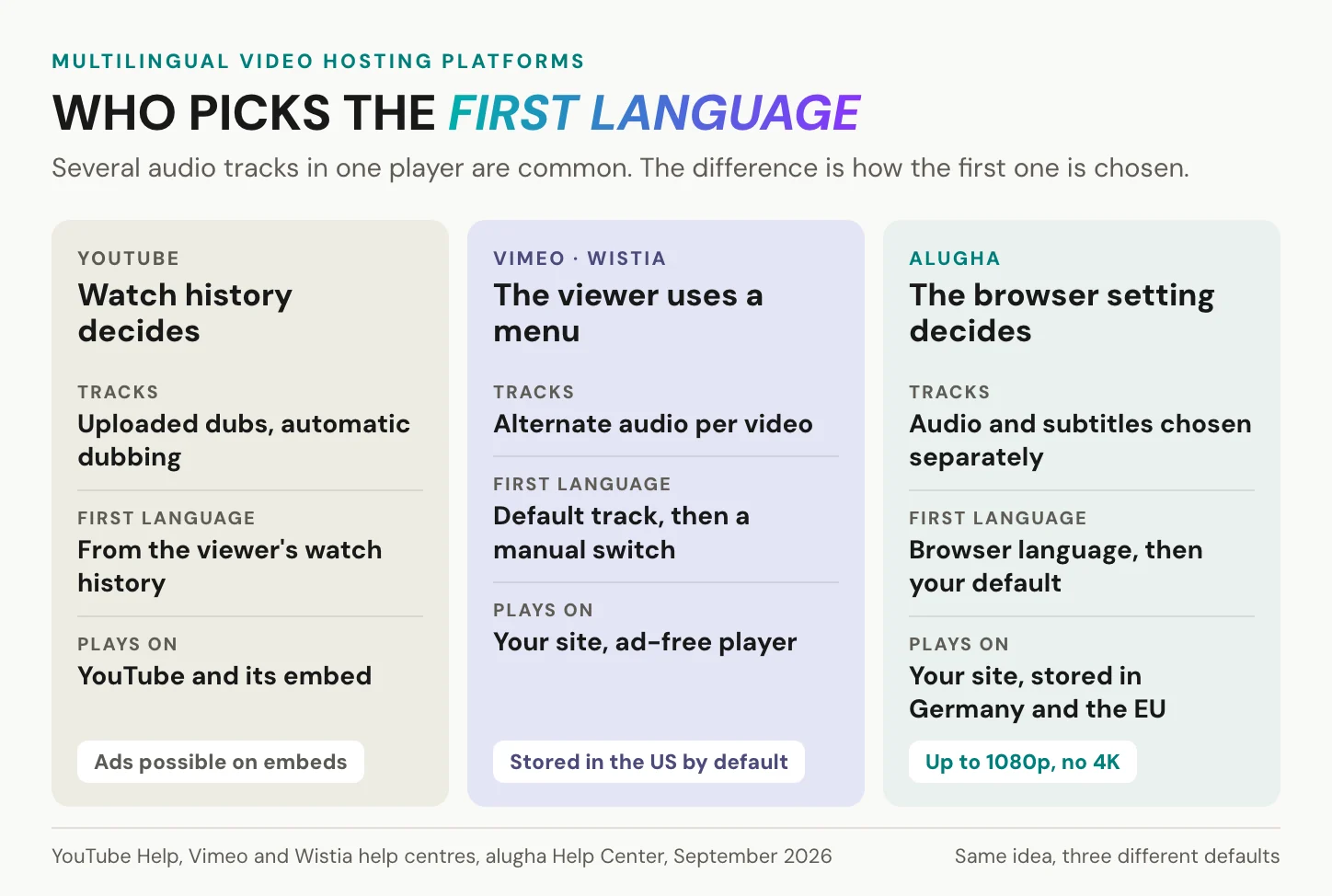
The second model is no longer rare. YouTube, Vimeo and Wistia all carry several audio tracks in one player, and Cloudflare Stream and Mux attach them through their APIs. The real difference is who picks the first language. YouTube uses the viewer’s watch history. Vimeo and Wistia let the viewer switch tracks in the player, and neither describes an automatic first pick. Our player reads the browser’s language setting. Whatever the model, the player has to switch without a reload, and subtitles need the same care as audio. Our explainer on closed captions covers that side.
One URL, every language, with alugha
The limits come first, and the encoding ceiling and the missing password protection for embeds from our entry above still apply. Two more matter for multilingual work. The number of audio tracks per video rises with the tier, and the analytics that split plays by language track and count subtitle views sit on our top tier. For viewer-level marketing analytics, other rows on this list go further.
Now the advantage: you upload once and get one URL and one embed code. Our multilingual video player reads the viewer’s browser language and starts there; if we have no match, it falls back to the default you set. Audio and subtitles are chosen separately, mid-playback, with no reload, so a viewer can pair English audio with French subtitles. Title, description and thumbnail are set per language in the dubbr, and a shared link unfurls into a preview card built from that per-language metadata. Our Help Center explains the automatic language switcher in detail.
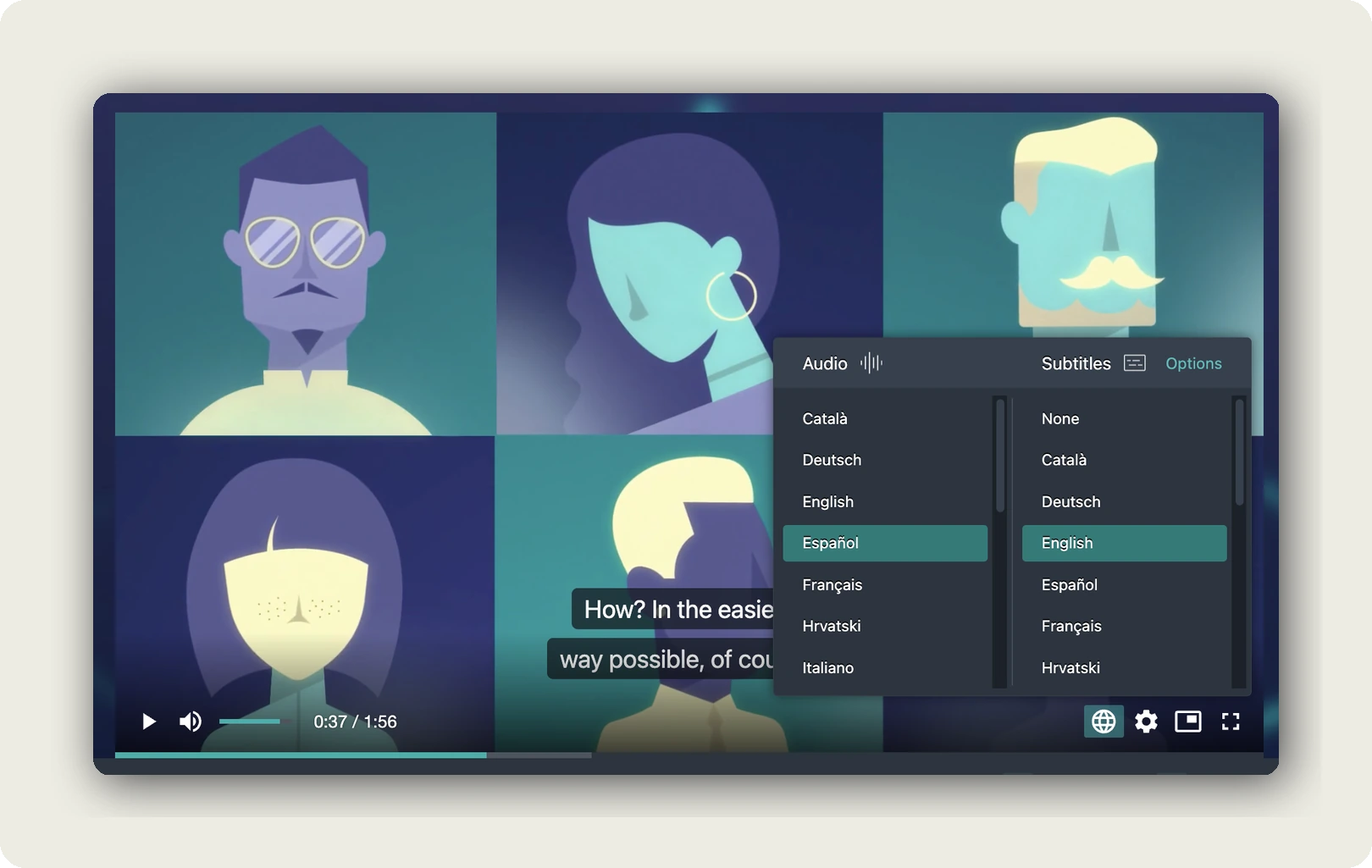
One URL carries every language of the video, and the browser decides which one plays first.
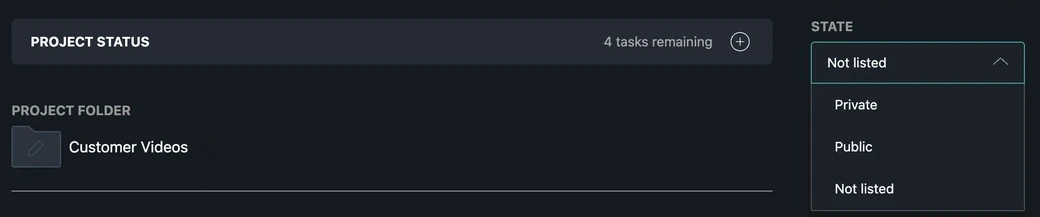
Control is deliberately simple. A project is Private, Public or Not listed, and Not listed means anyone with the link can watch. One switch prevents embedding everywhere at once. Folder-level permissions decide which users reach which content, and a paid tier can restrict where the player embeds. The steps are in set video visibility and privacy.
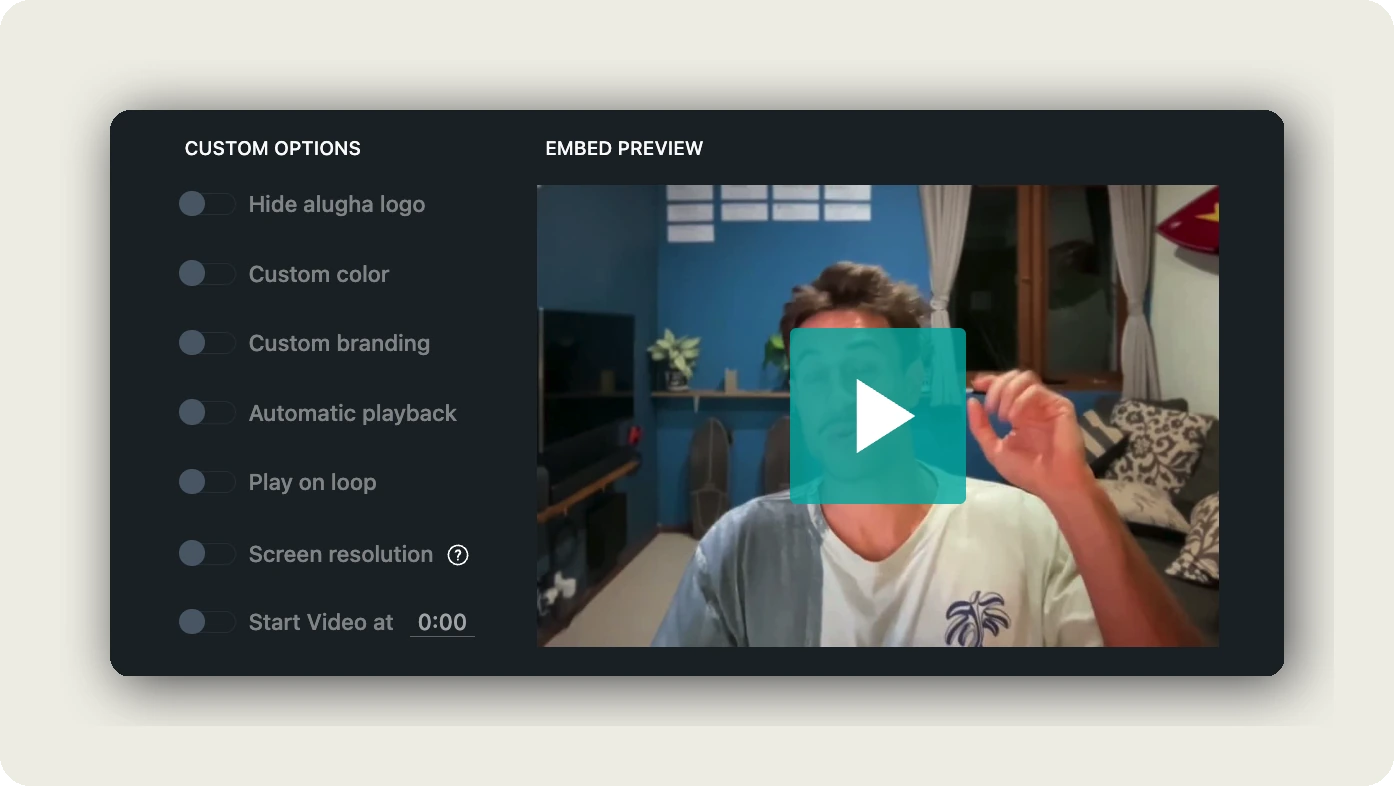
The videos sit on servers in Germany and the EU and reach viewers through a global CDN with over 100 data centres. On a paid tier, a branding profile puts your logo and colour on the player.
Transcription, translation and dubbing run in the same workflow, and every step shows its credit cost before you confirm. The details are in how to translate a video and what dubbing and AI dubbing are. AI-voiced tracks fall under the transparency duties in Article 50 of the EU AI Act, which apply from 2 August 2026.
When you do not need us
Plenty of teams do not. A public, single-language video whose job is reach belongs on YouTube. If viewer-level engagement data decides the purchase, our analytics will not be enough; look at the marketing hosts and at Mux, and ask them about heatmaps and CRM sync. 4K masters or broadcast delivery call for Brightcove-class infrastructure. An internal audience that lives in one Microsoft 365 tenant is already served by Stream. A team with a compliant EU host and no second language gains nothing from a one-URL player. One more boundary for training teams: Moodle takes our player as an iframe, and we emit no xAPI statements. The setup is in embed alugha in Moodle.
In short: several hosts carry several languages. Ours starts in the viewer’s browser language, on your own site, stored in Germany and the EU.
Frequently asked questions about video hosting platforms
Which is the best video hosting platform?
The one built for your job. YouTube wins on public reach, Wistia on marketing sites, Vidyard on sales outreach and Brightcove on broadcast delivery. Microsoft Stream suits internal video inside Microsoft 365. alugha suits one video in several languages, stored in Germany and the EU. No host wins every row, so put the eight questions above to your shortlist in writing.
What is a video hosting service?
A video hosting service turns your master file into video people can watch anywhere. It transcodes the file into a ladder of resolutions, packages it in HLS or MPEG-DASH, stores it, delivers it over a CDN and plays it in an embeddable player, usually with analytics. The ladder of resolutions and the player are exactly what a plain web server lacks.
Is there a free video hosting platform?
Yes, several: YouTube is free and funded by ads. Vimeo has a free tier with an ad-free player and a storage cap. Wistia’s free tier keeps its branding on the player, and Vidyard’s allows five embeddable videos. Our free tier encodes up to 720p and needs account verification before the first public share. Free usually costs ads, branding or a cap.
Is Vimeo free to host videos?
Vimeo has a free tier, its player shows no ads on it, and storage is capped. For business use, two details matter more than the price. Vimeo offers no data processing agreement to self-serve users, and its EU data residency option is limited to enterprise contracts. Vimeo has also belonged to Bending Spoons since November 2025, a change of owner worth knowing.
How much does it cost to host a video?
That depends less on the price list than on the pricing model. Hosts charge by seats, storage, bandwidth, minutes stored and delivered, or credits, and Wistia counts even player and thumbnail loads as bandwidth. As a yardstick, one minute of 1080p at YouTube’s recommended 8 Mbps is about 60 MB. Ask for the pricing model before you ask for the price.
Who is YouTube’s biggest competitor for business video?
For watching, no single platform comes close. For publishing business video, the competitors are the hosts on this list, each for its own job: Vimeo for general company video, Wistia for marketing, Brightcove for broadcast. Vimeo and Brightcove have shared an owner, Bending Spoons, since November 2025. Our overview of YouTube alternatives groups the options by use.
Do I need a data processing agreement with my video host?
Yes, whenever the host processes personal data such as viewer IP addresses on your behalf. Article 28(3) GDPR requires a contract that covers instructions, security, sub-processors, deletion and audits. Vimeo offers one only to enterprise and OTT customers, and Google offers none for the YouTube player. Ask any host, us included, before the first upload. More in our GDPR hosting article.
Getting started
Somewhere on your roadmap is the next embed code you will paste. Before you paste it, do three things. First, pick the job from the quick picks, because the job narrows ten video hosting platforms to three. Second, send the eight questions to those three and get the answers on storage, the processing agreement and player behaviour in writing. Third, test one real video in every language you sell in, on the page where it will live, with a browser set to each language. If one of the three is us, our free tier is enough for that test. Teams whose first use case is training will find the production side in how to create training videos.
The code you paste is short. What it decides is not.
Test one video in every language you sell in, on your own page. Create your free alugha account or book a call with our team.