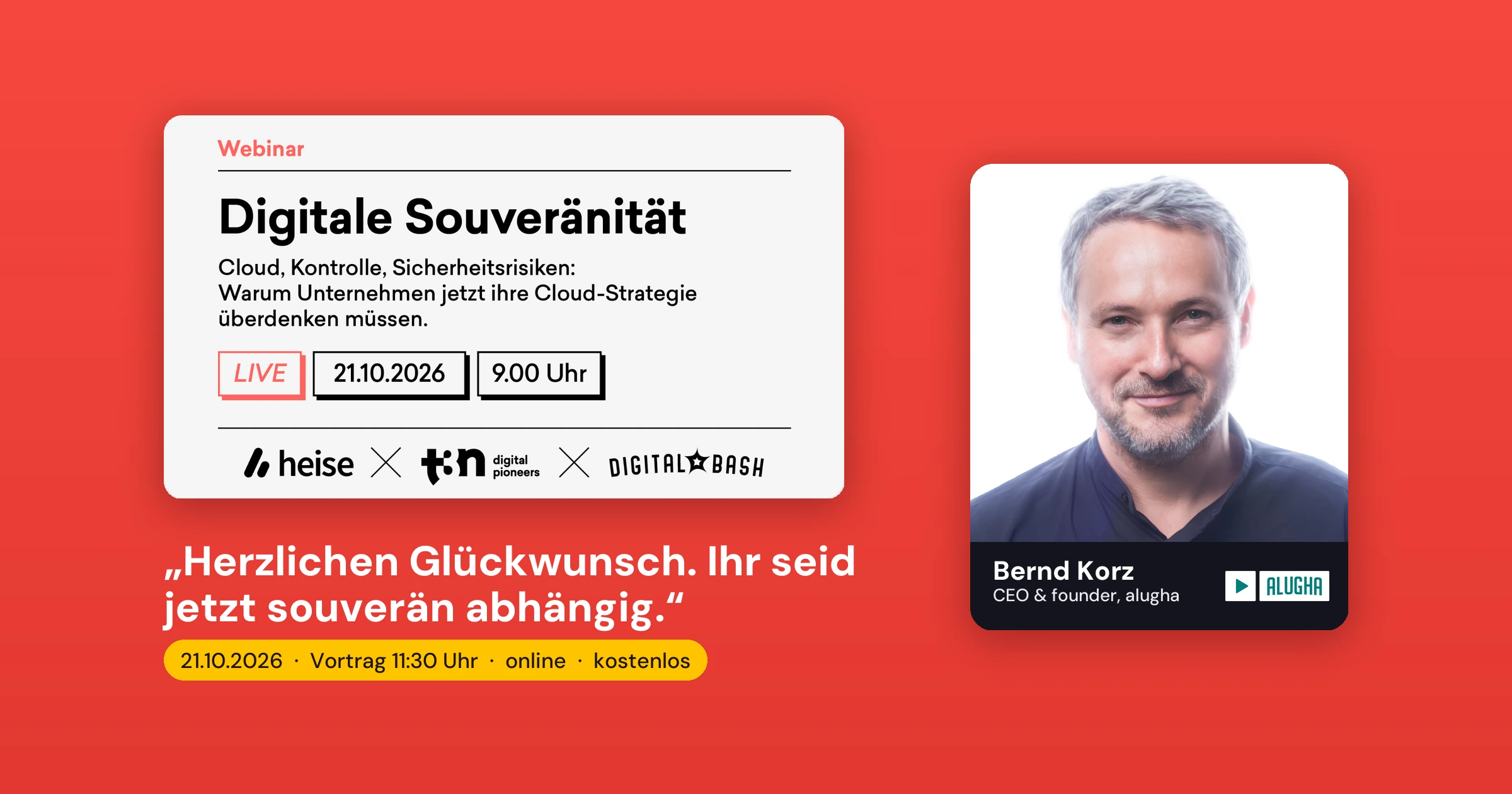
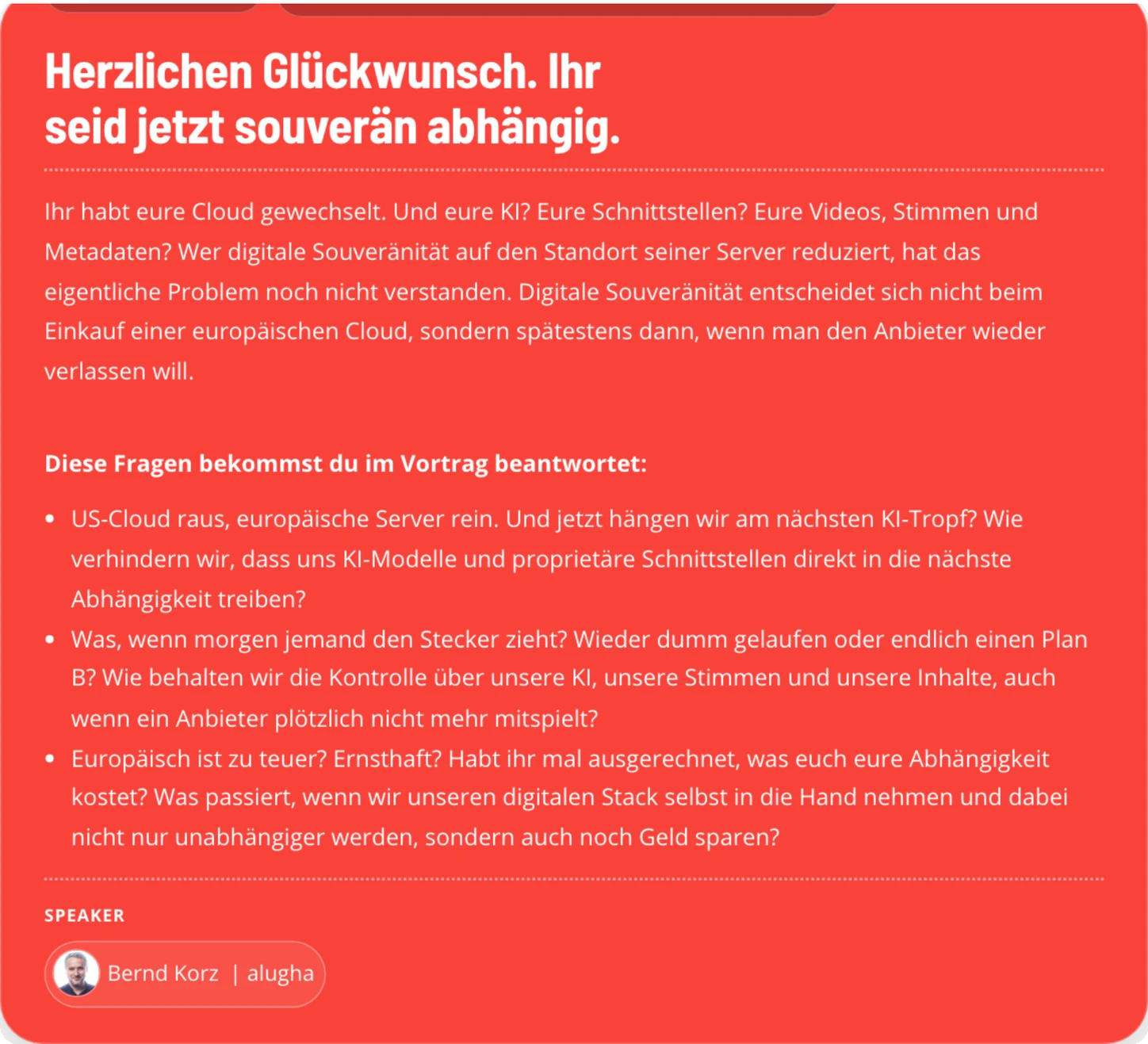
On Wednesday, 21 October 2026, at 11:30, our CEO Bernd Korz closes the speaker line-up of t3n x heise x Digital Bash: Digitale Souveränität. His talk carries a title that reads like a greeting card: “Herzlichen Glückwunsch. Ihr seid jetzt souverän abhängig.” Congratulations, you are now sovereignly dependent. The online conference is free, runs in German from 09:00 to 12:05, and every registered attendee receives the recording and the slides afterwards.
Key takeaways
- Bernd Korz speaks on 21 October 2026 from 11:30 to 12:00, the last of five talks at t3n x heise x Digital Bash on digital sovereignty. Attendance is free and online.
- His point: moving to a European cloud fixes one layer of vendor lock-in. AI models, proprietary APIs, voices, videos and metadata can tie you to the next provider.
- The talk answers three questions: how to avoid the next AI dependency, what your plan B is if a provider pulls the plug, and what dependency really costs.
- We moved our complete AI video pipeline off US hyperscalers, with no AWS and no OpenAI, and spend less on infrastructure than on a comparable US setup.
- The morning brings five talks in 3 hours: noris network, Exasol, VITAS, plusserver and alugha, moderated by Digital Bash founder Marc Stahlmann.
- Registration takes one form on digitalbash.de and includes the recording, so a clash with a meeting on 21 October costs you nothing.
Free, online, in German: register for t3n x heise x Digital Bash on 21 October and get the recording and slides afterwards.
Why a European cloud is only half the job
Moving workloads from a US hyperscaler to a European provider is real work, and it pays off. It answers the jurisdiction question: whose law reaches the servers, and whether the US CLOUD Act can compel a provider to hand over data. In April, Bernd described at the same event how we built a European stack for alugha, layer by layer.
But a server location is a fact about the past. Vendor lock-in is a question about the future: what it costs you to leave. You are locked in when switching a provider costs more than staying, in money, in time or in lost data. A European cloud contract does not change that. If the language model behind your product sits behind one vendor’s API, if your voice clones only exist in one vendor’s format, if your videos, transcripts and subtitle tracks can only be exported without their metadata, the dependency simply moved.
That is the gap the title of Bernd’s talk points at. Sovereignty is not decided when you buy a European cloud. It is decided the day you want to leave a provider again, and find out whether you can.
In short: data location protects you from foreign access. Portability protects you from your own provider. Digital sovereignty needs both.
Three questions Bernd answers on 21 October
Out of the US cloud, onto the next AI drip?
The first question is about the layer most migration plans skip. Teams move compute and storage to European servers, then connect their product to the most convenient AI model through a proprietary interface. Prompts, fine-tunes, embeddings and workflows grow around that one API, and within a year the new dependency is deeper than the old one. Bernd shows how we kept that from happening at alugha. We replaced the AI models in our pipeline, historically the hardest component to move, with open-source and European-licensed models running on infrastructure in the EU. The rule behind it is simple to state and harder to keep: no AI component without a path to replace it. The talk covers what that rule means in practice for speech-to-text, translation and synthetic voices.
What if someone pulls the plug tomorrow?
The second question is the plan B. A provider changes its terms, raises prices, gets acquired, or stops serving a market. Then the question is not who is to blame but what you still control: your AI, your voices and your content. For a video platform that is concrete. Every video we host is more than a file. It carries transcripts, subtitle tracks, audio tracks in other languages, synthetic voices, titles and descriptions per language. If those only live inside one system, a switch means starting again. Bernd talks about which assets a company should be able to take with it at any time, in which formats, and why an exit test belongs in the first week of a project rather than in the last week of a contract. Our own rule for subtitles, for example, is that they leave in open formats such as WebVTT and SRT.
Is European really too expensive?
The third question turns the usual objection around. “Europe is too expensive” is usually said without a number for the alternative: what does the dependency cost? Lock-in has a price, and it rarely appears on an invoice. It shows up as egress fees, as price increases you cannot refuse, as migration projects that take a year. In our case, the infrastructure bill went the other way. After the migration, we spend less on infrastructure than we did on a comparable US setup. In April, Bernd brought the breakdown of which layers are cheaper, which cost roughly the same, and where the real savings come from. This time he asks what happens when a company takes its whole digital stack into its own hands, and becomes more independent and cheaper at once.
What we run, and what we left behind
We are a German multilingual video platform, and we run the complete AI pipeline ourselves: speech-to-text, automated translation, voice cloning that keeps the speaker’s intonation, and multilingual playback in a single player. A few years ago, parts of that stack ran on US infrastructure, like most SaaS products of the time. Today, none of it does. There is no AWS and no OpenAI in our delivery path.
The migration covered every layer. Compute and storage moved to European hosting providers. Identity, analytics, email and payments moved to providers under European ownership. Our own company files, shared folders and calendars run on Nextcloud, open-source software from Stuttgart. For customers, that means hosting in Germany and the EU, no third-party advertising cookies and trackers, on a platform that teams at Warner Bros, John Deere, Trimble and Röchling use.
The full programme on 21 October
The morning moves from infrastructure to data, to AI and to the exit question. Bernd’s talk closes the line-up.
| Time (CEST) | Talk | Speaker |
|---|---|---|
| 09:00 to 09:10 | Opening | Marc Stahlmann, Digital Bash |
| 09:10 to 09:40 | Souveräne Cloud in der Praxis: Was der Sovereign Cloud Stack wirklich leistet | Johannes Meyer, noris network |
| 09:45 to 10:15 | Souverän ist, wer Nein sagen kann | Rainer Sternecker, Exasol |
| 10:20 to 10:50 | Datensouveränität bei KI-Telefonassistenten | Mareike Tatic, VITAS |
| 10:55 to 11:25 | Cloud & KI: Neue eco-Studie, KI nutzen, Kosten steuern, Kontrolle behalten | Stephan Wehrle, plusserver |
| 11:30 to 12:00 | Herzlichen Glückwunsch. Ihr seid jetzt souverän abhängig. | Bernd Korz, alugha |
| 12:00 to 12:05 | Closing | Marc Stahlmann, Digital Bash |
Read together, the talks give a decision-maker the full chain: where the data sits, who may act on it, how AI handles sensitive data, what other companies plan, and how to keep the option to leave. Each talk leaves time for live questions to the speaker.
How to register
Registration is free and takes one form on the event page on digitalbash.de. The conference runs in German, as a live stream you can follow from the office, at home or on the road. Everyone who registers receives the recording and the speakers’ slides afterwards, so you can sign up even if 21 October is already full.
If your team is working through the same questions, send them the link. The best talks on lock-in are the ones a whole team hears before the next contract is signed.
Frequently asked questions about vendor lock-in and the event
What is vendor lock-in?
Vendor lock-in is the situation in which leaving a provider costs more than staying, because data, formats, interfaces or contracts tie you to it. The costs can be money, such as egress fees, or time, such as a migration project. In digital sovereignty, lock-in is the test: you are only sovereign if you can switch providers without losing your data.
What is AI vendor lock-in?
AI vendor lock-in is the same dependency at the model layer. A product built on one provider’s language model, proprietary API, fine-tunes or voice clones cannot move without rebuilding those parts. Open-source models, documented interfaces and exportable formats reduce it. Bernd Korz covers this layer in his Digital Bash talk on 21 October 2026, from 11:30 to 12:00.
When does Bernd Korz speak at Digital Bash?
Bernd Korz, CEO and founder of alugha, speaks on Wednesday, 21 October 2026, from 11:30 to 12:00 CEST. His talk is the last of five at t3n x heise x Digital Bash: Digitale Souveränität, which runs online from 09:00 to 12:05. The title is “Herzlichen Glückwunsch. Ihr seid jetzt souverän abhängig.”
Is the Digital Bash on digital sovereignty free?
Yes. Attendance at t3n x heise x Digital Bash: Digitale Souveränität is free after registration on digitalbash.de. The conference runs online, so you can follow it at your desk or on the road. Registered attendees also receive the recording and the speakers’ slides afterwards, which helps if a meeting overlaps with the live stream.
In which language is the event held?
The conference is held in German, including all five talks and the live questions. If German is not your working language, the recording that every registered attendee receives lets you watch at your own pace. The talk titles and the agenda in this article give you the topics of each slot in advance.
See you on 21 October
The cloud contract is signed, the servers are in Europe, and the congratulations are deserved. The question Bernd brings to the end of the morning is the next one: could you leave again tomorrow? Thirty minutes on 21 October are enough to find out where your answer is still no.
Register for free on digitalbash.de and hear Bernd Korz on 21 October at 11:30. Curious how a portable video stack looks in practice? Create a free alugha account and put every language of one video under a single link.