Asynchronous learning is learning in which the learner and the instructor are not present at the same time: you watch, read and answer on your own schedule, and the instructor responds later. In many companies, the first asynchronous learning object anyone produces is a meeting recording. Microsoft’s Teams documentation, in its 2026 version, gives those recordings a default expiration of 120 days, after which the file moves to the recycle bin. Its soundtrack also carries exactly one language, the one spoken in the meeting. That is the distance between a recording and a course. Read on and you can tell asynchronous from synchronous with three questions and decide which format a given training needs. You also get six design rules that follow from the evidence, and a way to run it all for a team that does not share a language.
Key takeaways
- Asynchronous learning means learner and instructor never meet at a fixed time. Since 2021, US federal rules for colleges require at least two kinds of substantive interaction on a predictable schedule.
- Bernard’s 2004 meta-analysis of 232 studies found asynchronous distance education slightly ahead of the classroom on achievement, and dropout substantially higher than in synchronous formats.
- Hung and colleagues’ 2024 trial with 170 medical students found no significant difference in test or retention scores between a live and a recorded lecture, but higher cognitive load when recorded.
- Short segments answer that load. Rey and colleagues’ 2019 meta-analysis of 56 investigations found that segmenting instruction improves retention and transfer and lowers overall cognitive load.
- Time is only the first barrier. In the 2024 Special Eurobarometer, 41 percent of Europeans surveyed could not converse in any foreign language. A recording in another language loses them.
- Microsoft Teams recordings expire after 120 days by default, Microsoft’s documentation says. A recording is a backup, not a course: asynchronous learning needs short, captioned video stored where it lasts.
- Key takeaways
- What asynchronous learning is
- Asynchronous vs synchronous learning
- The evidence on asynchronous learning
- Why asynchronous courses fail
- Asynchronous learning examples
- Asynchronous learning in many languages
- Where the training video lives
- Frequently asked questions about asynchronous learning
- Getting started
What asynchronous learning is
The word describes time, not technology. Asynchronous means “not at the same time”, and a course earns the label when nobody has to be anywhere at a fixed hour to take part.
The three tests
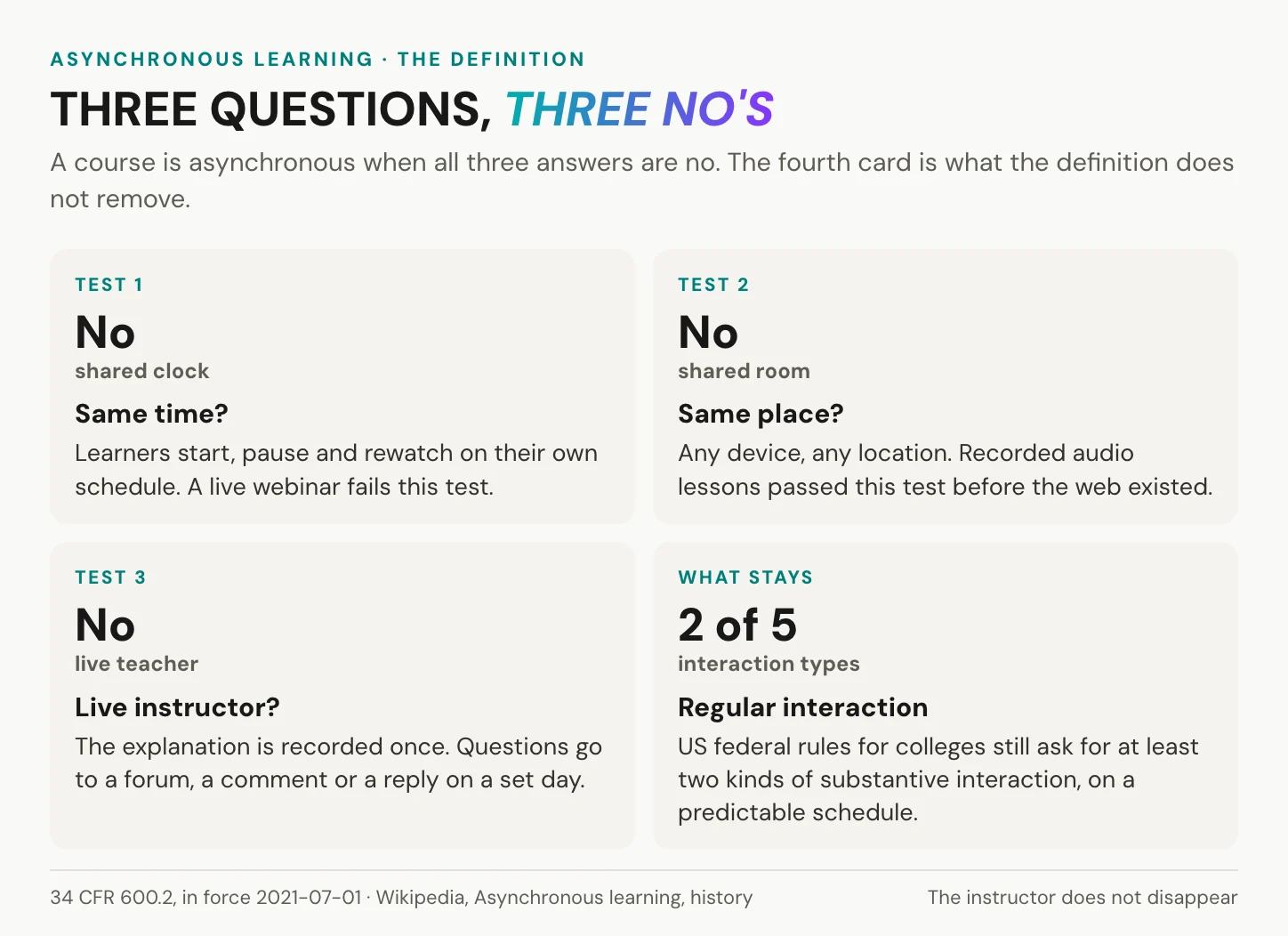
Ask three questions about any course. Do learners and instructor meet at the same time, in the same place, and is a live instructor teaching? Three no’s make a format asynchronous. A live webinar fails the first test, and a lecture hall fails all three.
The instructor does not vanish, though. The US federal definition of distance education, 34 CFR 600.2, in force since July 2021, covers synchronous and asynchronous delivery alike. It applies to colleges that take part in federal student aid, and it requires “regular and substantive interaction”. Substantive means at least two of five kinds: direct instruction, feedback on coursework, answering questions about the content, facilitating a group discussion, or other activities the accreditor approves. Regular means predictable and scheduled.
Online, offline and asynchronous
Is asynchronous the same as online? No. A live webinar is online and synchronous, and asynchronous learning is older than the web: correspondence courses and recorded lessons carried it long before anyone streamed a video. It still works offline, as a lesson downloaded to a phone for the commute or a workbook sent out before a seminar. Most of it does run online today. In fall 2024, 54.7 percent of the 19.66 million students at US colleges took at least one distance course, according to the NCES Digest of Education Statistics. One in six, 16.5 percent, studied only at a distance. Those courses can be live or recorded.
Workplaces moved the same way. Eurostat counted 52.9 percent of EU enterprises with ten or more employees holding meetings remotely over the internet in 2024. Every one of those meetings can be recorded, which is where many company libraries of recorded training begin.
What an asynchronous week looks like
Picture an asynchronous class in its fourth week. On Monday, three short videos and a reading unlock, and you watch them on Tuesday night, the second one at 1.5x speed. Each video ends with a question. By Thursday you post in the discussion thread. On Friday the instructor replies to everyone, as the syllabus promised. The quiz closes on Sunday. Nobody met. Everybody took part.
The Friday reply is not a courtesy. It is the regular interaction the federal definition asks for, delivered on a day everybody knows in advance.
The corporate twin looks the same. A new hire on the night shift watches the safety units at 3 a.m., answers the questions, and finds the trainer’s reply after the weekend. A colleague six time zones away takes the same units during her morning, and the trainer answers both of them in one pass on Monday.
In short: asynchronous describes timing, not place or technology, and it never means that nobody teaches. The instructor still answers, on a schedule the learner can count on.
Asynchronous vs synchronous learning
Each mode does something the other cannot. Stefan Hrastinski put it most usefully in EDUCAUSE Quarterly in 2008: synchronous e-learning better supports personal participation, the arousal and motivation of being there together, while asynchronous e-learning better supports cognitive participation, the time to process and reflect. Here they are beside the blended model many companies run.
| Synchronous | Asynchronous | Blended | |
|---|---|---|---|
| Timing | Fixed session | Learner’s own schedule | Recorded core, scheduled touchpoints |
| Feedback | In the moment | Hours to days | Live for the hard part |
| Best for | Practice, simpler discussions, getting acquainted | Reflecting on complex issues, learners who cannot be scheduled | Most corporate programmes |
| Pace | The group’s | The learner’s, including playback speed | Both |
| Scale limit | Time zones, rooms, trainer hours | None from the calendar; language remains | Regional live slots |
| Captions under WCAG 2.2 | Live captions, Level AA | Prerecorded captions, Level A | Both |
| Typical weak point | Fatigue from video calls | Dropout | Coordination |
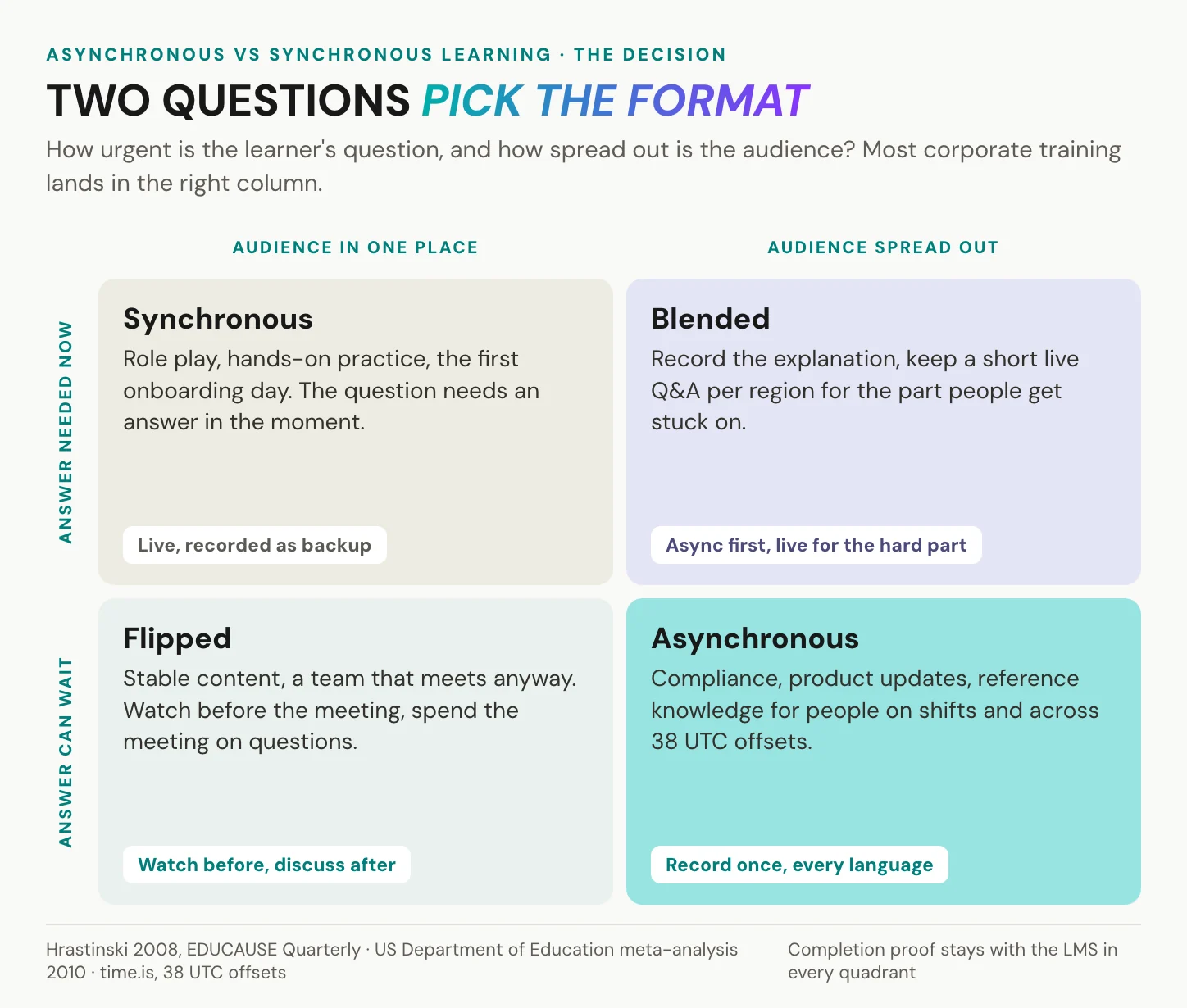
When live teaching wins
Start with the case against recorded formats, because it is real. A meta-analysis published in Learning and Individual Differences in 2026 pooled 31 randomised trials with 3,823 learners. Synchronous online teaching beat the control conditions on knowledge and skills, with an effect size of g = 0.50. The gap was largest where the comparison group learned asynchronously or sat on a waitlist. Ebner and Gegenfurtner found the same direction in Frontiers in Education in 2019. Webinars led asynchronous courses on knowledge at g = 0.29, across only five studies. Martin and colleagues, reviewing 19 publications in 2021, saw a small cognitive edge for synchronous learning and none on attitudes.
So keep live time for what needs it: role play, practice with immediate correction, and the first day of onboarding, when people need faces. Video calls carry a cost as well. Jeremy Bailenson argued in 2021 that four mechanisms, from close-up eye gaze to constant self-view, make them tiring. That is a theory, not a trial.
When asynchronous learning wins
In 2026 the world observes 38 UTC offsets, from UTC-12 to UTC+14, according to the reference site time.is. No meeting slot fits them all, and shift workers miss every slot that suits the office. Hrastinski’s own table names this case: asynchronous formats for when meetings cannot be scheduled because of work, family and other commitments. Some content has to be reread: a procedure, a policy, a configuration. Recorded material can also be spaced over weeks. Cepeda and colleagues reviewed 839 assessments in 317 experiments in 2006 and found distributed practice ahead of cramming. Learners can speed up, too. Murphy and colleagues found in 2022 that lectures watched at 1.5x or 2x cost little comprehension, and that performance declined beyond 2x.
Time is scarce on the learner’s side as well. ATD’s State of the Industry report put formal learning at 13.7 hours per employee in 2024, down from 17.4 hours in 2023. With so few hours, a course cannot wait for a slot that suits everybody’s calendar.
Blended is the corporate default
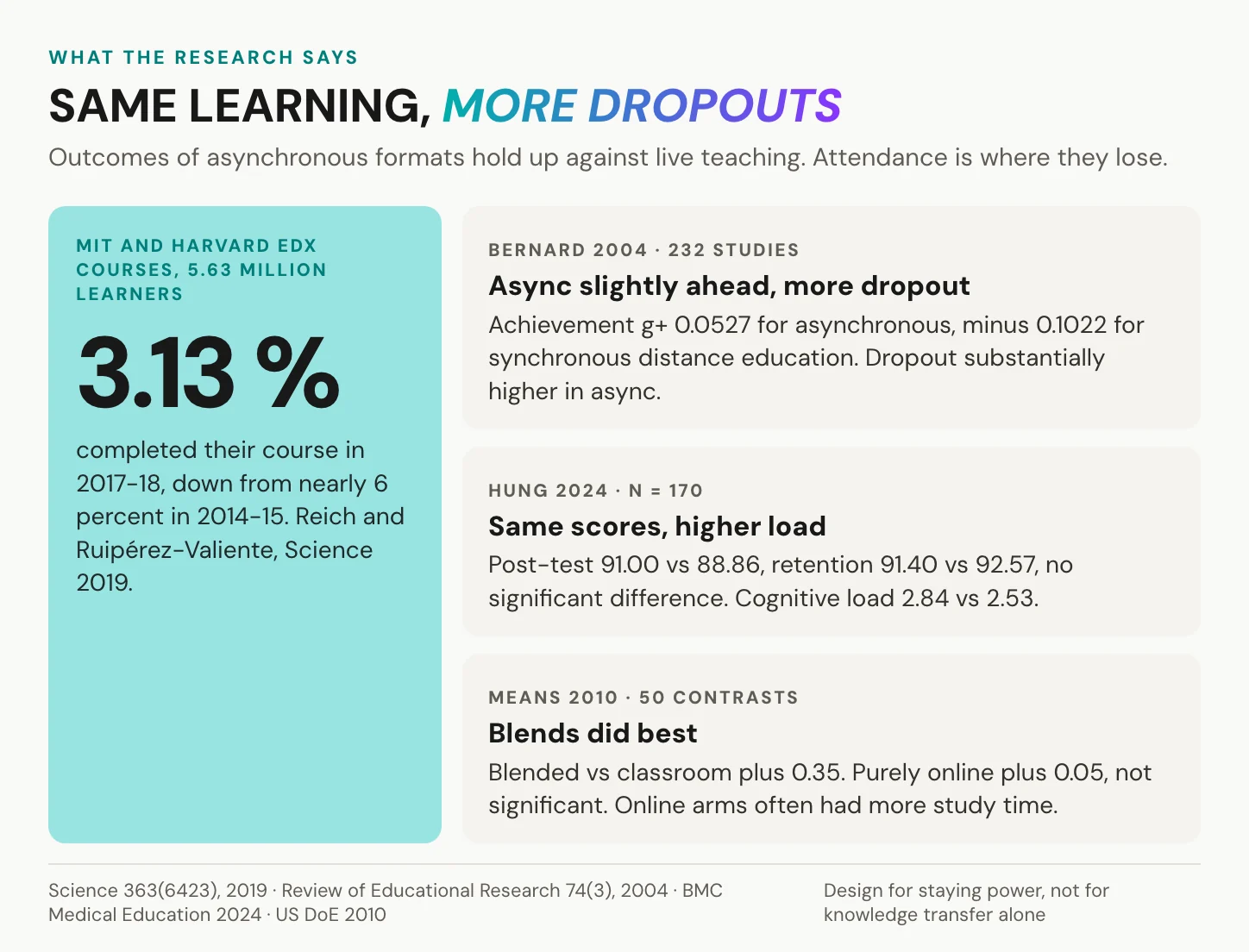
Most training should not choose. The US Department of Education’s 2010 meta-analysis compared 50 contrasts from 45 studies. Blended instruction came out ahead of face-to-face teaching with an effect size of 0.35. Purely online instruction came out at 0.05, which was not significant. The report adds its own caveat: the online and blended arms often gave learners more time and material, so the medium alone does not explain the gain. Record the explanation, and keep live time for the questions people actually get stuck on.
And leave recorded formats out where they do not belong: skills that need live correction, crisis communication, and a new team that first has to get to know each other.
In short: live formats win on motivation and immediate correction, recorded ones on reflection, reach and scale. Most training gets both, with the recording as the core.
The evidence on asynchronous learning
Can people learn from a recording as well as from a person? The question is older than the web, and the best answers are steadier than the debate about them.
What holds up
The largest classic review is Bernard and colleagues in Review of Educational Research, 2004: 232 studies and 688 outcomes from 1985 to 2002. Overall, distance education and the classroom came out level, with an average effect of 0.0128 and wide variation. Split by mode, asynchronous distance education came out slightly ahead of the classroom at 0.0527. Synchronous distance education came out slightly behind, at minus 0.10. The same review found dropout substantially higher in asynchronous formats.
A 2024 trial in BMC Medical Education looks at the question up close. Hung and colleagues in Taiwan taught one dermatitis lecture to 170 fourth-year medical students: 70 live, 100 by recording. Post-test scores were 88.86 live against 91.00 recorded, retention scores 92.57 against 91.40. None of those differences was significant, but cognitive load was: 2.84 recorded against 2.53 live. One lecture at one school, but the shape is familiar. The recorded group learned as much and worked harder for it.
Staying is the other half. Reich and Ruipérez-Valiente analysed 5.63 million learners in MIT and Harvard edX courses for Science in 2019. Of the 2017-18 learners, 3.13 percent completed their course, down from nearly 6 percent in 2014-15. These were open courses that anyone could join or leave, with no employer behind them. Left alone, people learn when they stay, and many do not stay. The 2010 Department of Education analysis above fits the same pattern: blends did best.
Numbers to retire
Four figures travel through slide decks on this topic. They are quoted in good faith, and the direction they point in is sometimes right, but none has a traceable primary source that says what the slide says.
- “E-learning needs 40 to 60 percent less employee time” is credited to Brandon Hall, and no Brandon Hall report with that figure is publicly available.
- “E-learning raises retention to 25 to 60 percent” is credited to the Research Institute of America. It traces to a 2000 investor report citing 1990s trade sources. No such study exists.
- “You forget 70 percent within 24 hours” descends from Hermann Ebbinghaus. In 1885 he measured the time saved relearning nonsense syllables, on himself. His one-day savings figure was 0.33, and Murre and Dros replicated it at 0.26 in PLOS ONE in 2015. Savings are not a percentage remembered.
- “Viewers retain 95 percent of a video message” comes from a small marketing survey with no published method. Gernsbacher’s 2015 captions review, below, is the citable replacement.
In short: asynchronous formats teach about as well as live ones. They lose people along the way, and that is a design problem, not a verdict on the format.
Why asynchronous courses fail
Two weak points, both documented. In the 2024 trial, the students who watched the recording reported more cognitive load, and more learners drop out, as Bernard’s review and the edX data show. Both can be designed against.
A recording is not a course. A course is a recording someone designed to be watched alone.
Cut every topic into short segments
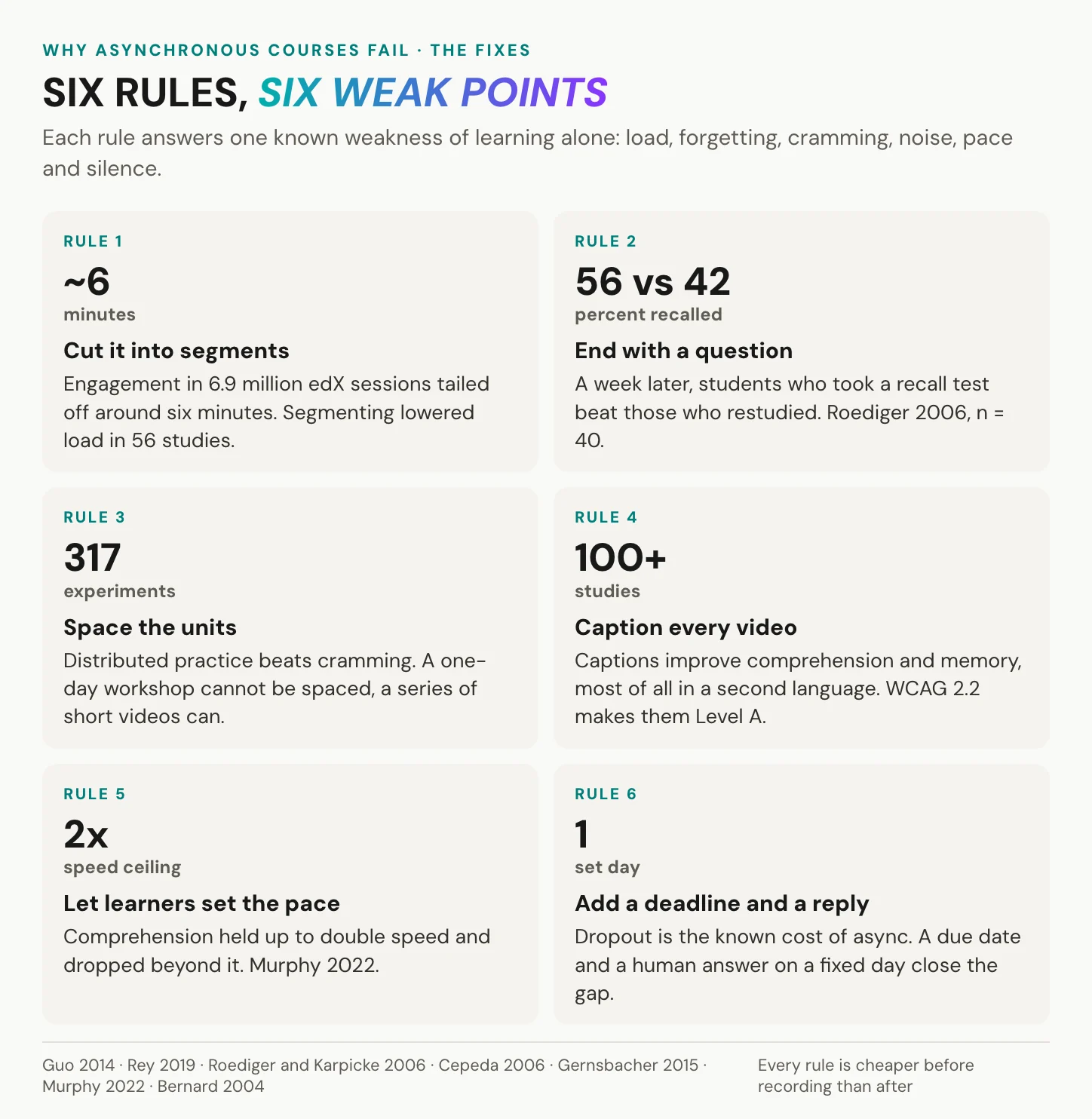
Guo, Kim and Rubin studied 6.9 million video sessions in four edX courses in 2014. Engagement tailed off around six minutes, whatever the video’s length. That was lecture video from 2012 and 2013, though, and engagement is not learning. The outcome evidence comes from Rey and colleagues in 2019: across 56 investigations with 88 comparisons, segmenting improved retention and transfer and lowered overall load. It also increased learning time, the honest price of pauses between segments, and learners with more prior knowledge gained more on retention. Brame’s 2016 review adds signalling, a conversational tone and guiding questions.
In practice, cut where the topic changes, not where a timer says so. A 40-minute meeting recording on a new expense policy might hold six ideas. Each one becomes its own unit, with its own title and its own question.
End each video with a question
Roediger and Karpicke had 120 students read two short prose passages in 2006. Each student reread one passage and took a recall test on the other. A week later, students recalled 56 percent of the passage they had been tested on and 42 percent of the one they had reread. After five minutes the order had been reversed. In a second experiment, the students who only reread predicted they would remember best, and remembered least. A question at the end feels harder. That is why it works.
The question does not need to be clever. Ask the learner to produce the answer, as the students in that study had to, rather than to spot it in a list. Put it in the LMS quiz or the discussion thread, and let it count toward the week’s deadline.
Space the units and set a deadline
A one-day workshop cannot be spaced. A series of short units can, and Cepeda’s 317 experiments say it should be. The same review found that the best gap between sessions grows with how long the knowledge has to last. Material needed next week tolerates short gaps, while material needed next year wants longer ones, and a recap quiz a week after the unit is the simplest way to build that in.
Dropout is the cost Bernard names. A due date plus a human reply on a set day is the design answer, and it is close to what “regular” interaction means in the federal definition. Tie discussion to a timestamp. The question then sits next to the moment it came up, and the trainer can answer it without rewatching the whole video.
Caption every video and share the transcript
Morton Ann Gernsbacher summarised more than 100 studies in 2015. Captions improve comprehension of, attention to and memory for a video, especially for viewers watching in a language that is not their first. WCAG 2.2 makes captions for prerecorded video a Level A requirement, success criterion 1.2.2, while live captions sit one level higher, at AA. The recorded format has the lower bar to clear. Captions also serve people watching without sound, on a train or in an open-plan office.
The transcript is the second half of the rule. As plain text, it gives the learner something to search and reread, and it gives the trainer raw material for the end-of-video question. The mechanics are in what closed captions are, and the transcript comes out of the same step: how to transcribe video to text.
Let learners set the pace
Playback speed is a property only recorded video has. Murphy’s 2022 team compared 1x, 1.5x, 2x and 2.5x, with comprehension tests right after watching and again a week later. Up to 2x, the cost to comprehension was small. Beyond 2x, performance dropped.
Leave the speed control in the player. The learner who already knows the topic moves faster, and the one who does not can pause and rewind. Both finish the same unit, in different amounts of time, and neither holds up the other. Some teams lock the seek bar to force full viewing. The intent is understandable, but it punishes the learner who already knows the material, and it proves attendance, not learning.
In short: short segments, a question at the end, a deadline and a reply turn a recording into a course. Captions make it work for people who read along or learn in a second language.
Asynchronous learning examples
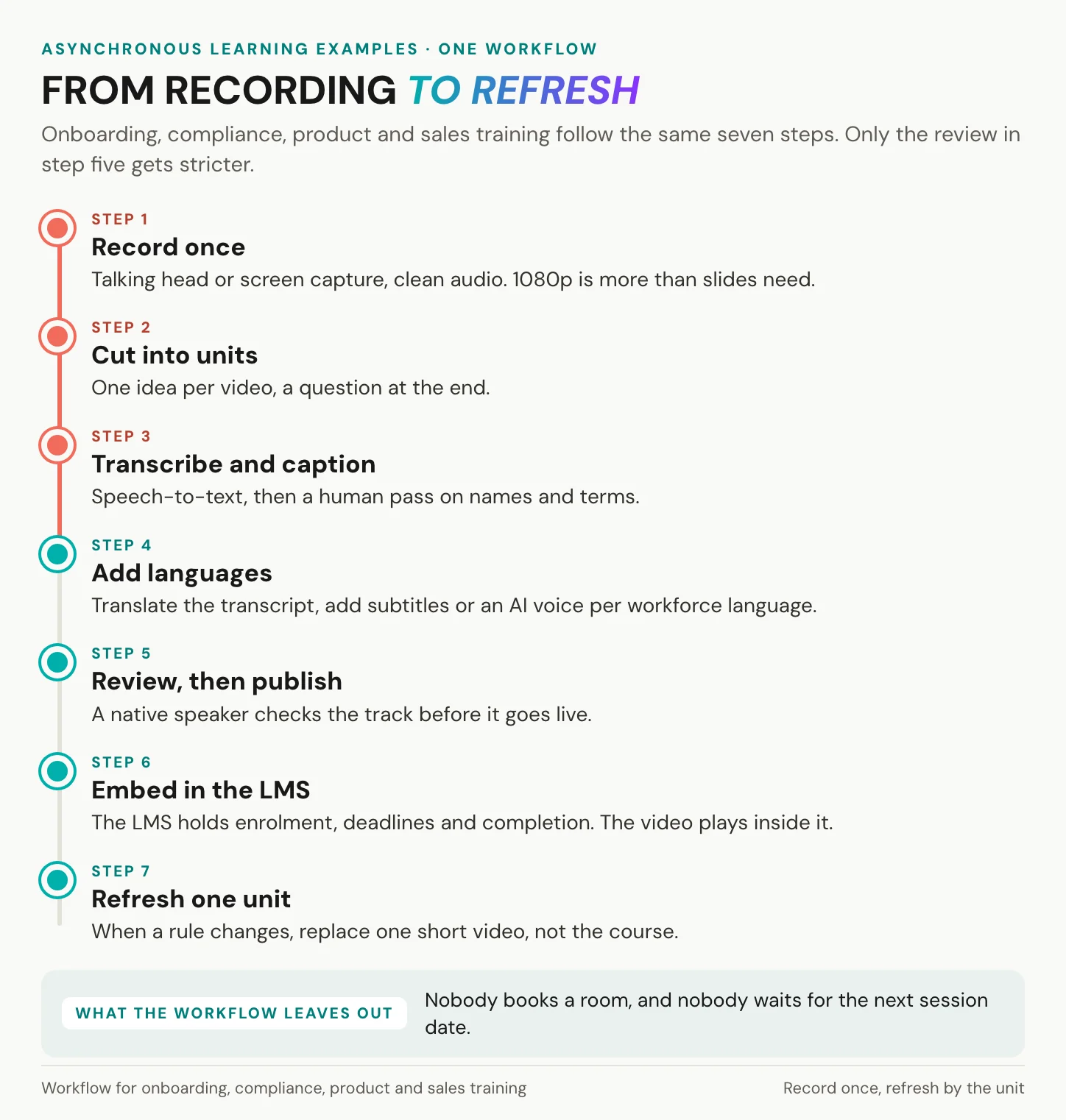
One workflow serves every case below. Only the review step changes.
Onboarding
Week one is full of knowledge that does not change from hire to hire: the tools, the policies, who does what. Record it once as short units, each with a question, and let new people take it at their own pace. Keep the first day live, for the reasons above: people need faces before they need a policy. A buddy or the trainer answers questions on set days, which keeps the interaction regular without a standing meeting.
The payoff grows with every cohort. The tenth group of new hires watches the same units the first group did, and the trainer spends the saved hours on the live day. When a tool changes, one unit is re-recorded and the rest stay. Production is covered in how to create training videos.
Compliance training
Mandatory content changes when a rule changes, not on a quarterly rhythm. Build it in units you can swap one at a time, and put the version date in each unit’s title, so learners and auditors can see which version someone watched. Translated tracks need a human reviewer before they go live, because a wrong sentence in a safety instruction is a real risk. Name an owner for each unit, usually the person responsible for the rule it explains.
Refreshers fit the spacing evidence. When a topic comes back each year, a short recap unit with a question does more than the full course again, and it costs the learner minutes instead of an afternoon. Proof of completion per employee belongs in your learning management system, next to the rest of the training record.
Product and software training
Screen recordings, one feature per unit. When the interface changes, you replace one unit, not the course. Record at a window size where menu labels stay legible on a laptop, and zoom in on the field that matters instead of showing the whole desktop.
The transcript doubles as a searchable reference. A user who half remembers a setting finds it in the text and watches that part again, instead of the whole unit. A support team can link the exact unit in a ticket reply instead of sending the whole course. A video transcript example shows what a usable one looks like. Release cycles set the rhythm here: tie the review of each unit to the release notes, so the course never shows a button the product no longer has.
Sales enablement
Pitch and objection videos, watched before a live role-play session. This is the flipped model inside a company: the explanation moves to the recording, and the meeting goes to practice with feedback. It follows the evidence from both sides. Live formats lead on skills that need immediate correction, and a recording costs no live time for the plain explanation. A rep who has watched the objection unit arrives with the vocabulary, so the session can start at the hard part. Record the objections your reps actually hear, in their words, not the ones from last year’s deck.
Sales teams also tend to span regions. A rep in Madrid who rehearses a pitch written in English hears it differently from a rep in Munich, and that puts the language question on the table early.
Higher education
The flipped classroom and the recorded lecture are the university versions of the same idea, and the design rules apply unchanged. A 90-minute live lecture should reach students as short segments, not as one 90-minute file. Colleges in the US federal aid system also carry the rule from the start of this article: regular and substantive interaction, whether the course is live or recorded.
Accessibility deadlines are close as well. The US Department of Justice’s 2024 rule requires WCAG 2.1 Level AA for the web content of state and local governments, public universities included. A 2026 interim rule moved compliance to 26 April 2027 for entities serving 50,000 people or more, and to 26 April 2028 for smaller ones. Captioned lecture video is part of meeting it.
Asynchronous learning activities
Recorded video is the core, not the whole. Each of the eight activities below works without a shared clock, and each gives the trainer something to answer on the set day:
- Watch and answer: a question at the end of each video.
- A discussion prompt tied to a timestamp.
- A short recorded video response from the learner.
- Peer review of a draft, with a deadline.
- A case study that ends in a written decision.
- A spaced recap quiz a week after the unit.
- A subtitle review: a bilingual colleague checks a translated track against the source, which doubles as the review step for compliance tracks.
- An annotated reading of the transcript.
In short: the examples differ in content and review, not in workflow. Record once, segment, caption, add languages, embed, and refresh by the unit.
Turn one training video into a course unit every team can watch in its own language. Create an alugha account and upload your first video.
Asynchronous learning in many languages
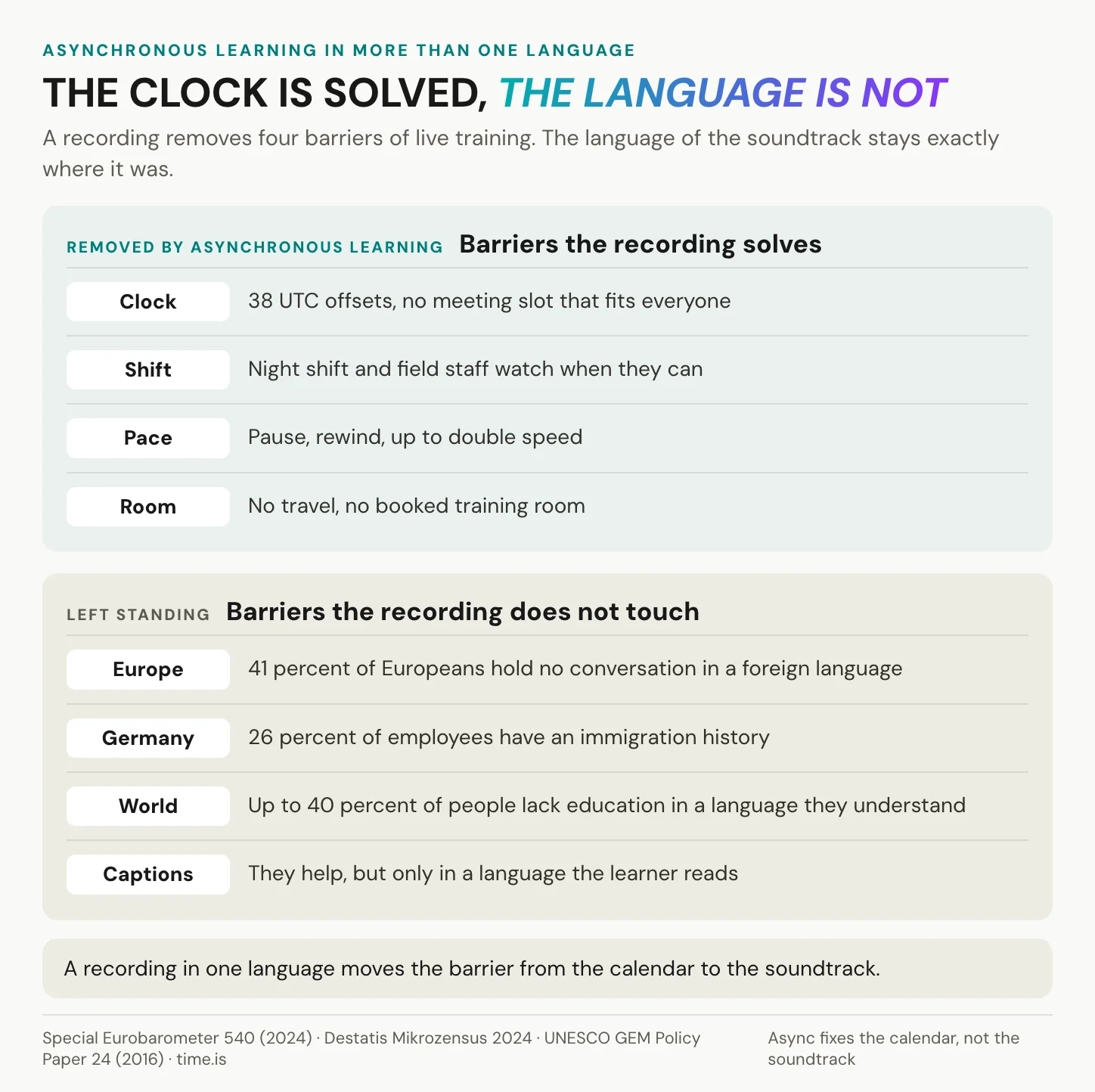
Asynchronous learning removes the clock from training. It does not remove the language.
The barrier the recording leaves standing
A recording solves the calendar and keeps the soundtrack. In Special Eurobarometer 540, published in May 2024, 59 percent of Europeans surveyed could hold a conversation in a foreign language, 47 percent in English. Turned around, 41 percent could not in any foreign language. In Germany, 26 percent of employees had an immigration history in 2024, according to the Destatis Mikrozensus. Among welders it was 60 percent. The US Bureau of Labor Statistics put foreign-born workers at 19.1 percent of the civilian labour force in 2025. UNESCO estimated in 2016 that up to 40 percent of the world’s population lacks education in a language they understand. That is a schooling figure, with the same mechanism.
Captions in the source language help second-language viewers, as Gernsbacher showed, but only in a language they read.
Learning platforms localise, and they do it well. On their product pages in 2026, Docebo supports more than 50 languages, Articulate translates courses into more than 80, and Moodle’s multi-language filter shows each user text in their own language. Those pages describe the interface and the course text. None of them describes translating what is said in the video.
Our limits, and when you do not need us
Our limits first. We are not a learning management system. We do not enrol, grade or certify anyone: no quizzes, no certificates, no per-learner completion records, and no xAPI statements. Completion proof stays with your LMS, where a SCORM course can still carry our video as a web object. Our upload wizard encodes at 540p, 720p or 1080p, and 1080p needs a paid tier. For a talking head and slides, that is enough. AI translation and AI voices are machine output, so have a reviewer check compliance tracks before they go live.
Plenty of teams do not need us at all. A team that shares one language and already plays video inside its LMS has no problem we solve. A meeting recording watched once by those who missed the meeting needs nothing beyond the meeting tool. Public content whose point is discovery belongs where the audience is, often on YouTube. Training built from text, slides or simulations gains nothing from us.
One video, one link, every language
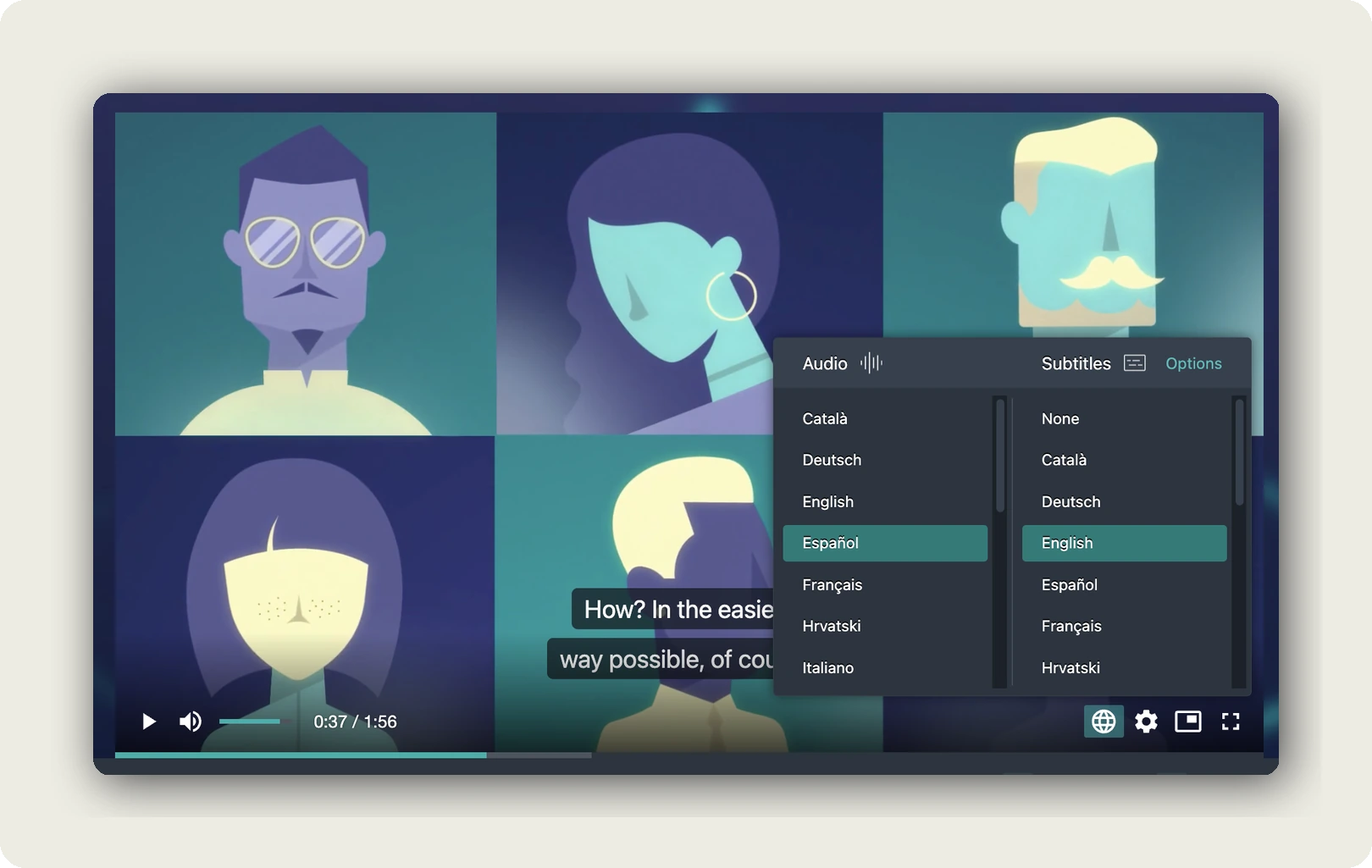
One video, one link, every language of the workforce inside it. Our player carries all audio and subtitle tracks of a video under one URL. The learner picks audio and subtitles independently, Spanish audio with English subtitles if that helps. The switch is immediate, without a reload. There is no “German version” in a folder, only one video.
The player starts in the language of the learner’s browser, not their location, and falls back to the default track you set. A Polish colleague in the Munich office hears Polish if their browser is set to Polish and a Polish track is published.
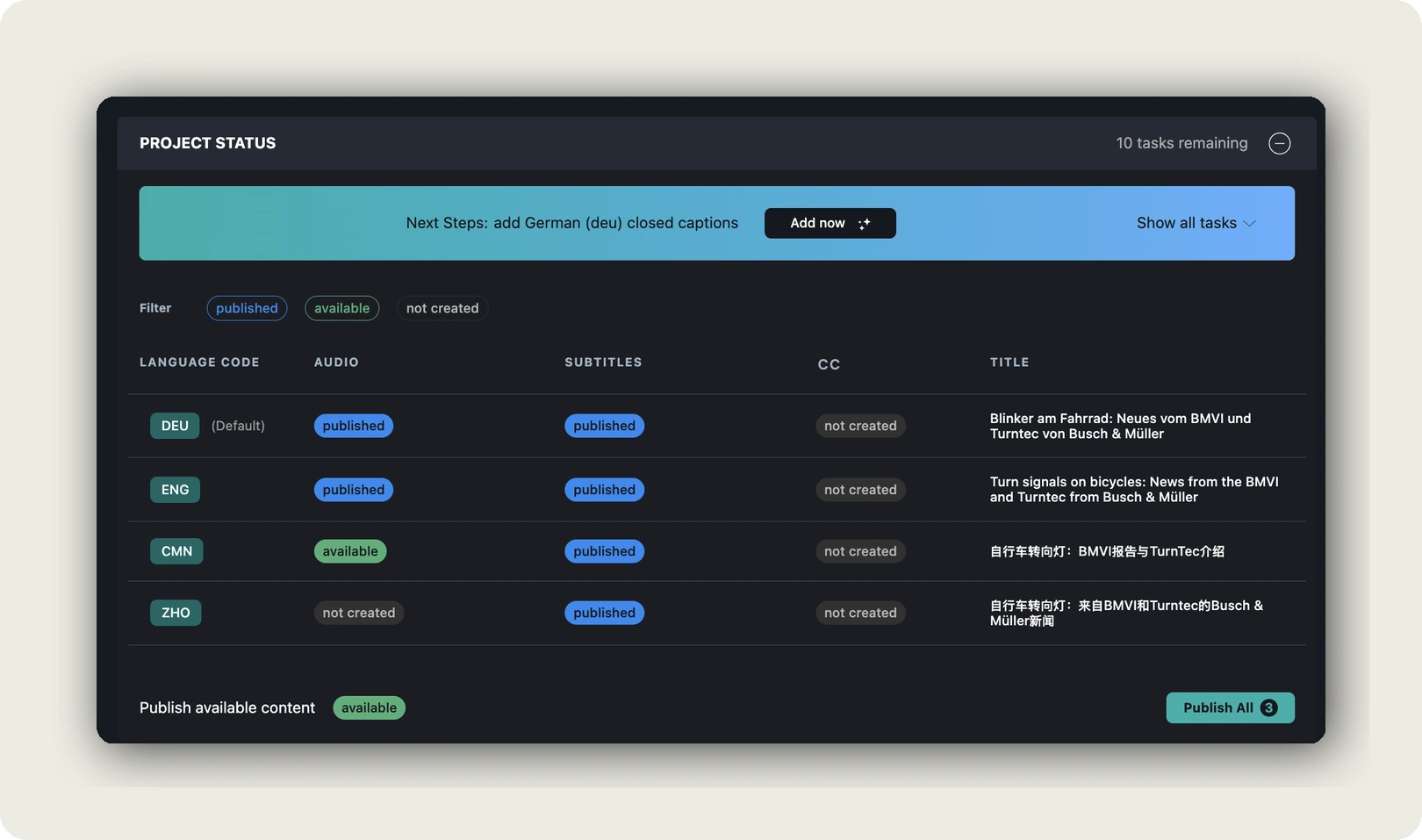
The tracks are built in one project, in the dubbr, our editing workspace. Speech-To-Text creates the transcript, a new language is translated from it, and Text-To-Speech gives that track an AI voice. Each step shows its credit cost before you confirm. We translate into more than 200 languages and transcribe in more than 100. A track can stay available but unpublished until someone has reviewed it. That gives you a staged rollout: the source language on day one, the rest as they pass review. Title, description and thumbnail exist per language, so the course card reads German for the German learner.
Set the embed’s subtitles to Automatic (force), and every learner gets a text layer, whatever audio they chose. On a paid tier and through our API, we count plays per language track, so you see whether the Polish track is used at all. More in the automatic language switcher, published vs available content, how to translate a video and what dubbing is.
In short: asynchronous learning fixes the clock, and one link with every language fixes the soundtrack. The LMS keeps the roster and the proof.
Where the training video lives
Training video sits close to HR data: who watched which module, when, in which language.
YouTube deserves its due first. An unlisted video costs nothing, needs no procurement and plays everywhere, and for public content its reach is unmatched. Google says a view in its privacy-enhanced mode “will not be used to personalize the YouTube browsing experience”, and promises no more. For internal training the costs are structural. Google’s scripts load inside the intranet page, and a finished module ends in related videos that YouTube picks, not your team.
The law is short. A host storing employee training video processes personal data on your behalf, which under Art. 28 GDPR needs a binding contract. Section 25 TDDDG requires consent before information is stored on or read from the learner’s device, unless strictly necessary. German supervisory guidance treats embedded third-party players as part of that question. US hosting is lawful too: since 10 July 2023, the EU-US Data Privacy Framework covers certified companies. EU hosting removes the transfer question, but it is not the only lawful answer.
What we offer is narrow and exact: hosting in Germany and the EU, no third-party advertising cookies and trackers, no ads and no third-party recommendations in the player. Our own first-party analytics do run, so have your data protection officer check the intranet’s consent setup whatever the host. Access runs through visibility (Private, Public or Not listed), the embedding switch and folder permissions. A not-listed link works for anyone it is forwarded to. The LMS login in front of the embed is the real gate. Ask any host, us included, for its Art. 28 agreement before the first upload. To go through it with us, book a call.
Storage time is part of the same decision. Teams’ 120-day default sends an untouched recording to the recycle bin, and Zoom gives administrators a setting that deletes cloud recordings after a set number of days.
A course needs a home that does not delete it.
The LMS embed
Our embed is one responsive iframe, no plugin, in Moodle and any LMS with an HTML editor. Some LMSs strip iframes, so an admin may have to allow alugha.com. Some block third-party cookies, which can affect automatic language detection but usually not playback. The embed works once the account is verified, the project is published and not private, and embedding is allowed.
Paste the embed code, not the address of the video page, because only the embed path can be framed. Set the language and subtitle options in the embed dialog before you copy; the code rewrites itself, so nothing needs editing by hand. Steps: embedding alugha in Moodle or another LMS. Legal background: GDPR-compliant video hosting.
In short: training video is HR-adjacent data. Pick a host whose location, contract and player you can explain to your data protection officer, and keep the proof of completion in the LMS.
Frequently asked questions about asynchronous learning
What is asynchronous learning?
Asynchronous learning is learning in which learner and instructor are not present at the same time. The learner watches, reads and answers on their own schedule. Three questions test it: same time, same place, live instructor. Three no’s make a course asynchronous. For US colleges, federal rules still require regular interaction, on a predictable schedule.
Is asynchronous online or face to face?
Usually online, but the term is about time, not place. Correspondence courses and recorded lessons were asynchronous long before the web existed. A course can also mix both: recorded lectures online, and a face-to-face seminar every second week. If nobody has to be present at a fixed hour for a given part, that part is asynchronous, wherever it happens.
Is asynchronous the same as online?
No. A live webinar is online and synchronous, because everyone attends at the same hour. In fall 2024, 54.7 percent of the 19.66 million students at US colleges took at least one distance course, according to the NCES Digest of Education Statistics. Those courses can be live or recorded. Online describes the place. Asynchronous describes the timing.
What is the difference between synchronous and asynchronous classes?
Synchronous classes meet at a set time, with feedback in the moment. Asynchronous classes let each learner work on their own schedule, with feedback hours or days later. Hrastinski’s 2008 framework sums up the trade. Synchronous formats better support personal participation and motivation. Asynchronous formats better support cognitive participation: the time to process and reflect on complex material.
What is an example of asynchronous learning?
A compliance unit is a clean example. Three videos of about six minutes each, every one ending with a question. A discussion thread where the trainer answers on a set day. A deadline at the end of the week, and the completion record in the LMS. Nobody meets, everyone takes part, and each learner chooses the hour.
What are the disadvantages of asynchronous learning?
Three stand out. Dropout is higher: Bernard’s 2004 review of 232 studies found it substantially higher than in synchronous formats. In MIT and Harvard edX courses, only 3.13 percent of learners completed in 2017-18. Cognitive load can be higher too: in Hung’s 2024 trial, students watching the recording reported more of it. And answers come later. Each weakness has a design fix.
How long should an asynchronous learning video be?
Short. In 6.9 million edX sessions from 2012 and 2013, Guo and colleagues found engagement tailing off around six minutes, regardless of length. Rey’s 2019 meta-analysis of 56 investigations found that segmenting improves retention and transfer. Six minutes is a pattern, not a law of nature. The better rule is one idea per video, with a question at the end.
Does asynchronous learning work for a multilingual team?
Only if each learner gets the material in a language they understand. In the 2024 Special Eurobarometer, 41 percent of Europeans surveyed could not converse in any foreign language. Captions help second-language viewers, but only in a language they read. Our player puts every language of a training video on one link, and each learner chooses audio and subtitles separately.
Getting started
Go back to the Teams recording. It solved the calendar for 120 days, in one language, and then it expired. A course solves the calendar for good, and three steps get you there.
1. Pick the training you repeat most often and place it in the decision matrix: live, blended, flipped or asynchronous. 2. Cut it into short units, each with captions and a question at the end. 3. Add the languages your workforce actually speaks, and embed the video inside your LMS, where the roster and the proof already live.
The recording that deleted itself becomes a unit that stays, and it plays in every learner’s language.
Planning asynchronous training for a team that does not share a language? Book a call and we will set up one of your training videos with every language on one link, or create an account and start with one upload.