A product video that went live on a European web shop on 27 June 2025 is exempt from the European Accessibility Act. The same video published a day later is not. Two facts decide almost every case: whether the video sits inside a service sold to consumers, and when it went live.
The Act is Directive (EU) 2019/882, and it covers online shops, consumer banking, passenger transport, telecoms, e-books and the services that give access to audiovisual media. Every Member State enforces it through its own law. In Germany the main law is the BFSG, with fines of up to 100,000 euros. Only the smallest service providers are exempt.
By the end you will be able to answer four questions for your own organization. Are we in scope? Which standard do we test against? Which dates apply in the EU and the US? And what exactly do our videos need, and what can stay as it is?
Key takeaways
- The European Accessibility Act, Directive (EU) 2019/882, has applied since 28 June 2025 to six groups of consumer services, from online shops and banking apps to e-books and passenger transport.
- Microenterprises are exempt only as service providers. They must employ fewer than 10 persons and stay at or below 2 million euros in turnover or balance sheet. Both tests must hold.
- Pre-recorded video published on a website or app before 28 June 2025 is permanently outside the Act. A video you publish inside a covered service from that date on is not.
- The Directive never names WCAG. EN 301 549 carries it: version 3.2.1 maps to WCAG 2.1 AA, and version 4.1.1, published in September 2026, maps to WCAG 2.2.
- At Level AA, five WCAG criteria, 1.2.1 to 1.2.5, govern video: captions for recorded and live video, audio description for recorded video, and alternatives for audio-only and video-only content.
- Fines are set nationally, up to 100,000 euros under Germany’s BFSG. In the US, the ADA Title II web deadlines moved to 26 April 2027 and 26 April 2028.
- Key takeaways
- What the European Accessibility Act is
- Who must comply, and who is exempt
- WCAG 2.1, WCAG 2.2 and EN 301 549
- Fines, enforcement and the statement
- Germany: BFSG and Medienstaatsvertrag
- Video accessibility laws outside the EU
- European Accessibility Act rules for video
- What a compliant video player does
- How to make your videos EAA-ready
- The data question on the same player
- Where alugha fits, and where it does not
- Frequently asked questions about the European Accessibility Act
- Getting started
What the European Accessibility Act is
The European Accessibility Act is an EU directive, (EU) 2019/882, that sets common accessibility requirements for a defined list of consumer products and services. It was adopted on 17 April 2019. Member States have had to apply it since 28 June 2025, through national laws such as Germany’s BFSG.
It has two aims. The first is the single market: one set of accessibility rules instead of a patchwork that diverged from one Member State to the next. The second is people. In 2025, 24.2 percent of EU residents aged 16 and over reported some or severe long-standing limitation in usual activities because of health problems, according to Eurostat’s EU-SILC survey.
On the product side the Act lists consumer computers and operating systems, payment terminals, ATMs, ticketing and check-in machines, and interactive information terminals. It adds consumer terminal equipment for telecoms and for audiovisual media, and e-readers. On the service side it lists six groups. Video lives there, and so does everything below. The full text is on EUR-Lex as Directive (EU) 2019/882.
Three dates, three meanings
The Act was adopted on 17 April 2019 and entered into force on 27 June 2019. That second date started a clock, nothing more. Member States had to publish their national laws by 28 June 2022 and apply them from 28 June 2025. That is the date that binds your services.
Some obligations run on. Service contracts agreed before 28 June 2025 may continue unchanged until they expire, but no longer than five years from that date. Products a provider already used for its service may stay in use until 28 June 2030. Self-service terminals may run for up to 20 years, where a Member State allows it. The only 2027 date in the Directive concerns answering 112 emergency calls. And the standard behind the Act moved too: EN 301 549 V4.1.1 was published in early September 2026.
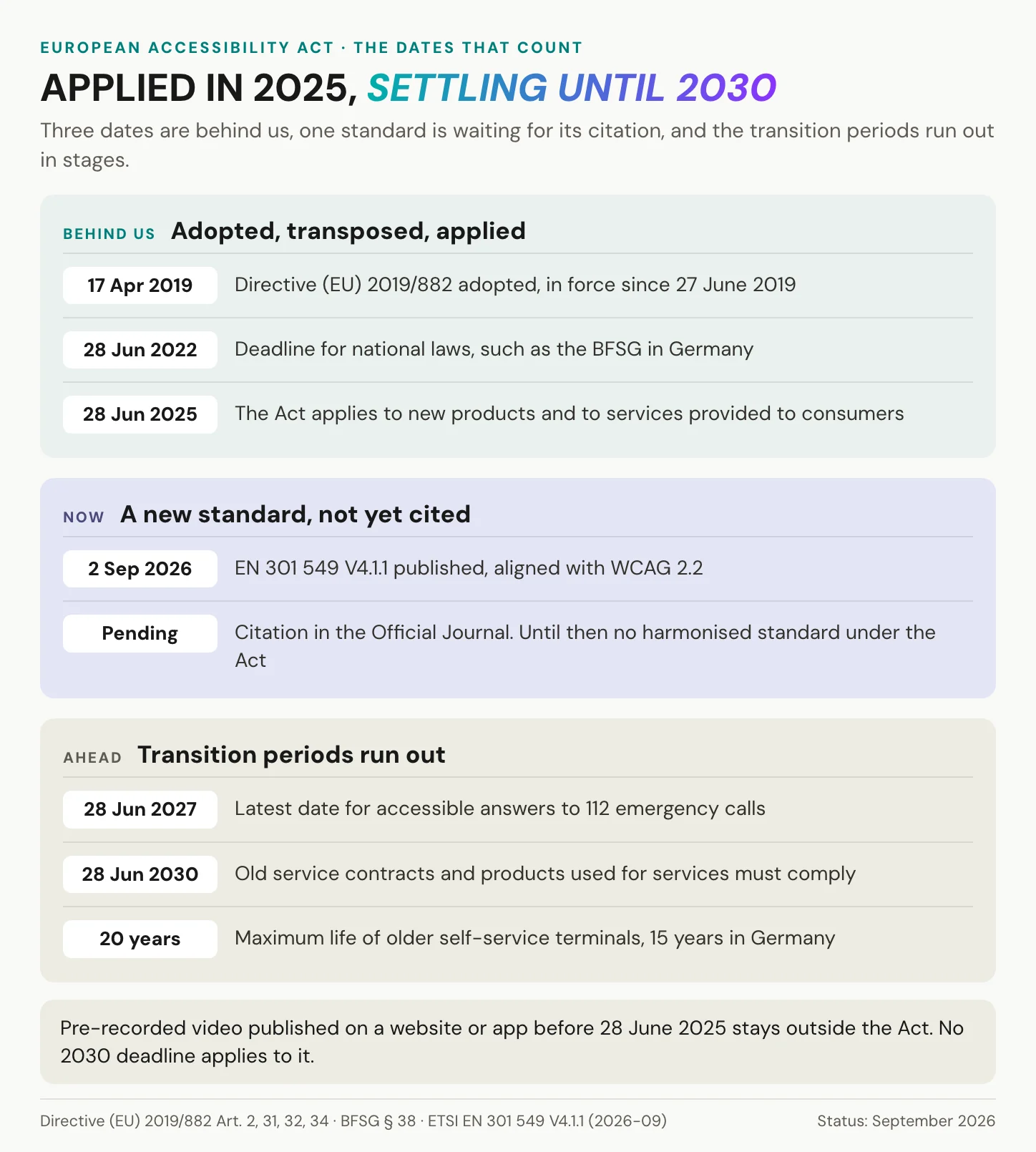
In short: adopted in 2019, binding since 28 June 2025, transitions running to 2030, and a new standard waiting for its citation.
Who must comply, and who is exempt
Three conditions decide scope, and where your company is based is not one of them. The Act attaches to services provided to consumers in the Union, so a US or UK shop selling to consumers in France or Germany is in scope for those sales. The UK’s 2018 web accessibility regulations are a separate matter, and they cover UK public bodies only.
The six consumer services
The Act covers services “provided to consumers after 28 June 2025”. A consumer, in the Directive’s definition, is a person acting outside their trade, business, craft or profession. Six service groups are listed, each with a typical place for video:
- E-commerce: product videos in an online shop.
- Consumer banking: an explainer inside the banking app.
- Passenger transport by air, bus, rail and water: travel information on the website or app.
- Electronic communications: a set-up video on a telecoms provider’s site.
- E-books and dedicated reading software.
- Services giving access to audiovisual media: streaming apps and TV platforms.
These are illustrations, not rulings. E-commerce, the group most brands meet, means services provided at a distance through websites and apps, at a consumer’s request, with a view to concluding a consumer contract. The question is always the same: does a consumer use this video as part of the service?
Microenterprises, B2B and the public sector
The microenterprise exemption is real, and it spares a small shop real work. It is also narrow. A microenterprise employs fewer than 10 persons and has an annual turnover or an annual balance sheet total of at most 2 million euros, and both tests must hold. The exemption covers service providers only, not manufacturers of products. A shop with 12 employees and 1 million euros in turnover is in scope. Larger firms have a different route, the burden assessment covered below.
The Act protects consumers, so a purely B2B service, such as a video platform licensed only to companies, falls outside it. Internal training for your own staff is outside as well. One caution for B2B sellers: if consumers can buy through the same shop, that part of the journey is a consumer service. Public bodies sit under different law. The Web Accessibility Directive has bound their websites since 2019 and 2020, with its own video carve-outs, and German public bodies follow BITV 2.0.
In short: a consumer service, a provider above micro size, and a video published on or after 28 June 2025. All three must hold, or the Act does not reach that video.
WCAG 2.1, WCAG 2.2 and EN 301 549
Which WCAG version does the European Accessibility Act require? The answer starts with a surprise: the Directive never names it.
Search the Directive for “WCAG” and you find nothing. Annex I asks that websites and apps be perceivable, operable, understandable and robust. Those are WCAG’s four principles, yet the guideline itself is never named. It enters through a harmonised standard, EN 301 549. Under Article 15, a service that meets a harmonised standard cited in the Official Journal of the EU is presumed to conform. That citation is the legal door. In practice, EN 301 549, and through it WCAG 2.1 AA today and WCAG 2.2 AA once version 4.1.1 is cited, is the benchmark regulators use.
EN 301 549 V4.1.1, published September 2026
ETSI, CEN and CENELEC published version 4.1.1 in early September 2026, under the Commission’s standardisation request M/587. It is the first version written for the Act, with an annex that maps its clauses to the Directive. Its web and software clauses now follow WCAG 2.2: they add the six new criteria at Levels A and AA and drop 4.1.1 Parsing. As of September 2026, the new version is published but not yet cited in the Official Journal. Until it is, no harmonised standard is cited under the Act at all. The version cited today is V3.2.1 from 2021, under the Web Accessibility Directive, by Commission Implementing Decision (EU) 2021/1339. It maps to WCAG 2.1. For a video team, clause 7 is the part to read, and we return to it below.
Which version to test against today
Testing to WCAG 2.2 AA now is sensible. It is where the standard is going, it has been a W3C Recommendation since 5 October 2023, and it is already an ISO standard, ISO/IEC 40500:2025. Still, the legal baseline in practice remains V3.2.1 and WCAG 2.1 AA until V4.1.1 is cited. For video teams, the wait costs nothing: none of the nine criteria WCAG 2.2 adds concerns time-based media. WCAG 3 is an early draft that the W3C expects to change substantially, so it is not a target yet. Criterion-by-criterion detail sits in our article on WCAG 2.2 success criteria for enterprise video.
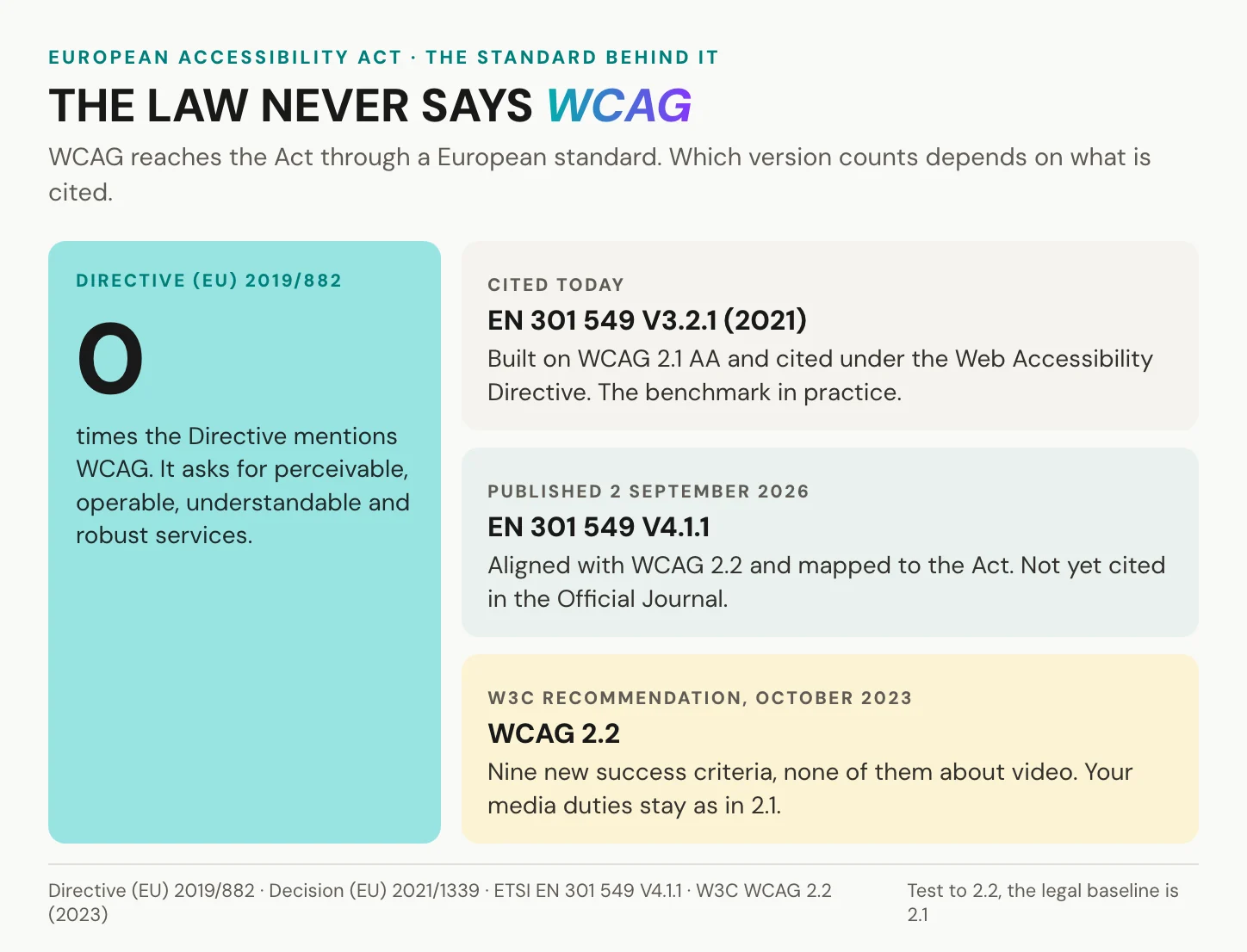
In short: test to 2.2, document against 2.1, and expect the switch when the Official Journal cites V4.1.1.
Fines, enforcement and the statement
The alarm in many compliance newsletters is right on one point: enforcement is real. Germany put market surveillance under the BFSG in the hands of one authority, the MLBF in Magdeburg, which takes reports of barriers and applications from consumers. The Directive itself sets no fine. Article 30 asks Member States for penalties that are “effective, proportionate and dissuasive”, weighed by the seriousness of the breach, the number of non-complying services and the number of people affected. The figures are left to each country. Germany’s BFSG allows up to 100,000 euros for offering a non-compliant service and up to 10,000 euros for lesser breaches. Other Member States set their own ceilings in their own laws. Read the national statute, not a summary table.
The statement, and the burden file behind it
Every provider of an in-scope service must explain how the service meets the requirements. The Directive puts this in Article 13(2) and Annex V. The explanation goes into the general terms and conditions or an equivalent document, and it must be public, in written and oral form, and accessible itself. Germany’s BFSG asks the same in § 14 with Anlage 3, in the terms or “in another clearly perceivable way”.
The statement is also the natural place to note exempted content and any burden assessment you rely on. A requirement does not apply where it would fundamentally alter the service or impose a disproportionate burden. That sounds like an exit. It works like a file. You assess each requirement against the criteria in Annex VI, document the result and keep it for five years. You renew it when the service changes, when an authority asks, and at least every five years. A provider that receives outside funding to improve accessibility cannot invoke the exception at all.
In short: fines are national, the statement is compulsory, and the burden exception is paperwork you keep, not a door you walk through.
Germany: BFSG and Medienstaatsvertrag
Germany transposed the Act with the Barrierefreiheitsstärkungsgesetz, the BFSG of 16 July 2021. Its § 1(3) lists five service categories, not six. Services giving access to audiovisual media are missing. They sit in media law instead.
The rest mirrors the Directive closely. § 1(4) excludes recorded time-based media published before 28 June 2025, and archives not updated after that date. § 2 No. 17 defines the Kleinstunternehmen with the same two tests, and § 3(3) exempts it when it provides services. One date differs. The BFSG’s transition in § 38 ends on 27 June 2030, a day before the Directive’s, and self-service terminals get 15 years instead of up to 20.
The technical detail sits in the BFSG ordinance, the BFSGV of 15 June 2022, which points to the state of the art. It has no explicit subtitle or audio description clause for websites. For video, the duty flows from the perceivable principle and the standards behind it. The amendment of 10 July 2026 changed nothing on video.
Warning letters from competitors are a widely discussed risk, and the worry is understandable. The BFSG itself sets out enforcement by the authority, by consumers and by associations, with a conciliation body as a route before court.
Audiovisual services: the Medienstaatsvertrag
The audiovisual category lives in the Medienstaatsvertrag, §§ 99a to 99e. Under § 99a(1), providers of services giving access to audiovisual media must make access and selection accessible along the lines of the Act’s Annex I, Sections III and IV(b). Microenterprises are exempt here too. The Landesmedienanstalten supervise under §§ 99b and 99d, not the MLBF. A streaming app in Germany therefore reads media law for its programme guide and its access services, not the BFSG. Separately, § 7 and § 76 ask broadcasters and TV-like on-demand services to expand their accessible offer step by step. That softer “should” duty is separate from the EAA.
In short: five BFSG services with the MLBF, one media-law service with the Landesmedienanstalten, the same pre-2025 video exclusion, and one day’s difference on the 2030 deadline.
Video accessibility laws outside the EU
Sell in the EU and serve the US public, and you answer to several laws. Here they are side by side, with the video duty each one states.
| Law | Who it binds | Applies | Standard | Video duty | Enforcement |
|---|---|---|---|---|---|
| EAA, Directive (EU) 2019/882 | Six consumer service groups, EU-wide | 28 June 2025 | EN 301 549; WCAG 2.1 AA in practice | Via Annex I and EN 301 549; access services on AV platforms | National authorities, fines set per country |
| BFSG (Germany) | Five of the six groups | 28 June 2025 | State of the art, EN 301 549 | Same as the EAA; AV access sits in the MStV | MLBF, up to 100,000 euros |
| ADA Title II | State and local government | 26 April 2027 or 26 April 2028 | WCAG 2.1 AA | Captions included; archived video on request | DOJ, private suits |
| ADA Title III | Businesses open to the public | In force, no web regulation | None set; WCAG in practice | “No captions on videos” named as a barrier | Private lawsuits |
| Section 508 | Federal agencies and the ICT they buy | 18 January 2018 | WCAG 2.0 AA | Caption and description controls beside the volume | Procurement, complaints |
| FCC IP captioning (CVAA) | TV programming shown online | 2016 to 2017 for clips | FCC rules | Captions if it aired on US TV with captions | FCC |
| UK public sector regulations 2018 | Public bodies | 2019 and 2020 | WCAG via EN 301 549 | Recorded video from before 23 September 2020 exempt | UK regulators |
ADA Title II: new dates in 2027 and 2028
The Department of Justice’s final rule of 24 April 2024 set WCAG 2.1 Level AA for the websites and apps of state and local governments, captions for videos included. An interim final rule of 20 April 2026 moved the deadlines. As of September 2026, public entities serving 50,000 people or more must comply by 26 April 2027. Smaller entities and special district governments follow by 26 April 2028. Archived content created before the deadline and kept unchanged in an archive area is excepted, as are preexisting documents, third-party content and preexisting social media posts. The DOJ’s own example still asks for an archived city video to be made accessible on request, for instance by adding captions. Comments on the interim rule closed on 22 June 2026.
ADA Title III and the lawsuits
Title III covers businesses open to the public, and it has no web regulation. DOJ guidance of 18 March 2022 gives businesses flexibility but expects online services to be accessible. It names “no captions on videos” as a barrier and cites a settlement with Teachers Test Prep over uncaptioned video courses. Enforcement runs mostly through lawsuits. Seyfarth Shaw, a US law firm, counted 3,117 federal website accessibility lawsuits in 2025, up from 2,452 in 2024. That was 36 percent of 8,667 federal ADA Title III filings. New York led with 1,021 of those website cases, ahead of Florida with 961 and Illinois with 585. The count covers federal courts only, so state-court cases, such as those under California’s Unruh Act, are not in it.
Section 508 and the FCC captioning rule
Section 508 binds federal agencies and the technology they buy. The revised standards, applied since 18 January 2018, still use WCAG 2.0 at Levels A and AA. Rule 503.4 is the player rule: caption and audio description controls must sit at the same menu level as volume or program selection. A vendor selling a player to US agencies meets the same control rule that EN 301 549 sets in clause 7.3.
The FCC’s IP captioning rule under the CVAA is narrower than its name suggests. Online full-length programming must carry captions if it aired on US television with captions. Clips followed in 2016 and 2017, with live clips captioned within 12 hours and near-live clips within 8. Consumer-generated media is excluded, and corporate web video that never aired on TV is not covered.
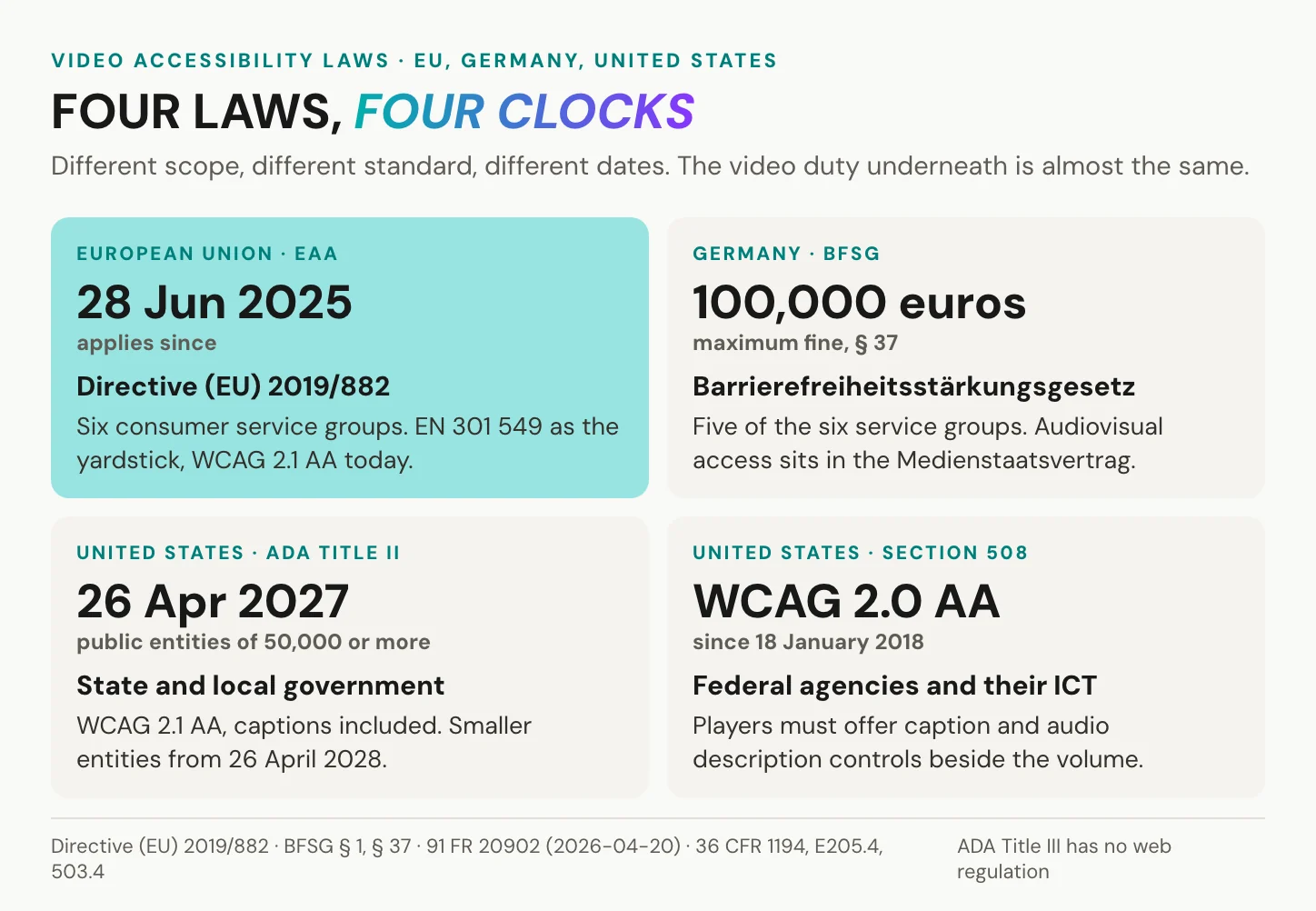
In short: the same few video criteria sit under all of these laws, and WCAG is the shared yardstick. What changes is who is bound, from when, and who enforces: authorities in the EU, fixed dates for US government, courts for US business.
European Accessibility Act rules for video
Here the law meets the file on your server.
Which videos are in scope
Article 2(4) of the European Accessibility Act is the key. It “does not apply” to “pre-recorded time-based media published before 28 June 2025” on websites and apps. It also excludes third-party content the operator neither funds, develops nor controls. And it excludes archives that are not updated or edited after that date. What remains is video published from 28 June 2025 inside a covered service. A product video in a consumer web shop is part of the e-commerce service. A company website with product or training videos is normally not an audiovisual media service, because EU media law excludes sites where video is only ancillary, such as product information. For a brand site, the video question is an e-commerce question.
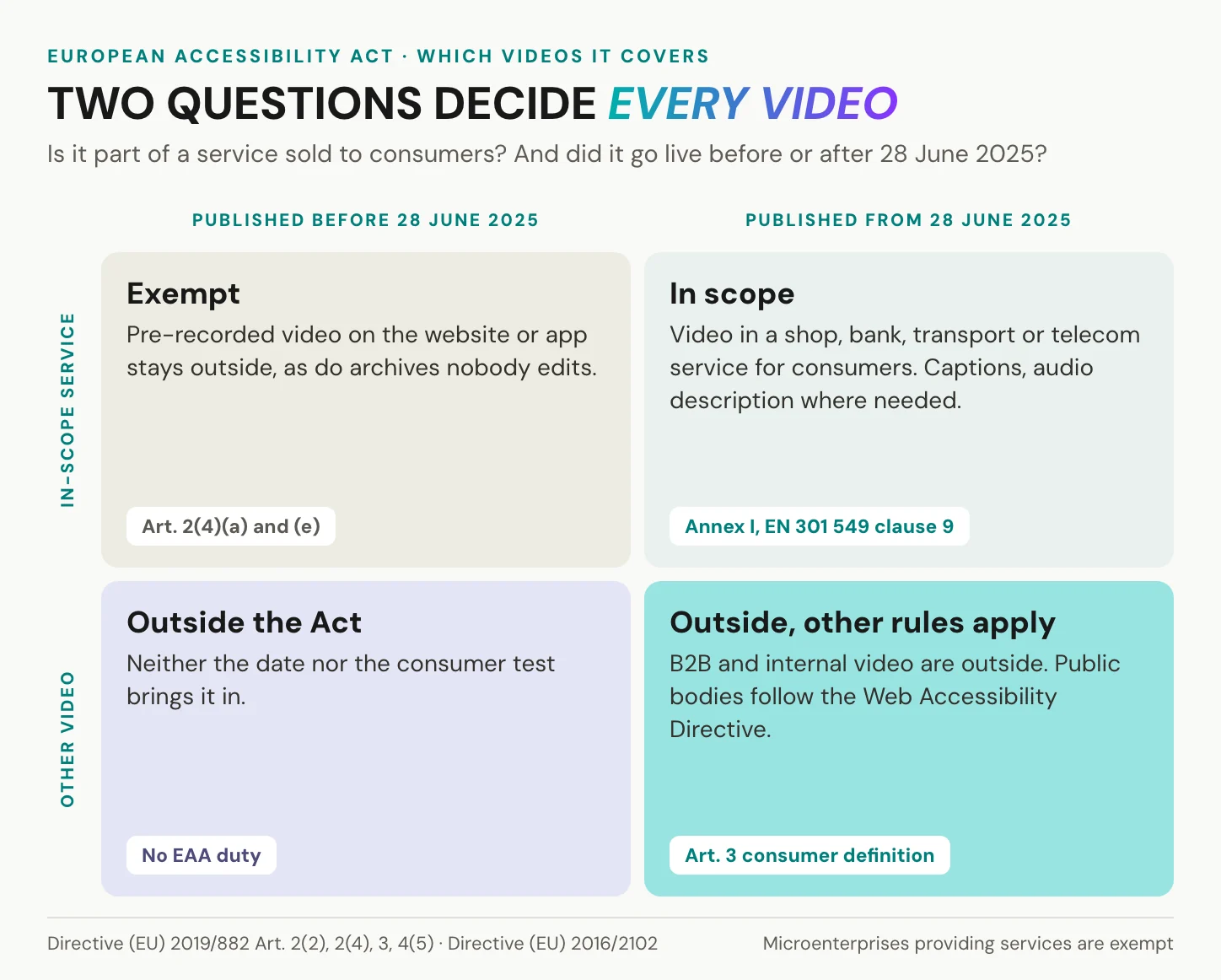
The Act does not follow every video you make. It follows the service you sell to consumers.
The five WCAG criteria for video
| Criterion | Level | What it asks | Satisfied when |
|---|---|---|---|
| 1.2.1 Audio-only and video-only (prerecorded) | A | An alternative for media with only sound or only picture | A transcript for audio; a text or audio alternative for silent video |
| 1.2.2 Captions (prerecorded) | A | Captions for recorded video with sound | Dialogue, speakers and important sounds are captioned |
| 1.2.3 Audio description or media alternative (prerecorded) | A | Access to visual information | A description track or a full text alternative |
| 1.2.4 Captions (live) | AA | Captions for live video with sound | Live captions run with the stream |
| 1.2.5 Audio description (prerecorded) | AA | A description of important visual information | A description track, unless the soundtrack already covers it |
Captions under 1.2.2 carry more than words. They include dialogue, speaker identification and important sound effects. The W3C lists “captions omitting some dialogue or important sound effects” as a named failure, F8. Our article on closed captions sets out what a complete track must contain.
Audio description has a sensible limit. If the main audio already conveys all important visual information, no extra description is needed. EN 301 549 says the same in its note to clause 9.1.2.3, and names a second audio track as one accepted way to provide it. The standard carries the five criteria as clauses 9.1.2.1 to 9.1.2.5. How to produce a description track is covered in audio description, from script to track. Four more criteria sit at Level AAA: sign language, extended audio description, a full media alternative and live audio-only. None is required at AA.
In short: captions for everything with speech, audio description where the picture says something the sound does not, and a transcript for audio-only.
Streaming and TV platforms
Services giving access to audiovisual media carry an extra duty in Annex I, Section IV(b). Their electronic programme guides must be accessible and tell users which accessibility features exist. And the access services broadcasters supply must reach the viewer intact: subtitles for the deaf and hard of hearing, audio description, spoken subtitles and sign language interpretation. They must be “fully transmitted with adequate quality for accurate display, and synchronised with sound and video”, with user control over their display. The platform passes them through. The duty to produce more accessible programs comes from the Audiovisual Media Services Directive, Article 7, not from the EAA. It asks Member States to make media services continuously and progressively more accessible, with a single online point of contact for complaints.
What the European Accessibility Act does not require
Captioning every clip is good practice, and many teams do it for reach and search. The law asks for less, and knowing where it stops frees budget for the videos that count. It sets no duty for recorded video published before 28 June 2025, and none for purely B2B or internal video. Sign language appears in three places only. Platforms must pass it through as an access service. Video calls with total conversation must carry video good enough for signing. And WCAG lists it at Level AAA. None of these asks you to sign your own videos. The Directive sets no accuracy figure for captions, and neither does EN 301 549. There is no special rule for machine captions either. The test is whether the captions are correct and complete.
What a compliant video player does
The content brings the captions and the description. The player has to deliver them, and EN 301 549 clause 7 is precise about how.
Subtitles and audio description in the player
Clause 7 of V4.1.1 asks a player to display the subtitles that exist. It must show them within 100 milliseconds of their timecode, with 20 milliseconds named as good practice. It must keep their position and color, and let users adapt color, font and size. Spoken subtitles, where available, must play. Users must be able to select and play audio description, and a player without a dedicated mechanism passes by letting them pick one of several audio tracks. The description must stay in sync. And switching subtitles, audio description or spoken subtitles must take a single action, placed at the same level as the volume control. V3.2.1 already had the 100 millisecond rule, and V4.1.1 now says “subtitles” where the older version said “captions”.
Sound, motion and flashes
Three WCAG criteria concern playback itself. Audio that plays automatically for more than 3 seconds needs a way to pause, stop or lower it (1.4.2). Moving content that starts on its own, lasts more than five seconds and runs beside other content needs a pause, stop or hide control (2.2.2). Nothing may flash more than three times in any one second, unless the flashes stay below the general and red flash thresholds (2.3.1). The controls themselves are interface components, so WCAG 1.4.11 asks for a contrast of at least 3:1 against their background. Keyboard and screen reader support need a test by hand, covered in step 4 below.
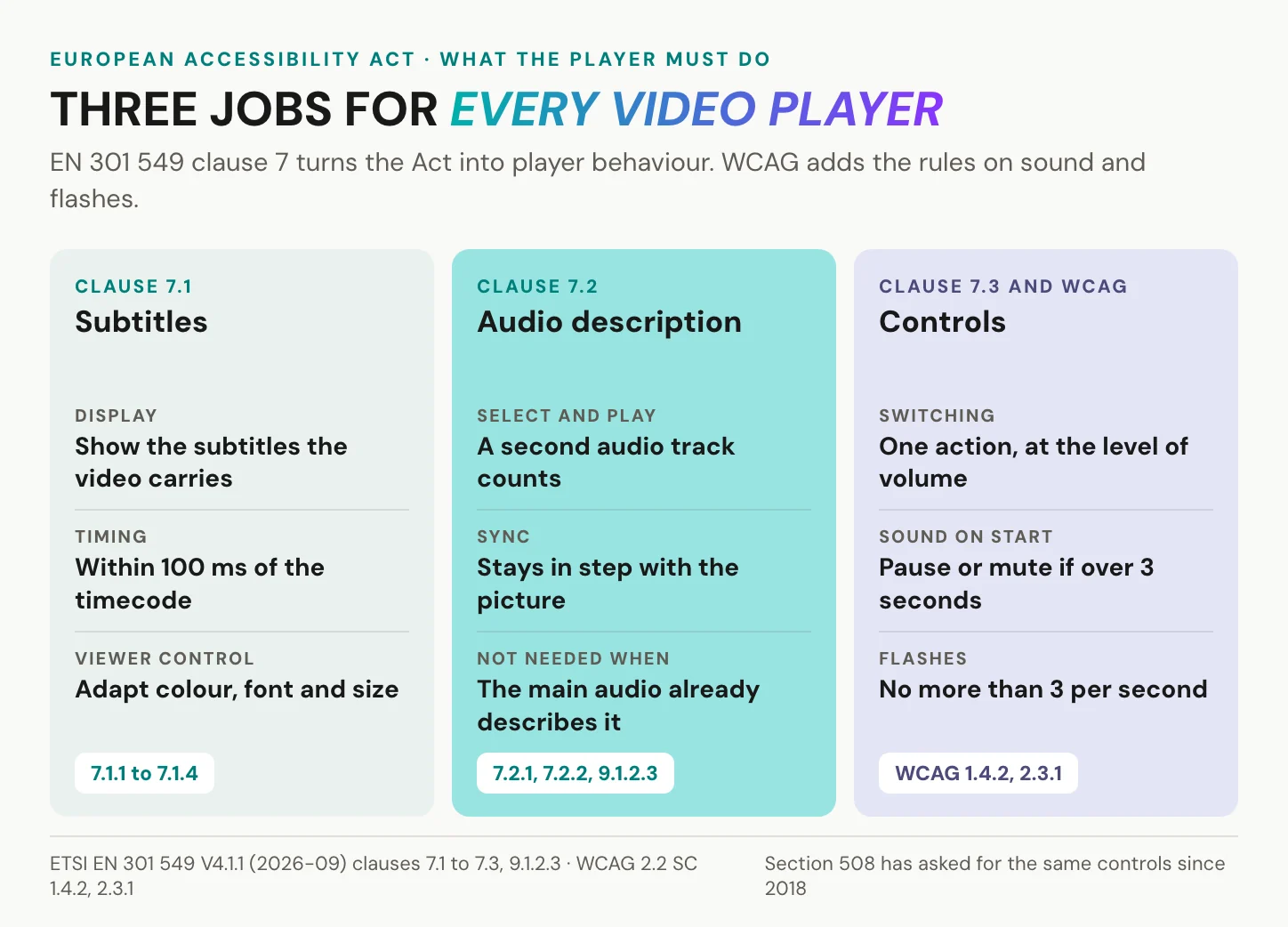
In short: the player has to show the captions on time, keep the description in sync, and let the viewer switch either as easily as the volume.
How to make your videos EAA-ready
Five steps, newest videos first.
Step 1: Sort videos by service and date. List every video by where it lives and when it went live. Inside a consumer service and published on or after 28 June 2025: on the list. Older, B2B-only, internal or third-party: off it, for now. One piece of advice beyond the law: treat an edited re-upload as a new publication.
Step 2: Caption every new video. Machine speech-to-text is fast and gives you a sound first draft. YouTube says the quality of its automatic captions may vary and that you should always review them. That is the right standard for any engine, ours included. Check the speaker labels, and add the sounds that carry meaning: a doorbell, laughter, a warning tone. Our walkthrough on how to transcribe video to text covers the drafting.
A machine caption is a draft. It becomes a caption when someone who heard the video has read it.
Step 3: Decide on audio description per video. Close your eyes and play the video. If you lose nothing, the soundtrack already describes it, and no description is needed. If a chart appears without being read out, or a step happens on screen in silence, you need one. Many talking-head and screen-recording videos pass once the speaker says what they show.
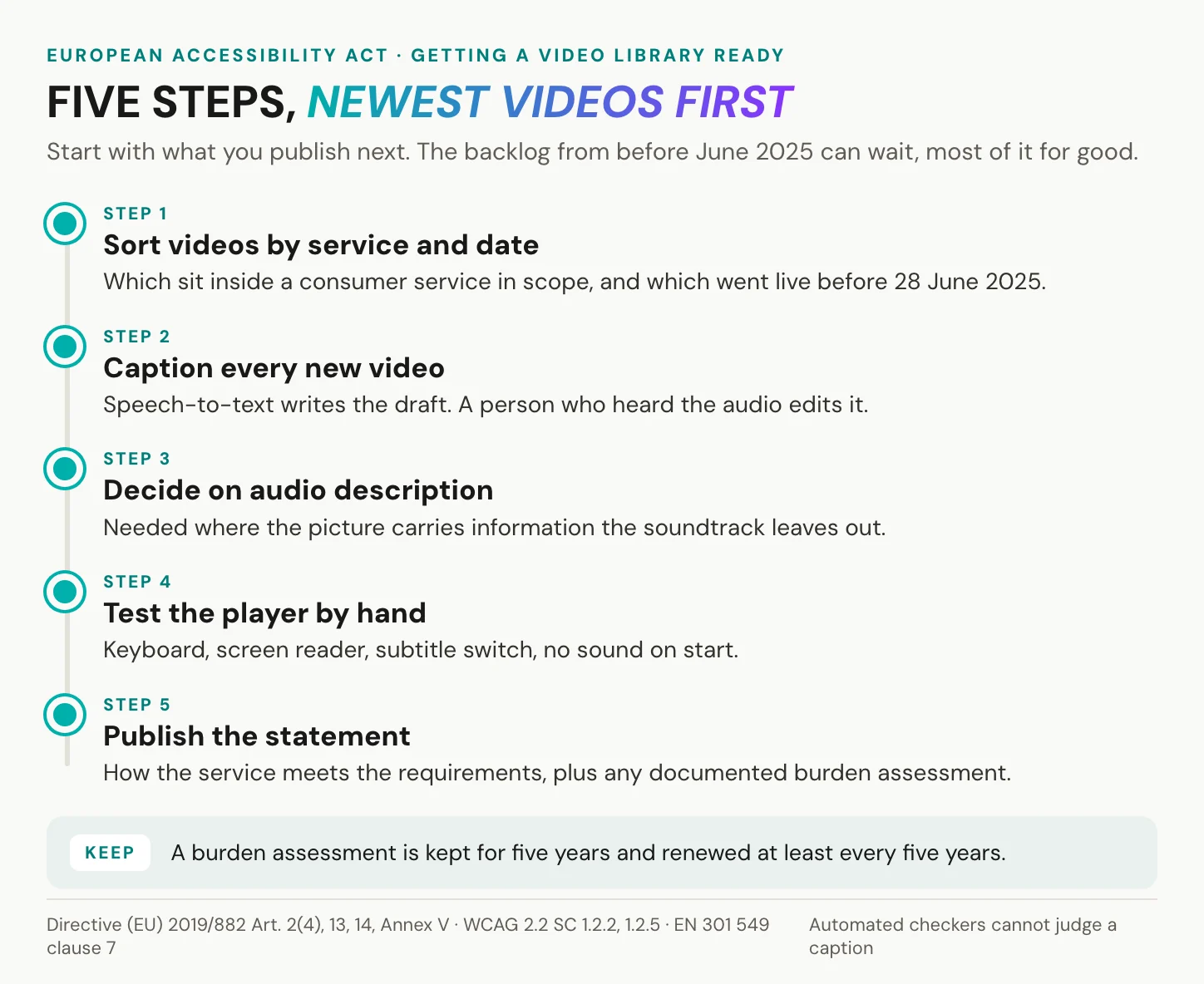
Step 4: Test the player by hand. WebAIM’s 2026 scan of the top one million home pages, crawled in February 2026, found detectable WCAG 2 failures on 95.9 percent of them. No scanner can judge whether a caption is right or a description is needed. So test by hand. Tab through the player with the keyboard. Run a screen reader. Switch the subtitles on. Load the page and listen for sound you did not ask for.
Step 5: Publish the statement and keep the file. Write the accessibility statement into your terms or an equivalent public document, and say how the service meets the requirements. If you rely on a burden assessment, keep it on file for five years. Renew it when the service changes.
In short: list, caption, describe where needed, test by hand, and document. Newest videos first.
See captions that switch on for every viewer. Create an alugha account, upload one video, let our speech-to-text write the first draft and correct it before anyone watches.
The data question on the same player
The European Accessibility Act check and the data protection check land on the same desk. They concern the same player, so ask both at once.
YouTube deserves its due first. By its own 2026 press figures, it is localized in more than 100 countries and 80 languages and takes over 20 million uploads a day. In 2026 its help pages list automatic captions in around 70 languages. No one else offers that reach. Its privacy-enhanced mode means views are not used to personalize the viewer’s YouTube experience. It does not say that no data is transmitted.
In Germany, two rules frame the embed. Under § 25(1) TDDDG, storing or reading information on the viewer’s device needs consent unless it is strictly necessary. Under Article 28(3) GDPR, a host that processes viewer data for you needs a contract setting out that processing. Ask these questions of any host, us included. Where is the video stored? Does the player load third-party trackers or advertising cookies? Is there an Article 28 agreement? Can the vendor document how its player meets EN 301 549 clause 7? More on the hosting side in GDPR-compliant video hosting.
In short: one player, two audits. Settle both before the embed goes live.
Where alugha fits, and where it does not
What we do not do, and when you do not need us
We do not make a website or a service compliant with the European Accessibility Act or the BFSG, and no player can. Compliance attaches to the whole service: the checkout, the forms, the documents, the page around the video and the statement. Our player also needs JavaScript, so a visitor who blocks scripts sees a notice instead of the video. If your procurement needs a conformance report for our player, that is a conversation, and a call is the right place for it.
You may not need us at all. Your EAA findings may be forms, checkout or PDFs, and a video platform does not fix those. Your videos may live on YouTube, captioned there, for a public audience, which is often enough. You may publish a handful of videos a year, where any caption file in your current player does the job. Or your videos are B2B-only, internal or pre-2025 archives the Act does not reach.
Captions people can reach
We earn our place when video sits inside your own service, in volume, in several languages, and the data question matters. What we cover there is part of the time-based media side: captions and transcripts, served from hosting in Germany and the EU. Our speech-to-text turns the spoken track into a subtitle track in the dubbr, with speakers detected. You then correct it line by line before anyone sees it.
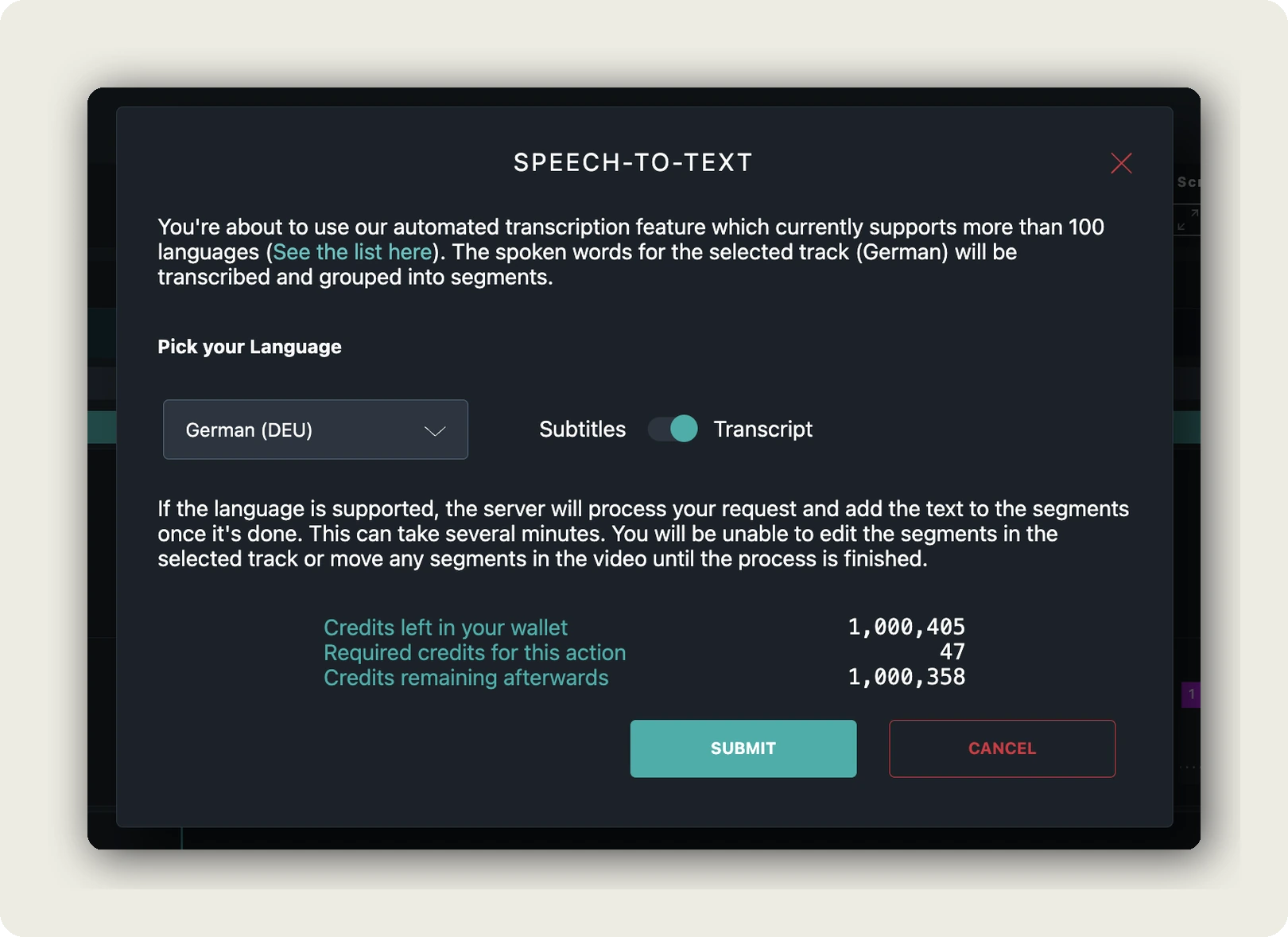
The same run can produce a transcript instead of timed subtitles. A subtitle track exports as plain text, WebVTT or SRT; exporting the file is a paid-tier feature.
Then the decisive part. In our embed options, SUBTITLES has four settings: None, Automatic, Automatic (force) or a fixed language. “Automatic (force)” shows subtitles for every viewer, so nobody has to hunt for a CC button. The details are in subtitles on embedded videos.
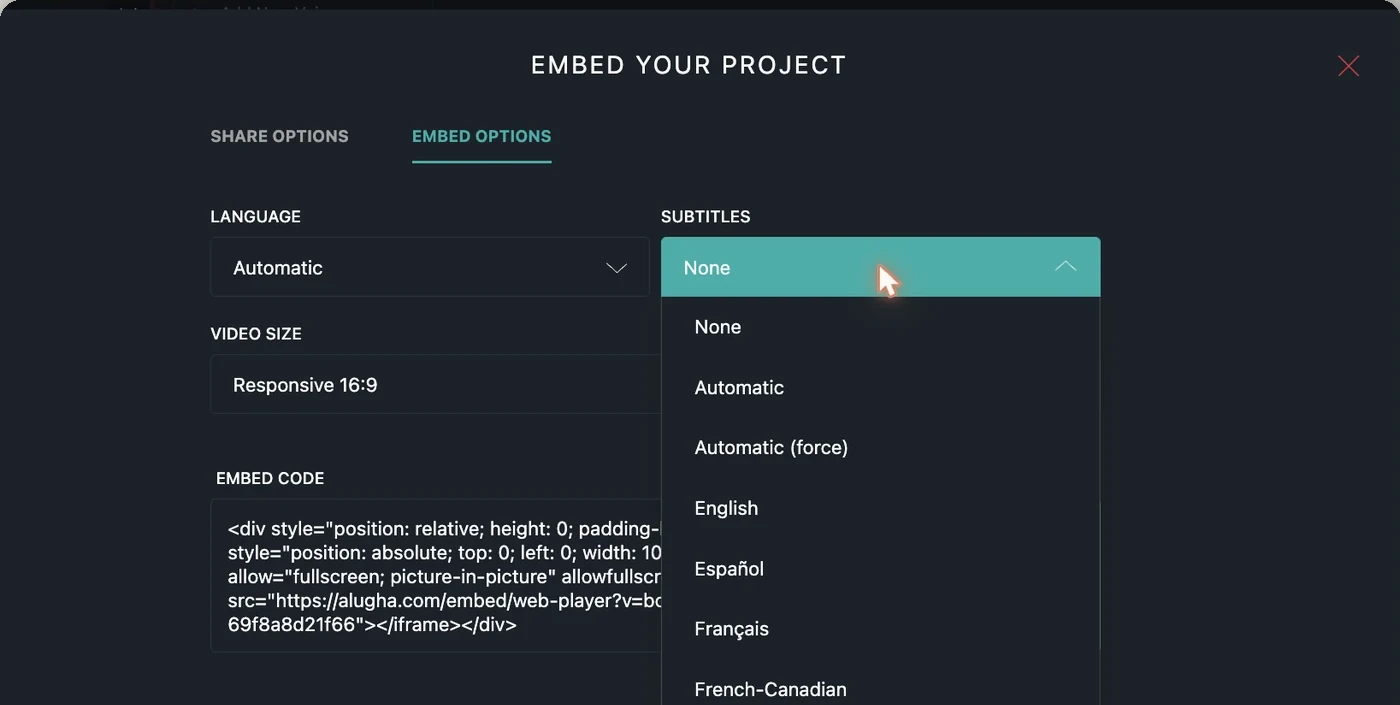
The law asks for captions people can reach, not captions that exist somewhere in a menu.
Automatic playback is off by default. If you switch it on, most browsers start the video muted unless the visitor has already interacted with the site. That is browser policy, not ours. If you turn on autoplay and loop, checking them against the pause and sound criteria is your job. Custom branding, a paid-tier feature, tints the controls with your hex color. Choose it with care, because a pale brand color can cost the controls the 3:1 contrast that WCAG 1.4.11 asks for.
One thing goes beyond the law. Viewers pick the audio and subtitle language separately, preset from their browser language, without a page reload. The EAA does not require it, but a multilingual audience notices anyway. Around all of it: hosting in Germany and the EU, no third-party advertising cookies and trackers, no external ads and no third-party recommendations.
In short: a draft in one place, corrected by a person, switched on for every viewer, and served from Germany and the EU.
Frequently asked questions about the European Accessibility Act
Does the European Accessibility Act apply to video on my website?
Only if three things are true. The website must be part of one of the six consumer services the Act lists, such as an online shop. Your company must be larger than a microenterprise. And the video must have gone live on or after 28 June 2025, the cut-off in Article 2(4). A brand site selling nothing to consumers is outside.
Do I have to caption videos published before 28 June 2025?
No. The Act excludes pre-recorded time-based media published on websites and apps before 28 June 2025, and it excludes archives that are not updated or edited after that date. No 2030 deadline applies to these videos; the 2030 date concerns old contracts and products. One piece of practical advice: treat an edited re-upload as a new publication.
Does the European Accessibility Act require audio description?
Through WCAG Level AA, yes for recorded video where the picture carries information the soundtrack does not. Where the narration already describes everything important, no description is needed, as WCAG and EN 301 549 both say. Streaming and TV platforms have an extra duty under Annex I: they must pass through the audio description that broadcasters provide.
Does the European Accessibility Act apply to B2B companies?
Not to purely B2B or internal services. The Act protects consumers, defined as people acting outside their trade, business or profession, so a service sold only to companies falls outside. Any part of the journey that consumers can use, such as a shop open to private buyers, is a consumer service and in scope.
Does the EAA apply to US and UK companies?
Yes, when they provide covered services to consumers in the EU. The Act attaches to the service and the consumer, not to where the company is registered. A US web shop selling to shoppers in Spain must meet it for those sales. The UK is not bound by the EAA, and its 2018 web accessibility regulations cover only UK public bodies.
Which WCAG version does the European Accessibility Act require?
None by name. The Directive never mentions WCAG; it enters through EN 301 549. In practice that means V3.2.1, and so WCAG 2.1 AA, until V4.1.1 is cited in the Official Journal. As of September 2026, V4.1.1, which follows WCAG 2.2, is published but not yet cited. Testing to 2.2 now is sensible and costs video teams nothing.
What is the difference between the ADA and the EAA?
The EAA is EU market law for listed consumer services, enforced by national authorities with national fines. The ADA is US civil rights law. Title II binds state and local government, with WCAG 2.1 AA due on 26 April 2027 or 26 April 2028. Title III binds businesses open to the public, sets no technical standard, and is enforced largely through lawsuits.
Getting started
Three first moves, in this order:
- List every service you run for consumers, and decide with the three-part test above which are in scope.
- Mark every video inside them with its publication date. The ones from 28 June 2025 onward are your list.
- Caption those first, check the player against EN 301 549 clause 7, then write the statement.
If your team needs captions, the player and hosting in Germany and the EU sorted in one conversation, book a call. Bring one of your videos and your procurement questions.
The two product videos from the start still sit side by side on the same shop. One went live on 27 June 2025, the other a day later. The older one can stay as it is. The newer one, and every video after it, is what the European Accessibility Act is about. Start with the next upload, not the archive.