Key takeaways
- The alugha dubbr is a browser-based tool that takes a video from transcription to publishing in one place, so you can make any video multilingual without extra licenses or extra software.
- One workflow covers transcription, subtitles, translation, and voiceover: a built-in Speech2Text engine and AI draft the transcript and subtitles, then you and your collaborators refine them directly in the browser.
- Teams work together from anywhere: share a link, and anyone with access can log in and start translating or recording audio, the way people contribute to a wiki.
- Hosting and editing live under one roof: pairing the dubbr with alugha’s multilingual video hosting turns a single upload into a player that carries every language track. alugha ships this as one platform.
- It is included in every alugha account, the free beginner package included, so reaching a multilingual audience does not start with a software purchase.
- Built from real production need: alugha produces and dubs multilingual video every day, and the dubbr is the tool the team wished existed.
What the alugha dubbr is
We built the dubbr to solve a problem we kept running into ourselves: turning a single video into a global one should not require a stack of expensive desktop software and a different license for every step. The dubbr is an online tool that holds everything you need to make a video multilingual, from transcribing to publishing, in one place and from a single source. We spoke with alugha CEO Bernd Korz about how the team set out to redefine dubbing so that any message can reach the whole world.
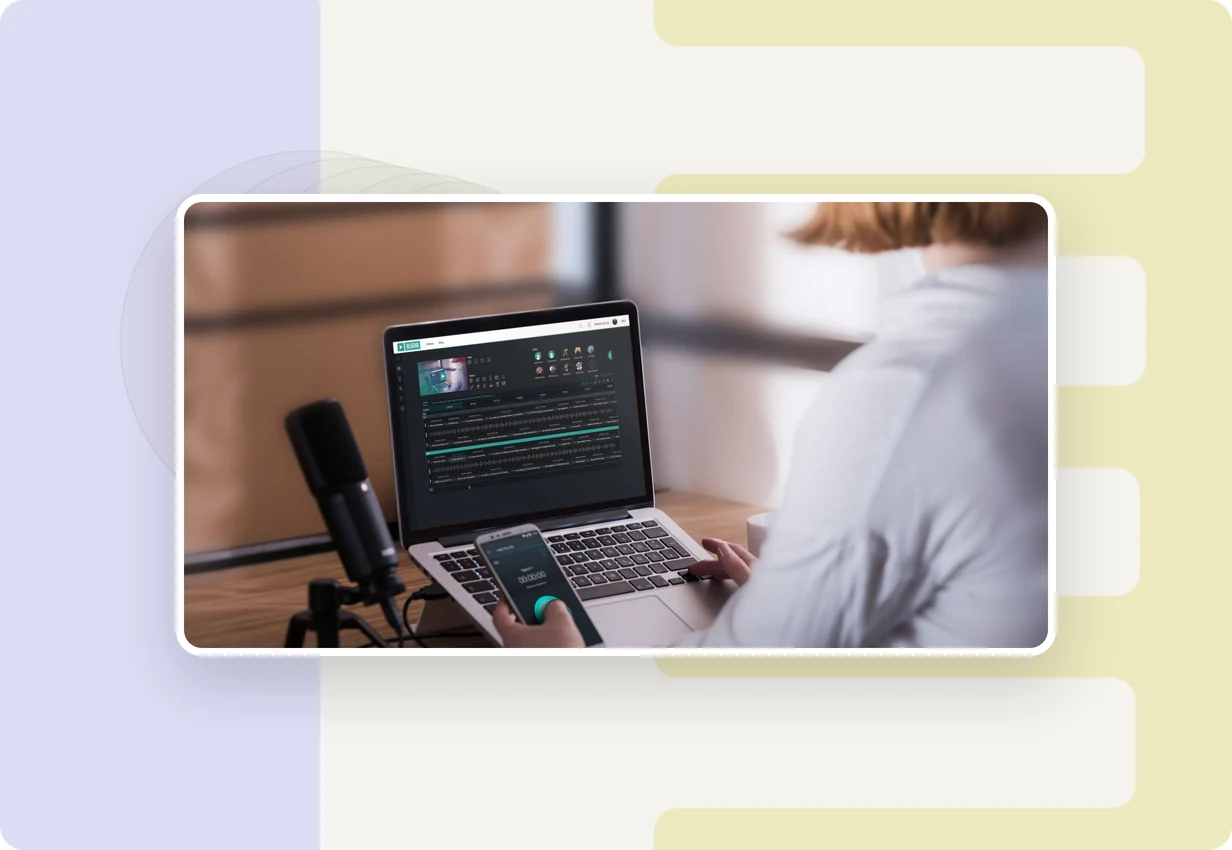
With the dubbr you can transcribe your videos, create subtitles, translate them, and record the voiceover, on your own or together with people spread around the world, all in the browser. You can add the full metadata set for each language. Think of it as an online counterpart to programs like Pro Tools or Adobe Audition, where you can also record audio, except it runs in a tab. It was important to us not to overload the tool: every feature earns its place.

Under the hood, the dubbr combines a proprietary Speech2Text engine with an AI that understands what is being said in the video and drafts the subtitles and transcript from it. The AI learns with every video and every additional language, so it works better over time. Pairing the dubbr with alugha’s multilingual video hosting is what makes the whole thing a complete video platform rather than a single-purpose editor: you produce in one place and you deliver from the same place.
Why multilingual video matters
There are more than ten million active video producers and over two billion people who speak two or more languages. The world counts more than 7,600 languages and dialects, and it has never felt closer together and further apart at the same time. If you want to reach as many people as possible with your videos, you have to offer them in more than one language. The reach is sitting there waiting; the bottleneck has always been the production effort.
It is easy to assume this only matters to companies that think of themselves as global. It does not. In Mannheim alone, more than 30 languages are spoken; in Berlin, more than 80. So even teams that consider themselves purely local are speaking to an audience that does not share a single language. If you want to reach your target group, you have to speak their language, not expect them to come to yours. That is the gap the dubbr closes, and you can see the tool itself on the alugha dubbr product page.
How the alugha dubbr works
The way it works is intuitive by design. The core steps are short:
- Upload a video to alugha.
- Create segments wherever someone is speaking.
- Activate the Speech2Text engine and wait for the text to land, then edit it if needed.
- Share the link. Whoever has it can log in and start translating or recording audio straight away.
A separate international audio-track feature keeps atmosphere, sound effects, and music apart from the spoken voices. That is what lets documentaries, interviews, and film versions be dubbed and published in several languages completely online. You can add background music through an upload window, and in the video-information editor you can set the title, description, tags, thumbnail, and background image for each language individually. Every search engine then receives the full metadata per language, so each language version is easier to find. When you export, you can switch on ducking, common in documentaries, which lowers the main language to 30 percent of its volume while another language is spoken.
The payoff is independence from time and place. You translate a video into many languages directly in the browser, you do not buy any software to do it, and, the way people already collaborate on Wikipedia, you can work with many contributors on the same project. It scales naturally: the more videos and speakers, the more possibilities. The dubbr is decentralized and works for producers and voice talent anywhere, so there is no real ceiling on how far a project can grow.
Accessibility: subtitles travel with every language
Multilingual reach and accessibility are the same job done well. Because the dubbr produces a transcript and subtitles as part of the normal workflow, you are not bolting accessibility on at the end. Subtitles help viewers who are deaf or hard of hearing, viewers in noisy environments, and people following along in a second language, and they travel with every language track you create rather than living in a separate file you have to remember to update.
That single-source approach is what keeps accessible video sustainable as a library grows. You can produce accessible subtitles in the same place you transcribe and translate, and the same logic extends to audio description for viewers who are blind or have low vision. When a correction lands, it lands once. When you add a new language, the accessibility scales with it instead of starting over.
Who the dubbr is for
The dubbr is for anyone who produces video and wants to offer it in more than one language. In practice, a few groups feel the benefit immediately:
- Independent creators and producers: reach an international audience without buying or learning a stack of separate audio and translation tools.
- Documentary and media teams: use the international audio track and ducking to dub interviews and film versions online, in several languages.
- Companies and organizations: communicate with a multilingual audience and translate a video and add new languages while keeping every version in sync from one source.
- Distributed collaborators and voice talent: contribute to a project from anywhere with nothing more than a browser and a shared link.
FAQ
What is the alugha dubbr?
The alugha dubbr is a browser-based tool for making video multilingual. In one place you can transcribe a video, create subtitles, translate them, and record the voiceover, then publish, without extra licenses or extra software.
How does the alugha dubbr work?
Upload a video to alugha, create segments where someone is speaking, activate the Speech2Text engine, and edit the resulting text if needed. Then share the link, and anyone with access can log in to translate or record audio directly in the browser.
How much does the dubbr cost?
The dubbr is included in every alugha account, including the free beginner package. For current plan details, see the alugha plans page.
Can several people work in the dubbr together?
Yes. The dubbr is built for collaboration. Share a project link and contributors anywhere can log in and translate or record audio, the way many people contribute to a single Wikipedia article. The work can be tracked in real time.
What makes the alugha dubbr different from other dubbing tools?
The dubbr combines alugha’s own hosting platform, a proprietary HTML5 multitrack player, and online software for managing multilingual video in one place. Transcription, subtitles, translation, voiceover, and delivery sit together rather than across separate, disconnected tools.
Who is the dubbr for?
Anyone who produces video and wants to offer it in more than one language: independent creators, documentary and media teams, companies communicating with a multilingual audience, and distributed collaborators and voice talent working from a browser.
Try it: the dubbr is part of every alugha account, including the free beginner package. Upload a video and turn it into a multilingual one at alugha.