Key takeaways
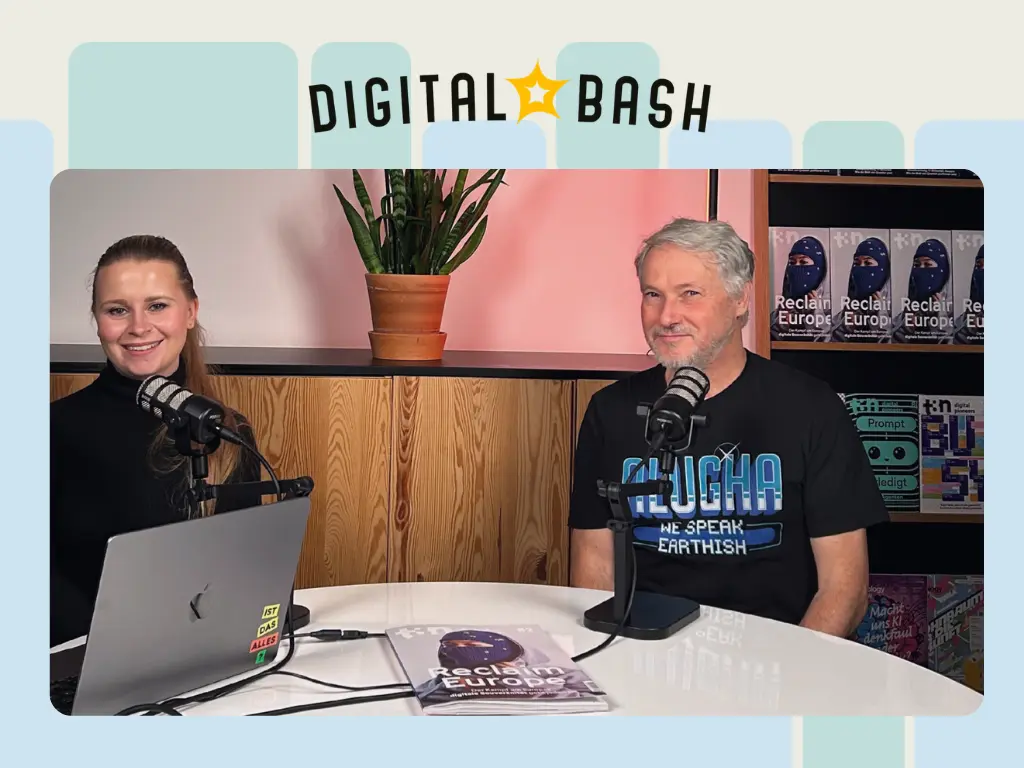
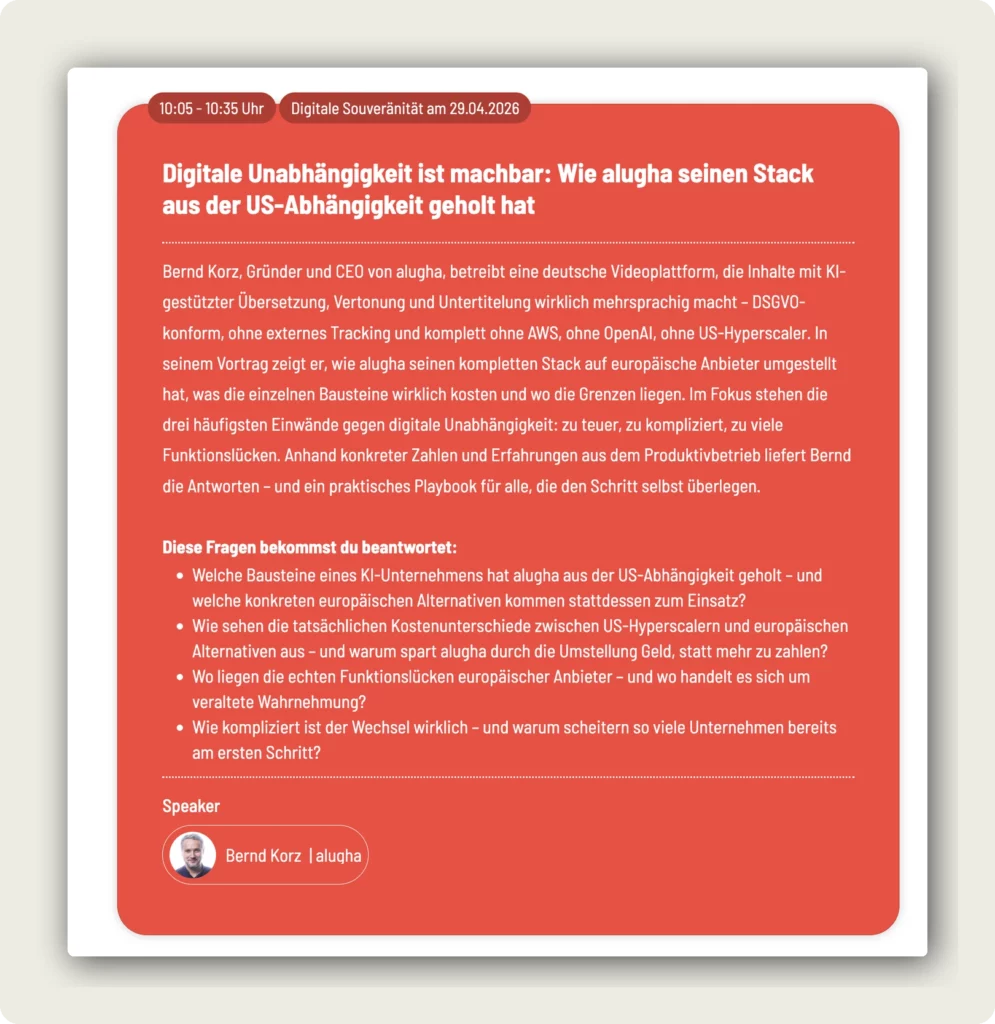
- Bernd Korz speaks at Digital Bash on April 29. alugha’s CEO joins the t3n × heise × Digital Bash online conference on digital sovereignty, slot 10:05 to 10:35 CEST. Free registration, recording available afterwards.
- A fully migrated EU stack, not a compliance theater. alugha runs its complete AI video pipeline, from speech-to-text through voice cloning to multilingual playback, on European providers. No AWS, no OpenAI, no US hyperscaler in the delivery path.
- Real cost data, not a whitepaper pitch. Bernd brings production numbers from the live platform, including the layers where European alternatives are cheaper and the ones where they are not.
- The three objections taken apart. Too expensive, too complicated, too many feature gaps. Each of these gets dismantled with specific examples drawn from the alugha migration.
Event: t3n × heise × Digital Bash. Digitale Souveränität. April 29, 2026. Online, free. Register →
What “digital sovereignty” actually means in 2026
US hyperscalers built the cloud as we know it. AWS, Azure, Google Cloud, and OpenAI set the performance benchmarks, shaped the developer ecosystem, and gave a generation of SaaS companies their starting stack. The scale is real. The feature depth is real. The reasons teams defaulted to them were never irrational.
But the assumption that a Data Processing Agreement plus an “EU region” selector equals sovereignty does not hold up legally. Under the US CLOUD Act, US-headquartered providers can be compelled to disclose EU-hosted data to US authorities, regardless of the region selected. After Schrems II, the legal basis for routine EU-to-US transfers was invalidated, and the Transatlantic Data Privacy Framework that followed is itself being challenged in European courts. For a growing number of EU-based teams in regulated industries, public procurement, and sensitive-content workflows, the contractual layer no longer absorbs the risk.
Sovereignty, in the 2026 sense, is an architectural property, not a contractual one. It means the data, the compute, the AI model weights, the user identity layer, and the network path all stay inside a legal jurisdiction that cannot be overridden by a foreign subpoena. That is a structurally different picture from “hosted in Frankfurt”. It is also exactly what the Digital Bash conference is about.
alugha’s stack, before and after the migration
alugha is a German multilingual video platform that processes the complete AI pipeline in-house: speech-to-text transcription, automated translation across 200+ languages, voice cloning that preserves the speaker’s intonation, and multilingual audio playback inside a single embed. A few years ago, parts of that stack ran on US infrastructure, like most SaaS products of the era. Today, none of it does.
The migration covered every layer of the product. Compute and storage moved to European hosting providers. The AI models, historically the hardest component to move, were replaced with open-source and European-licensed equivalents running on in-EU infrastructure. Identity, analytics, email, and payments were realigned to providers that sit under European corporate ownership. The result is a SaaS platform where a DPO, a procurement lead, or an auditor can trace every data path without hitting a US border.
The talk walks through that architecture layer by layer. It also does the honest thing: names the two or three places where the European alternative still trails its US equivalent on a specific feature, and explains how alugha worked around it rather than pretending the gap does not exist.
Three objections Bernd takes apart on April 29
Most digital sovereignty discussions stop at the principled argument. This talk keeps going, into the three operational objections that actually block migrations inside real companies.
“Digital sovereignty is too expensive”
The common assumption is that European providers charge a premium for compliance-branded hosting. In alugha’s case, the number went the other way. After the migration, the company spends less on infrastructure than it did on a comparable US setup. Bernd brings the line-item breakdown: which layers are cheaper on EU providers, which are roughly equivalent, and where the real savings come from (spoiler: it is not the compute line).
“It is too complicated”
Migrations are complicated. That part is true. But most companies fail at step one, not step ten, and the reason is usually not a technical limit. It is a scoping problem. The talk maps the decision tree alugha followed: which components to migrate first, which to move in the same cut, and which to defer. The complexity is manageable when the sequence is right. When the sequence is wrong, even a two-layer migration collapses under its own dependencies.
“European alternatives cannot keep up”
Some feature gaps are real. Most are legacy perception from 2021, when the European cloud landscape looked very different. The talk separates the two. Where European providers now match or exceed their US counterparts, Bernd names the specific services. Where a gap remains, he names it, and describes the architectural workaround alugha uses in production.
Why 30 minutes of production data matters
The sovereignty conversation has no shortage of principled arguments and policy papers. What it has less of is first-person operator accounts from SaaS companies that have already completed the migration and can share the receipts. That is the specific slot Bernd’s talk fills. The numbers come from a live platform serving enterprise customers, including Warner Bros, John Deere, Trimble, and Röchling. The lessons apply to any B2B SaaS leadership team evaluating whether a European stack is viable for their own product.
The event itself is co-organized by t3n and heise, two of the most credible German tech publications, alongside Digital Bash. The lineup on April 29 also includes sessions from DriveLock, plusserver, Bitdefender, and heise academy on related sovereignty and resilience topics. It is the kind of morning that compresses a quarter of reading into two and a half hours.
Register for the free event on April 29
t3n × heise × Digital Bash. Digitale Souveränität.
Tuesday, April 29, 2026. 09:00 to 11:55 CEST.
Bernd Korz’s slot: 10:05 to 10:35 CEST.
Online, German language, free. Recording and slides are distributed to registered attendees afterwards.
Register for free on digitalbash.de →
FAQ
What does digital sovereignty actually mean in 2026?
Digital sovereignty in 2026 refers to an architectural property: data, compute, AI model weights, identity, and network paths all remain inside a legal jurisdiction that cannot be overridden by a foreign subpoena (notably the US CLOUD Act). It is distinct from contractual GDPR compliance, which a Data Processing Agreement with a US-owned provider can offer on paper but not guarantee structurally after Schrems II.
What will Bernd Korz cover in his Digital Bash talk?
How alugha migrated its complete AI video stack, speech-to-text, translation, voice cloning, and playback, to European providers. The talk covers the real cost breakdown, which feature gaps are genuine versus outdated perception, and the sequencing that determines whether a sovereignty migration succeeds or stalls at step one.
Is alugha GDPR-compliant?
Yes. alugha is hosted entirely on EU infrastructure, uses no US hyperscalers, and processes no data outside the EU. The platform supports GDPR-compliant multilingual video hosting across 200+ languages with voice cloning and subtitle accessibility automation included.
The t3n × heise × Digital Bash conference on Digital Sovereignty runs on April 29, 2026, from 09:00 to 11:55 CEST. Attendance is free. Bernd Korz’s session runs from 10:05 to 10:35. Register on digitalbash.de.