Key takeaways
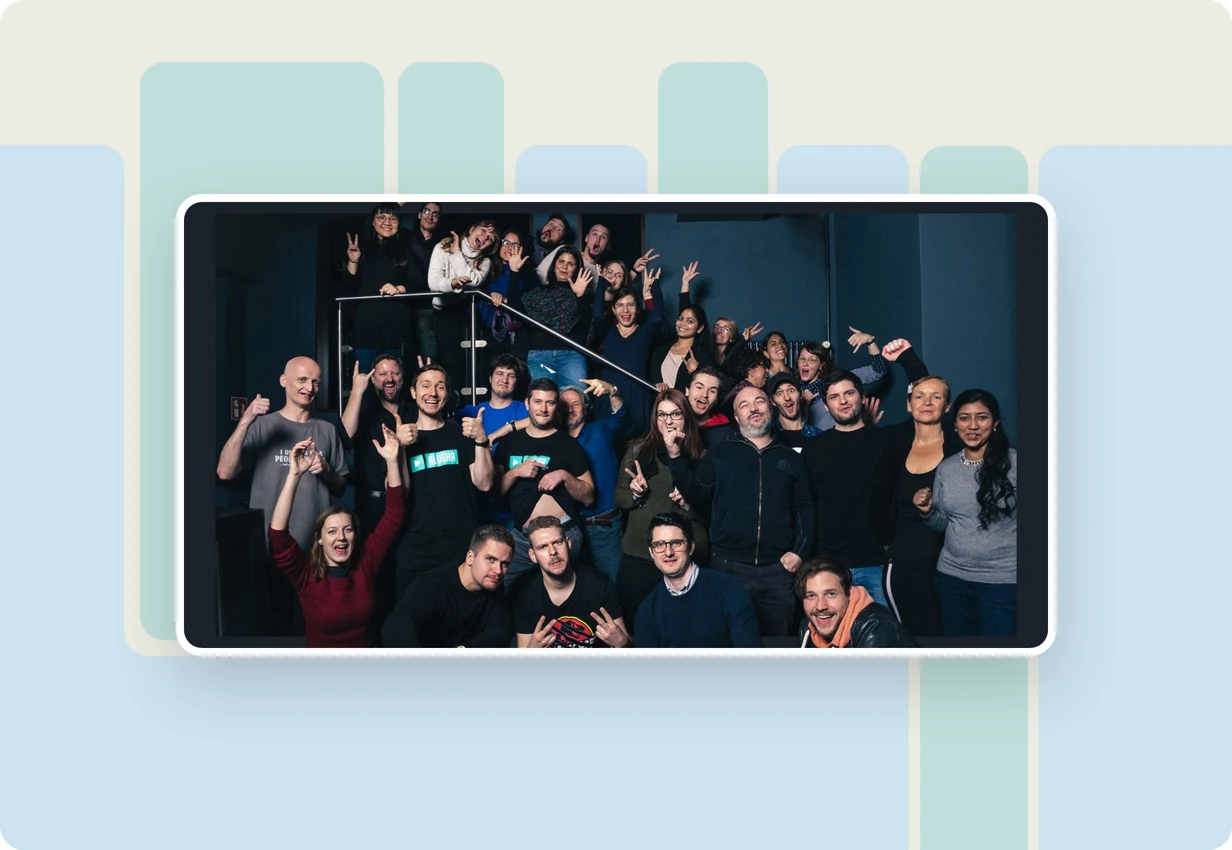
- The alugha team event 2018 was an internal team meeting, not a trade fair: every department presented what it had been working on so the whole company could see how the pieces fit together.
- Cross-team visibility is a working method, not a perk: knowing what the desk next to you is building is what keeps a multilingual product coherent across creative, dubbing, marketing, and engineering.
- The numbers were real: 15 translators, content dubbed in 10 languages, and 186 videos plus 516 audio tracks published with our partner Studio 71 in a single year.
- One culture, many languages: the team combines different backgrounds in one workplace, which is the same idea our platform applies to video. alugha builds for many languages because we work in many languages.
- The roadmap was set in the room: GraphQL, React, TypeScript, machine learning, and a cloud-based video platform were the engineering topics that shaped what came next.
Inside the alugha team event 2018
Knowing what your colleagues are working on matters for a company’s success. It makes day-to-day cooperation easier, and it pulls a team in the same direction. Most days, everyone is heads-down on their own projects and tasks, and it is easy to lose track of what the department next door is doing.
Our team meeting that week changed that for a few hours. We welcomed new colleagues, congratulated the new fathers on the team, and then went through the projects running across the company. As Katarzyna Paruszewska, one of our dubbing specialists, put it: it was genuinely exciting to get a clearer picture of everything happening inside the company. This is a short look back at that day and what it says about how we build multilingual video.

Like any creative company, we have to let ideas run. When our CEO, Bernd Korz, lands on one of his bigger ideas, he talks it through with our designer, Felipe Monte, who turns the abstract input into workable mockups. From there it goes to the developers. And alongside building new products for the platform, we keep expanding our multilingual world. Here are the highlights each department brought to the table.
What each department brought to the table
Creatives. Our creative team stood out in 2018 with internal productions like the BMW i3 series “Time To Switch” and with external commissions. What really caught everyone off guard, though, was the work of our dual-study media-design students, Michelle Acosta, Anna Hinckel, and Matthias Schaudig. Video creation, three-step drawing, the basics of typography, crossmedia in digital media, a campaign for the Bodenseefestival 2018, audio-active stage design, and even a short film, “In 13 Minutes,” made a lot of jaws drop.
Dubbing and translation. What do 15 translators do all day? They translate videos, articles, websites, and other projects, and they dub our videos into 10 languages. Counting the videos from our partner Studio 71 alone, the team published 186 videos and 516 audio tracks. That output is the everyday reality behind multilingual video, and it is also where the discipline of keeping every language version in sync starts to matter.
Marketing and PR. 2018 was a productive year. alugha was covered across magazines and other platforms, which pushed view counts and user numbers steadily upward over the year.
Technology. Keeping up with new methods in engineering while shipping every day is its own challenge, but our developers stay close to the state of the art and keep improving the platform and products with it. With the tireless work of our IT student Niklas Korz, one of the main developers, we have a team that impresses us daily.
GraphQL, React, TypeScript, a chatbot AI built with Python and machine learning, and how to scale an online video platform in the cloud were only some of the engineering topics on the table. The year ahead pointed to a lot of new work: artificial intelligence, dubbing, subtitles, photos, a new design, and products that would slot into the alugha toolkit.
Why cross-team visibility shapes multilingual video
A day like this is easy to read as a nice break from routine. It is more than that. Multilingual video is not made by one team in isolation. A creative idea becomes a mockup, a mockup becomes a feature, a feature has to carry translations and dubbing, and all of it has to hold together for the viewer. When each team can see the others’ work, those handoffs get cleaner, and the product stays coherent across languages instead of drifting apart version by version.
That is the principle behind how alugha treats multilingual video content: one video stays the source of truth, and many language tracks live on the same file. The same instinct that has every department in one room is the instinct that keeps every language in one player, so nothing falls out of sync as content grows.
Many cultures, one workplace
As Bernd Korz, our CEO, summed it up after the presentations: everyone got to see what each person was working on, and that makes it far easier to appreciate what colleagues contribute. At alugha we bring different cultures together in one workplace, and each person adds to the company in their own way through their daily work.
That mix is not a side note for a multilingual product. It is the reason the product makes sense. A team that already lives across languages and backgrounds builds accessible, multilingual video with fewer blind spots, because the perspective is in the room rather than assumed from the outside. It is also why accessibility and inclusion show up as defaults in how we work, from accessible subtitles through to the way content is stored and delivered.
From the 2018 meeting to the platform today
Looking back, the topics on the table that day were a fair preview of where the platform went. The artificial intelligence and machine-learning experiments turned into the AI-assisted transcription, translation, and voice work that creators use now. The cloud-scaling conversation became the infrastructure that carries multilingual video for teams across markets. And the quiet commitment to doing things responsibly grew into GDPR-compliant video hosting run in Germany.
None of that came from a single launch. It came from a team that keeps showing each other the work, year after year. The alugha team event 2018 was one small marker on that line, and the same habit still shapes how the platform is built.
FAQ
What was the alugha team event 2018?
It was an internal company team meeting in 2018 where every department at alugha presented its projects to the rest of the team. The goal was shared visibility: giving everyone a clear picture of what their colleagues were working on across creative, dubbing, marketing, and engineering.
Which teams presented at the alugha team event 2018?
Four areas shared their work: the creative team, dubbing and translation, marketing and PR, and technology. Each gave the rest of the company a look at its projects from the year, from video productions and translations to platform engineering.
How many languages did the alugha team work in?
In 2018 the team had 15 translators and dubbed content into 10 languages. With our partner Studio 71 alone, alugha published 186 videos and 516 audio tracks in the year.
Why does an internal team event matter for multilingual video?
Multilingual video depends on clean handoffs between creative, dubbing, and engineering. When teams can see each other’s work, those handoffs get tighter and the product stays consistent across every language instead of drifting apart version by version.
What engineering topics came out of the meeting?
The engineering discussion covered GraphQL, React, TypeScript, a chatbot AI built with Python and machine learning, and cloud-based scaling for an online video platform. These laid the groundwork for the AI-assisted and infrastructure features the platform ships today.
Originally published: 13 November 2018 by the alugha team. A look back at an internal company team meeting and what it says about how alugha builds multilingual, accessible video.