Key takeaways
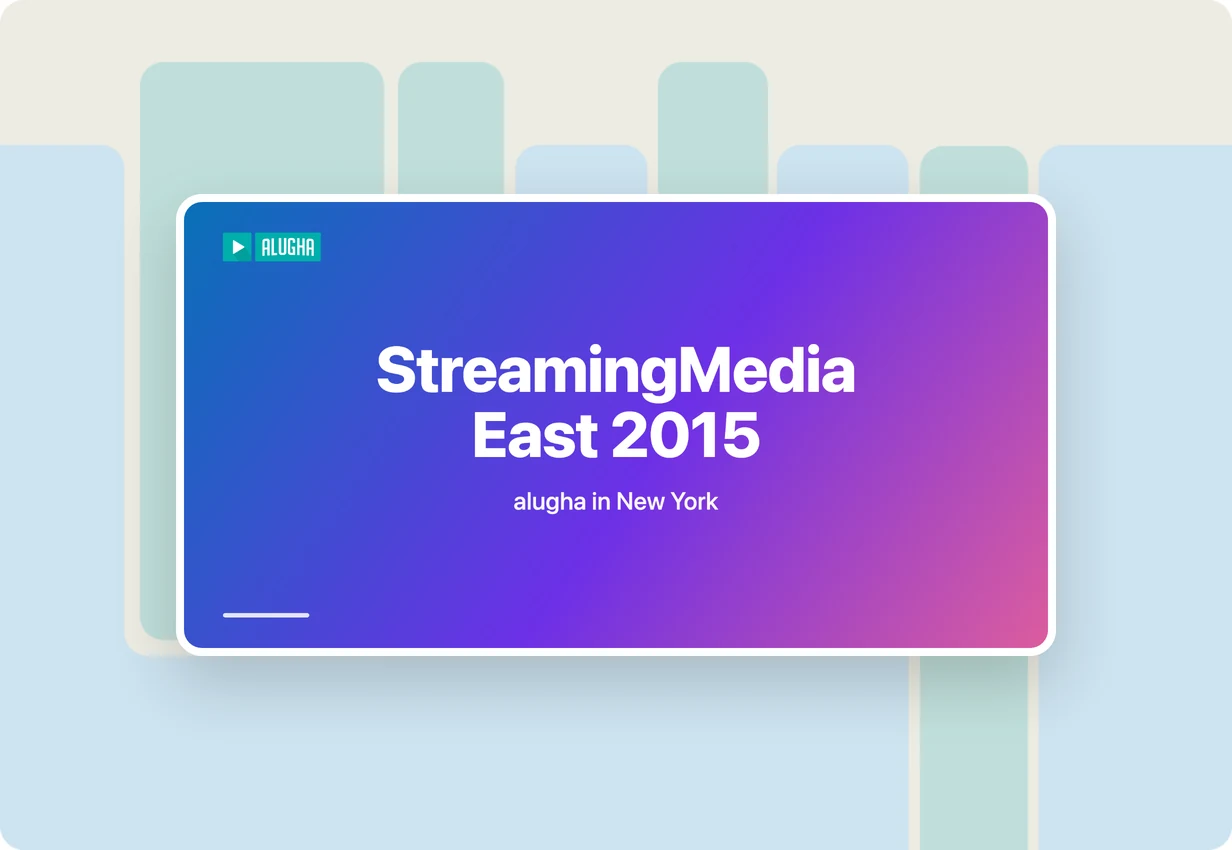
- alugha at Streaming Media East 2015: the alugha team exhibited at the New York conference for streaming and online video in 2015, and it was the first show that felt like exactly the right room for a multilingual video platform.
- Two full days of quality conversations: broadcasters from across the United States came to the booth to understand alugha in detail, and the team left with around 40 promising contacts over the two days.
- Real interest from major players: the team spoke with potential investors, held another revealing conversation with Amazon, and met two global players who came to the booth specifically because they had been told to see alugha.
- The core idea resonated: one video carrying many language tracks, switchable in the player, was the message that pulled broadcasters and streaming professionals across the floor. alugha still ships this as the default today.
- A deliberate step into the US market: alongside the show, the team met a PR agency to build a presence in the local media and push alugha into the international spotlight.
What alugha did at Streaming Media East 2015
The alugha team was already in the United States for CollisionConf in Las Vegas, and New York sat more or less on the way back, so the stop-over almost arranged itself. Streaming Media East was a conference built exclusively around video content, producers, and everything else connected to streaming and online video. After one hour on site, the open question of whether this was finally the right room for alugha already had an answer: yes, absolutely.
That fit mattered because alugha is not a general software product looking for any audience. It is a multilingual video platform, and a streaming-media conference is where the people who live with language and distribution problems every day actually gather. The first exhibition day made the difference between quantity and quality obvious. Diverse broadcasters from across the States came to the booth to get alugha explained in detail, rather than collecting a flyer and moving on.

The first day ran from 9 am to 5 pm and brought direct enquiries from potential investors and another revealing conversation with Amazon. The team headed back to the hotel that evening with around 20 business cards and a tiring but genuinely successful day behind them. The second day was shorter, 10 am to 4 pm, and started in a relaxed way, with only one short presentation before 11 am. Even so, it turned into roughly another 20 conversations, several of them outstanding.
Highlights from the alugha booth
A few moments stood out from the two days in New York:
- Two global players came looking for alugha: both walked up to the booth because they had been told they absolutely had to see the platform. Each conversation became a detailed presentation followed by an even more detailed question-and-answer session.
- Concrete next steps: one of those companies expressed strong interest in continuing the conversation, and the other raised the prospect of a larger investment.
- Another talk with Amazon: a continuation of an ongoing dialogue, and one more sign that the multilingual video approach was landing with the right people.
- A PR agency meeting: away from the show floor, the team sat down with a promising PR agency to start building a presence in the US media and to set up the next phase of the market push.
The conclusion was clear. The conference was a real success and attending it was the right call. Off the back of it, alugha planned to step up its activity in the US market and move the platform into the international spotlight.
Why a streaming-media conference mattered for multilingual video
Streaming and online video were already reshaping how audiences watched in 2015, and the people at a streaming-media conference were the ones who felt language barriers most directly. A programme produced in one language quietly leaves part of the audience behind, and viewers stay with content longer when it reaches them in their own language. For broadcasters and streaming teams, producing a separate edit for every territory was, and still is, one of the slowest and most expensive parts of distribution.
alugha approached this differently from the start. One video stays the source of truth, and many language tracks are layered onto the same file. Viewers pick their language directly in the player, with translations available in over 200 languages. There is no multi-file library to maintain, no version drift between territories, and no re-upload when a correction lands. That is the idea that pulled broadcasters across the floor in New York, and it is the same logic that powers the kind of video translation platform work that scales global reach without scaling the workload.
Accessibility and reach: subtitles and audio description
Reaching a wider audience is not only a language question. Accessible content widens who can watch a video in the first place, and the practical challenge is how to produce it without doubling the workload on every title. The conversations at the booth kept returning to this point, because for streaming teams accessibility and localization are two halves of the same distribution problem.
alugha builds accessible subtitles and audio description as part of the normal workflow rather than as an afterthought. Subtitles support viewers who are deaf or hard of hearing, viewers in noisy environments, and people watching in a second language. Audio description opens the same programme to viewers who are blind or have low vision. Both travel with the single multilingual file, so accessibility scales with every language a team adds rather than becoming a separate production each time.
What the alugha approach offers streaming teams
The booth conversations in New York kept circling the same set of capabilities that still define the platform:
- Multilingual content: reach international audiences with translations in over 200 languages, switchable directly in the player.
- Accessible media: build inclusive content with professional accessible subtitles and audio description that travel with the file.
- One source of truth: a single embed carries every language track, so streaming teams stop maintaining one file per language and per market.
- Secure, reliable hosting: secure video hosting that keeps control of the content with the team that produced it.
Who Streaming Media East 2015 was for
- Broadcasters and streaming services: the audience that came to the booth to localize programming for every territory without rebuilding it per language.
- Video producers and post teams: the people who fold subtitles, dubbing, and audio description into an existing pipeline.
- Investors and partners: the conference also drew the people thinking about where online video was heading, which is exactly the conversation alugha came to have.
Streaming Media East 2015 in the alugha story
Looking back, New York in 2015 was an early marker on a long road. The conference confirmed that a multilingual video platform belongs in the room where streaming and online video professionals gather, and the conversations there fed directly into the push onto the US market. The product has grown a great deal since, but the core promise the team described at that booth has not changed: one video, every language, no per-market re-edit.
FAQ
What was alugha at Streaming Media East 2015?
alugha at Streaming Media East 2015 was the alugha team exhibiting at the New York conference for streaming and online video. The team presented its multilingual video platform to broadcasters, producers, and streaming professionals over two exhibition days.
Where and when was Streaming Media East 2015?
Streaming Media East 2015 took place in New York. The alugha team attended both exhibition days, with the first day running from 9 am to 5 pm and the second from 10 am to 4 pm.
What did alugha at Streaming Media East 2015 focus on?
The focus was multilingual video: one source video carrying many language tracks, switchable in the player, with translations in over 200 languages plus accessible subtitles and audio description. That single-file approach was the message that drew broadcasters and streaming teams to the booth.
Why did alugha attend a streaming-media conference?
A streaming-media conference gathers the broadcasters, producers, and streaming services who deal with language and distribution every day. For a multilingual video platform, it was the most relevant room to be in, which is why the team described it as the first show that felt exactly right.
Does alugha support accessible video for streaming?
Yes. alugha produces professional subtitles and audio description inside the same workflow, so accessible video does not require a separate production. Subtitles and audio description travel with the multilingual file across every language a team adds.
How does alugha handle multilingual video?
alugha keeps one source video and layers multiple language tracks onto the same file. Viewers select their language in the player, so a single embed serves every market. That removes the per-language file library and keeps every version in sync.
Event: Streaming Media East 2015. Location: New York. The alugha team exhibited across both days of the conference and used the trip to step up its push into the US market.