
The video hosting world just got shaken up. Vimeo, the platform millions of businesses trusted for professional video hosting, was just acquired by Italian tech conglomerate Bending Spoons for $1.38 billion [1]. And if you’re a Vimeo user, you’re probably wondering what this means for your business.
Here’s the thing: major acquisitions like this rarely end well for existing users. Remember what happened to Evernote after Bending Spoons acquired it? Massive layoffs, feature cuts, and frustrated users scrambling for alternatives [2]. We’ve seen this story play out countless times. When a platform gets acquired, especially by a company known for aggressive cost-cutting, it’s time to start looking for a Vimeo alternative.
In this comprehensive guide, I’ll show you exactly why you need to start planning your exit strategy from Vimeo, and more importantly, I’ll reveal the best alternatives that can actually improve your video marketing results while saving you money. By the end of this post, you’ll have a clear action plan for migrating away from Vimeo before the inevitable changes hit your business.
Let’s dive in.
Why this acquisition changes everything (and why you should care about a Vimeo alternative)

The $1.38 billion acquisition of Vimeo by Bending Spoons isn’t just another tech deal. It’s a warning sign that every business using Vimeo needs to understand.
Bending spoons’ track record: A pattern you can’t ignore
Bending Spoons has a very specific playbook for acquiring companies. They acquire established platforms, implement aggressive cost-cutting measures, and prioritize maximizing short-term profits [3]. Here’s what happened to their previous acquisitions:
Evernote (acquired 2022):
– Laid off most of the US-based team
– Reduced free tier features significantly
– Increased subscription prices by 40%
– Eliminated several popular features that users loved
WeTransfer (acquired 2022):
– Cut free transfer limits from 2GB to 1GB
– Reduced file retention from 7 days to 3 days
– Introduced more aggressive upgrade prompts
The pattern is clear: acquire, cut costs, squeeze users for more revenue.
What this means for your business
If you’re using Vimeo for business purposes, here’s what you can expect in the coming months:
1. Price increases – Bending Spoons paid a 91% premium for Vimeo, and they’ll need to recoup that investment
2. Feature reductions – Expect cuts to free-tier offerings and consolidation of paid plans
3. Support degradation – Layoffs typically start with customer support teams
4. Platform instability – Major transitions often lead to technical issues and downtime
The writing is on the wall. Smart businesses are already seeking a Vimeo alternative before these changes affect their operations.
The $1.38 billion question: Why now?
Vimeo’s sale wasn’t a success story. The company had lost almost 90% of its market value since going public in 2021[4]. They were struggling with:
– Declining user growth
– Increased competition from YouTube and other platforms
– Difficulty monetizing their user base effectively
– Technical limitations that prevented innovation
Bending Spoons saw an opportunity to acquire a struggling platform at a discount and extract value through cost-cutting. This is precisely the scenario where existing users get hurt.
The hidden costs of staying with vimeo (that most businesses don’t calculate)
Before we explore alternatives, let’s discuss the actual cost of staying with Vimeo, particularly after the acquisition.
The obvious costs
Most businesses only consider the subscription fees when evaluating video hosting platforms. For Vimeo, that’s currently:
– Starter Plan: $20/month
– Standard Plan: $33/month
– Advanced Plan: $108/month
– Enterprise: Custom pricing (typically $500+/month)
But these prices are about to change. Based on Bending Spoons’ track record, expect price increases of 30-50% within the next 12 months.
The hidden costs that kill your ROI

What most businesses don’t calculate are the hidden costs that eat away at your video marketing ROI:
1. Limited global reach
Vimeo is blocked or restricted in several major markets, including China and parts of the Middle East. If you’re trying to reach global audiences, you’re automatically cutting off millions of potential customers.
2. Poor multilingual support
Creating videos for international markets requires separate uploads for each language. This means:
– Multiple video files to manage
– Increased storage costs
– Complex workflow management
– Inconsistent user experience across languages
3. Weak AI capabilities
Vimeo’s transcription accuracy hovers around 85-90%, meaning you’ll need to edit most automated captions manually. For a 10-minute video, that’s typically 30-45 minutes of additional work.
The real cost: Lost opportunities
Here’s what really hurts: the opportunities you’re missing by staying with a platform that wasn’t built for modern global business needs.
A recent study by Common Sense Advisory found that 65% of consumers prefer content in their native language, and 40% are less likely to buy from websites that aren’t in their language [5]. If your videos aren’t reaching these audiences effectively, you’re leaving money on the table.
What makes a great vimeo alternative in 2025
Not all video hosting platforms are created equal. After analyzing dozens of options and testing them with real businesses, here are the non-negotiable features your Vimeo alternative must have:
1. True global accessibility
Your platform needs to work everywhere your customers are. This means:
– No geographic restrictions or blocks
– Fast loading times worldwide through global CDN
– Compliance with international data protection laws (GDPR, etc.)
2. Advanced multilingual capabilities
In 2025, multilingual video is no longer optional—it’s essential. Look for platforms that offer:
– Multiple audio tracks in a single video file
– AI-powered transcription with 95%+ accuracy
– Automated translation services
– Voice synthesis in multiple languages
– Seamless language switching for viewers
3. Enterprise-grade security and compliance
Your video platform should meet the highest security standards:
– GDPR and data residency options
– Advanced access controls and permissions
– Detailed audit logs and reporting
4. Powerful analytics and integration
You need deep insights into how your videos perform:
– Detailed viewer analytics and engagement metrics
– Integration with major marketing automation platforms
– API access for custom integrations
– A/B testing capabilities for video optimization
5. Scalable pricing model
The best platforms offer flexible pricing that grows with your business:
– Usage-based pricing instead of rigid user seats
– No hidden fees or surprise charges
– Transparent cost structure
– Volume discounts for enterprise usage
The top 5 vimeo alternatives for business in 2025
After extensive testing and analysis, here are the platforms that consistently outperform Vimeo for business use:
1. Alugha: The multilingual video revolution
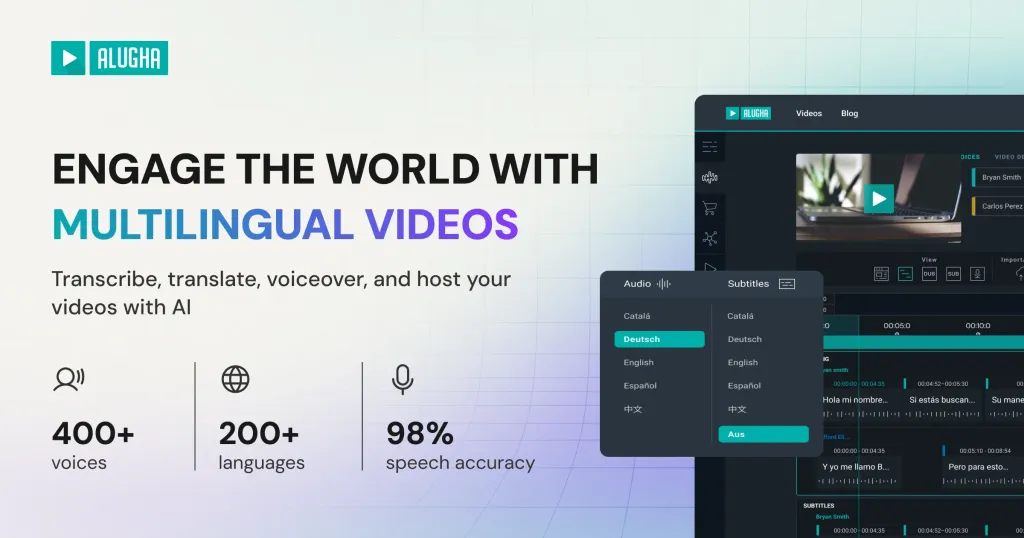
Best for: Businesses targeting global markets with multilingual content or Companies with international audiences, e-learning platforms, and global enterprises
If you’re serious about global video marketing, alugha represents a fundamental breakthrough in how multilingual video content is created and utilized.
What makes alugha different:
Unlike traditional platforms that require separate video uploads for each language, alugha’s proprietary technology allows multiple audio tracks within a single video file. Viewers can switch between languages instantly without any buffering or interruption.
Key advantages:
– Revolutionary multi-audio technology: One video file, unlimited languages
– 98% AI transcription accuracy: Industry-leading automated captions
– 200+ supported languages: Comprehensive global coverage
– Voice cloning capabilities: Maintain consistent brand voice across languages
– German engineering: GDPR-compliant with European data protection standards
– Flexible Credit Subscriptions: Use your credits for any service you need.
Real-world results: NPAW, a content analytics company, eliminated its need for external translation studios after switching to alugha. “We no longer need a translation studio for our videos. Since we’ve made our tutorials multilingual, we’re not only reaching more people with them, but also promoting the understanding and use of our content analytics software around the globe,” says Till Sudworth, Chief Marketing Officer [6].
2. Wistia: The marketing-focused platform
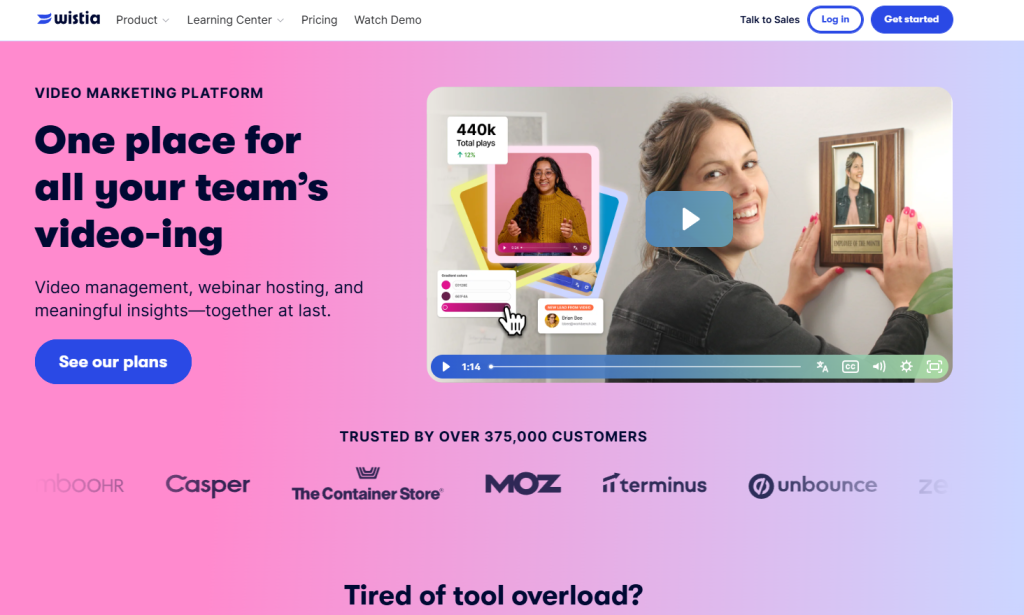
Best for: Businesses focused on lead generation and marketing automation
Wistia has built its entire platform around helping businesses use video for marketing and sales.
Key advantages:
– Advanced lead generation tools (CTAs, forms, etc.)
– Detailed viewer analytics and heatmaps
– Strong integration with marketing automation platforms
– Customizable video players that match your brand
– A/B testing capabilities for video optimization
Limitations:
– Limited multilingual capabilities
– Higher pricing for advanced features
– No multi-audio track support
– Restricted global accessibility in some regions
Pricing: Starts at $19/month for 20 videos
3. Brightcove: The enterprise solution
Best for: Large enterprises with complex video delivery needs
Brightcove offers robust enterprise features and global content delivery capabilities.
Key advantages:
– Enterprise-grade security and compliance
– Global CDN with excellent performance
– Advanced analytics and reporting
– Strong API and integration capabilities
– Live streaming capabilities
Limitations:
– Complex pricing structure
– Steep learning curve
– Limited AI-powered features
– Basic multilingual support
Pricing: Custom enterprise pricing (typically $500+/month)
4 JW Player: The developer-friendly option
Best for: Businesses with strong technical teams who want customization
JW Player offers extensive customization options and developer tools.
Key advantages:
– Highly customizable video players
– Strong API and developer tools
– Good analytics and reporting
– Flexible hosting options
– Live streaming capabilities
Limitations:
– Requires technical expertise to maximize value
– Limited built-in marketing features
– Basic multilingual capabilities
– Complex pricing structure
Pricing: Custom Enterprise Pricing
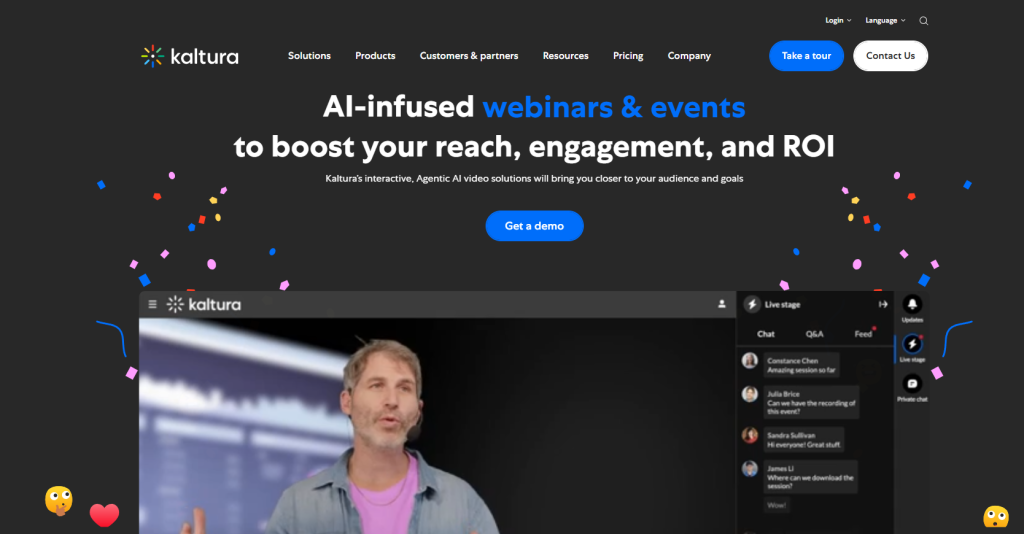
5. Kaltura: The open-source alternative
Best for: Organizations that prefer open-source solutions
Kaltura offers both cloud and self-hosted options, with extensive customization capabilities.
Key advantages:
– Open-source flexibility
– Self-hosting options for data control
– Extensive customization capabilities
– Strong educational and enterprise features
– Good API access
Limitations:
– Requires significant technical resources
– Complex setup and maintenance
– Limited out-of-the-box marketing features
– Basic AI capabilities
Pricing: Varies widely based on deployment option
Why alugha is the smart choice for forward-thinking businesses
After testing all these platforms extensively, alugha consistently delivers the best combination of innovation, value, and results for businesses serious about global video marketing.
The technology advantage
Alugha’s multi-audio track technology isn’t just a nice feature—it’s a game-changer for how businesses approach international markets.
Traditional multilingual video strategies require you to:
1. Create your original video
2. Extract the audio for translation
3. Record new audio in each target language
4. Create separate video files for each language
5. Manage multiple uploads and versions 6. Deal with inconsistent user experiences
With alugha, you:
1. Upload your video once
2. Create tracks in additional languages
3. Publish a single video that works for all markets
4. Let viewers choose their preferred language instantly
The time and cost savings are substantial, but the real advantage is the user experience. When someone watches your video in their native language, they don’t feel like they’re consuming translated content—they feel like you created that video specifically for them.
The business impact
Companies using alugha as vimeo alternative report significant improvements in key metrics:
Conversion Rate Improvements:
– 25-40% higher conversion rates in international markets
– 47% longer average viewing times for native-language content
– 62% higher emotional engagement (measured through neuroscience studies)
Operational efficiency:
– 70-80% reduction in video localization costs
– 40-50% time savings in content management
– 65% reduction in storage requirements compared to multiple video files
Market expansion:
– Access to previously blocked markets (China, MENA region)
– Ability to launch in new markets 3x faster
– Higher customer satisfaction scores in international markets
The German engineering difference
Alugha’s German heritage provides significant advantages for businesses concerned about data protection and platform stability:
Data protection:
– Full GDPR compliance with European data residency
– No data sharing with third-party advertisers
Engineering quality:
– Platform uptime consistently above 99.9%
– Predictable, backward-compatible updates
– Long-term thinking over rapid iteration
– Stable API that won’t break your integrations
Support quality:
– Direct access to the engineering team
– Proactive platform monitoring
– Transparent communication about updates
– Focus on customer success over user acquisition
The migration strategy: How to switch from Vimeo without disrupting your business

Making the switch from Vimeo doesn’t have to be complicated. Here’s the step-by-step process:
Phase 1: Assessment and planning (week 1)
Step 1: Audit your current video library
– Document all videos currently hosted on Vimeo
– Identify your most important/high-traffic videos
– Note any custom integrations or embed codes
– Calculate your current monthly usage and costs
Step 2: Define your Vimeo alternative requirements
– List your must-have features
– Identify your target markets and languages
– Determine your budget range
– Set success metrics for the migration
Step 3: Test your top choice
– Sign up for a trial account with your preferred alternative
– Upload 3-5 representative videos
– Test the platform with real users
– Verify integration capabilities
Phase 2: Pilot migration (weeks 2-3)
Step 1: Migrate high-priority content
– Start with your most essential videos
– Set up proper categorization and tagging
– Configure analytics and tracking
– Test all embed codes and integrations
Step 2: Update critical integrations
– Modify website embeds for key pages
– Update email marketing templates
– Adjust social media sharing settings
– Test all customer-facing touchpoints
Step 3: Monitor performance
– Track video performance metrics
– Monitor user feedback and engagement
– Identify any technical issues
– Document lessons learned
Phase 3: Full migration (weeks 4-6)
Step 1: Bulk content migration
– Use migration tools or APIs when available
– Maintain consistent naming and organization
– Preserve video metadata and descriptions
– Set up proper redirects for SEO
Step 2: Team training
– Train content creators on the new platform
– Update documentation and processes
– Establish new workflow procedures
– Create troubleshooting guides
Step 3: Go-live and optimization
– Complete the switch from Vimeo
– Monitor performance closely
– Gather user feedback
– Optimize based on real usage data
Phase 4: Optimization and growth (ongoing)
Step 1: Leverage new capabilities
– Implement features not available on Vimeo
– Expand into new markets or languages
– Optimize based on improved analytics
– Test new video marketing strategies
Step 2: Measure ROI
– Track cost savings vs. Vimeo
– Monitor engagement improvements
– Measure conversion rate changes
– Document business impact
The cost of waiting: Why you need to act now

Every day you wait to migrate from Vimeo increases your risk and reduces your options.
The acquisition timeline
Based on Bending Spoons’ previous acquisitions, here’s what typically happens:
Months 1-3 ( we are here ):
– Acquisition announcement and regulatory approval
– “Business as usual” messaging to users
– Behind-the-scenes integration planning
Months 4-6:
– First round of layoffs (typically customer support and sales)
– Initial feature deprecation announcements
– Price increase notifications
Months 7-12:
– Major platform changes and consolidation
– Forced migration of legacy accounts
– Significant feature cuts to free tiers
Year 2+:
– Full integration into Bending Spoons ecosystem
– Platform may be merged with other acquisitions
– Original Vimeo identity largely eliminated
The migration window
The best time to migrate is now, while:
– Vimeo’s current features are still available
– Your team has time to plan and execute properly
– Alternative platforms are competing for your business
– You can negotiate better deals with new providers
Waiting until Bending Spoons implements changes means you’ll be migrating under pressure, with limited options and potentially degraded service.
The competitive advantage
Early movers gain significant advantages:
– Better onboarding support from new platforms
– Access to migration tools and resources
– Opportunity to influence product development
– First-mover advantage in new markets (especially with multilingual capabilities)
Taking action: Your next steps
The evidence is clear: the Vimeo acquisition by Bending Spoons represents a fundamental shift that will impact every business using the platform.
You have two choices:
1. Wait and hope that this acquisition will be different from Bending Spoons’ previous pattern of cost-cutting and feature reduction
2. Take control and migrate to a platform designed for the future of global business video
If you choose option 2 (which I strongly recommend), here’s your immediate action plan:
Immediate actions (this week)
1. Audit your current Vimeo usage – Document your video library, integrations, and monthly costs
2. Research alternatives – Use this guide to identify the best fit for your business needs
3. Start a trial – Test your top choice with real content and users
4. Calculate potential ROI – Estimate the cost savings and performance improvements
Short-term actions (next 30 days)
1. Develop a migration plan – Create a detailed timeline and resource allocation
2. Get stakeholder buy-in – Present the business case to decision-makers
3. Begin pilot migration – Start with your most important content
4. Train your team – Ensure everyone understands the new platform
Long-term strategy (next 90 days)
1. Complete migration – Fully transition away from Vimeo
2. Optimize performance – Leverage new capabilities for better results
3. Expand globally – Use multilingual features to enter new markets
4. Measure success – Track ROI and business impact
The bottom line: Your video strategy deserves better
The $1.38 billion Vimeo acquisition isn’t just a business transaction—it’s a wake-up call for every business that depends on video for marketing, training, or customer communication.
Bending Spoons’ track record with previous acquisitions makes it clear that Vimeo users should expect significant changes in the coming months. Price increases, feature cuts, and service degradation are not just possible—they’re probable based on historical patterns. But this challenge also represents an opportunity. By migrating to a more advanced platform like alugha, you’re not just avoiding potential problems—you’re positioning your business for accelerated growth in global markets.
The companies that act now will have a significant advantage over those who wait. They’ll have better pricing, superior features, and the ability to reach international audiences more effectively than ever before. The question isn’t whether you should migrate from Vimeo—it’s which platform will give you the biggest competitive advantage in 2025 and beyond.
For most businesses serious about global growth, that platform is alugha.
Ready to future-proof your video strategy? Start your free trial with alugha today and see why forward-thinking companies are making the switch before it’s too late.
References
[1] Vimeo Enters into Definitive Agreement to Be Acquired by Bending Spoons for $1.38 Billion. (2025, September 10). Vimeo Investor Relations.
[3] Vimeo to be acquired by Bending Spoons in $1.38B all-cash deal. (2025, September 10). TechCrunch.
[4] Thomas Smale’s LinkedIn Post on Vimeo Acquisition. (2025, September 10). LinkedIn.
[5] Common Sense Advisory. (2024). “Can’t Read, Won’t Buy – B2B: Why Language Matters on Global Websites.“
[6] NPAW Case Study: Eliminating Translation Studios with Alugha. (2024). Alugha.
Disclaimer: This article contains opinions and analysis based on publicly available information. While we strive for accuracy, readers should conduct their own research before making business decisions. Some platform features and pricing may change after publication.
Last Updated: September 12, 2025