



Key takeaways: multilingual training videos at Teejit
- Teejit localized the 50 mandatory hotel trainings of MyHotelHub into 20 languages with alugha, delivered as subtitles and dubbed audio tracks from one platform.
- Human translation was ruled out early. It scaled neither in time nor in cost, and every change in the law would have restarted the process for each language separately.
- Teejit found alugha through AI-assisted research for providers of multilingual video. The decisive combination: a German company with headquarters and servers in Germany, pricing that holds up under continuous updates, and subtitles plus dubbing from one source.
- Onboarding was fast. The 50 videos went live in 20 languages, and central control makes later adjustments significantly easier for the team.
- For hotel staff the result is language accessibility in text and audio. Employees complete their mandatory trainings in their native language and understand them, instead of clicking through.
About MyHotelHub and its hotel compliance training
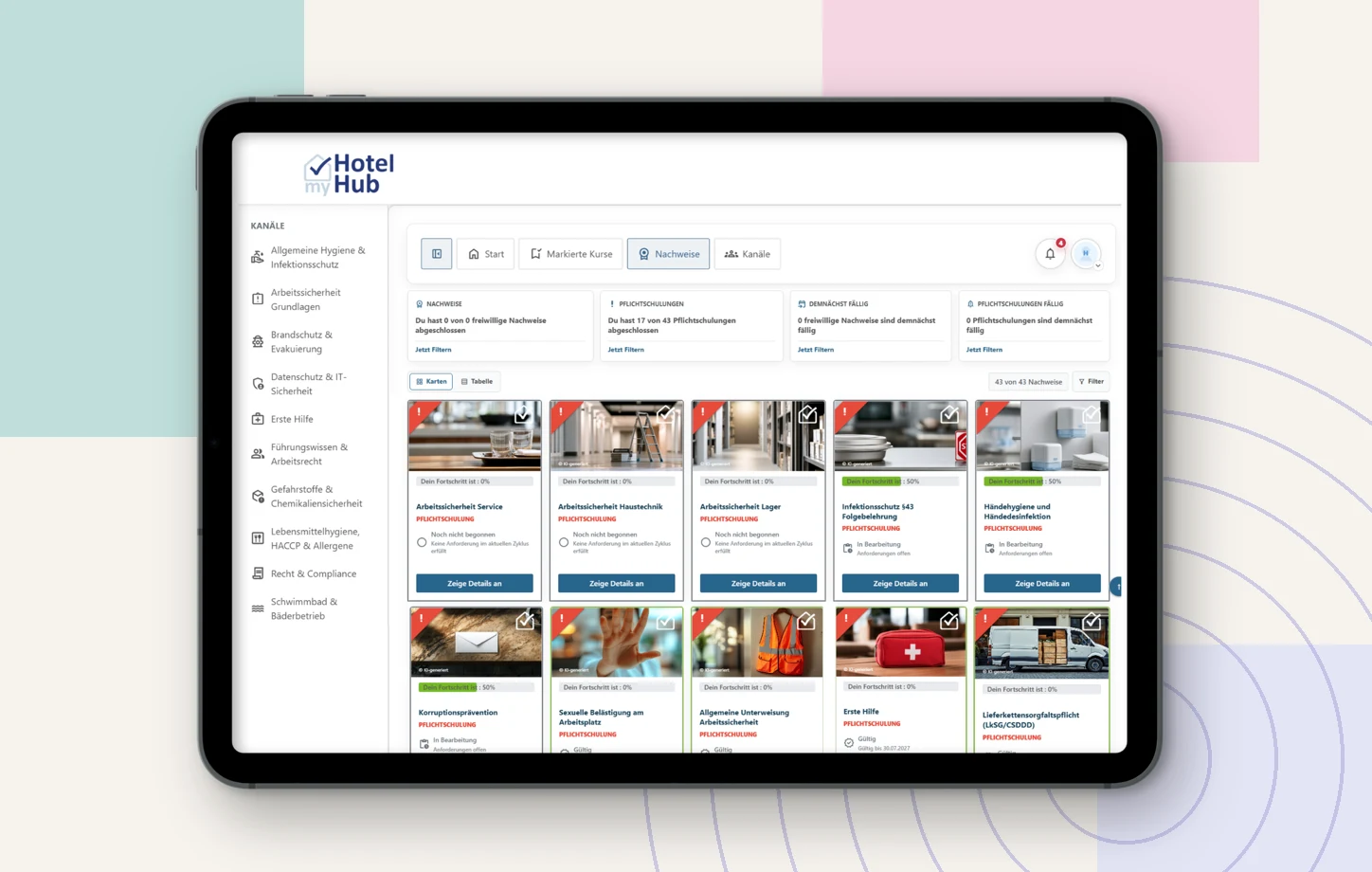
Teejit GmbH from Eichstätt in Bavaria builds software and development solutions for tourism organizations, businesses, associations and destinations. Its product MyHotelHub is a training and compliance platform for hotels: training videos with subtitles, comprehension tests, automatic reminders and audit-proof records in one system, ready for use within minutes. MyHotelHub is built for the reality of hotel operations, where staff turnover is high and teams bring many nationalities, and where every employee still has to complete the same legally required trainings.
Why human translation did not scale for e-learning localization
Mandatory trainings in hospitality are numerous, and they only work if every single employee actually completes and understands them. Teejit had two additional requirements of its own. The content on MyHotelHub is legally reviewed, so quality could not be traded for reach. And the platform had to grow to 20 languages without turning localization into a permanent project.
With human translation, that combination did not add up. Translating and recording dozens of videos into many languages scaled neither in time nor in cost. The bigger problem was maintenance: as soon as a legal text changed, Teejit would have had to restart the whole process for each language separately, from translation to recording to publishing. The requirement was clear. Subtitles and voice tracks in many languages had to come from one source, controlled centrally, so that an update to the German original could be pushed to every language without starting over.
Key challenges in solution selection
Teejit went looking for providers of multilingual video with a targeted, AI-assisted research process. The shortlist had to answer three questions. Where is the data hosted, and under which jurisdiction? Does the pricing still make sense when the videos are updated continuously rather than produced once? And can one platform deliver both subtitles and dubbed audio, so that the team does not have to combine two tools and two workflows for every language?
The decision for alugha
Teejit chose alugha because the platform answered all three questions at once. The deciding factors were:
- A German company with headquarters and servers in Germany. Hosting and processing in Germany matched Teejit’s own compliance standard and kept the data plane of a compliance product inside the EU.
- Pricing that holds up under continuous updates. The cost model works for an ongoing program of legal updates, not only for a one-time production.
- Subtitles and dubbing from one platform. With alugha dubbr, text and audio tracks for all languages are produced and managed in one place, on the same video.
- Central control for updates. A change in the original propagates through one workflow to every language version, which removes the maintenance risk that had ruled out human translation.
Implementation: AI dubbing and subtitles for 50 training videos
The rollout was straightforward. Benedikt Handel describes the onboarding as quick and the support as appreciative and good. After onboarding, Teejit uploaded its 50 training videos and localized them into 20 languages, with subtitles and dubbed audio tracks produced on the alugha platform. The MyHotelHub learning platform embeds the alugha player, so employees select their language directly in the video. Central control on the alugha side means that adjustments to a video no longer trigger 20 separate jobs. The team changes the original and the language versions follow.
Results: GDPR video hosting and trainings that land
For Teejit, the collaboration changed the economics and the maintainability of multilingual training. For hotel employees, it changed whether the training actually lands.
- Language accessibility in text and audio. Every mandatory training is available with subtitles and voice track in 20 languages, in a quality Teejit describes as really good.
- Trainings that are understood, not clicked through. Employees can watch mandatory trainings in their native language and understand them, which is the point of workplace training in the first place.
- One update, all languages. When a legal text changes, the update runs through one platform instead of restarting a translation process per language.
- Focus on content instead of translation logistics. Teejit spends its time on legally reviewed training content, while alugha carries the language complexity.
Conclusion and outlook
MyHotelHub launched with 50 trainings in 20 languages, which adds up to 1,000 localized video versions managed from one place. For a compliance product that has to reach every employee in a hotel, language is not a feature but a precondition, and Teejit built that precondition into the platform from the start. With alugha as the localization layer, new trainings and legal updates can be rolled out to all languages without multiplying the effort, and the team keeps its focus on what the hotels actually pay for: training content that is correct, current and understood.
FAQ on multilingual training videos at Teejit
Why did Teejit not use human translation for its multilingual training videos?
Because it did not scale in time or in cost, and because every legal change would have restarted the entire translation and recording process for each language separately. With 50 videos and 20 languages, that would have meant 1,000 video versions to maintain by hand. alugha produces subtitles and dubbed audio from one source and lets Teejit update centrally.
How does e-learning localization handle a change in the law across 20 languages?
Teejit updates the German original once. Because subtitles and audio tracks are produced and managed on the same alugha platform, the change propagates through one workflow to every language version instead of triggering 20 separate translation jobs.
Is this GDPR video hosting, and where is the data stored?
On alugha’s infrastructure in Germany. alugha is a German company with headquarters and servers in Germany, which was one of the three deciding factors for Teejit. More on the setup in our overview of GDPR-compliant video hosting.
Which languages and formats does AI dubbing give hotel employees?
Employees choose their language directly in the embedded alugha player, with subtitles and a dubbed voice track available in each of the 20 languages. Accessible subtitles are part of the standard delivery, see accessible subtitles with alugha.